



A Year in the Life of an Armenian Soccer Fan
By Dina Apovian
You often hear people say they had been looking forward to a trip for over a year, but in my case that was true. While I was watching Armenia’s opening Euro 2012 qualifying match versus Ireland through a grainy internet stream, a match held at the Republican Stadium in Yerevan back in September 2010, I decided to make arrangements to travel to the return fixture in Dublin (over a year later) to cheer on my beloved Hyeboys.
I spent 403 days to be exact, enjoying and enduring the ups and downs of Armenia’s latest attempt at its first major finals appearance. The “knowledgeable” soccer pundits were writing off Armenia’s chances even before a ball was kicked, and based on their history in previous campaigns, who could argue? Since independence, Armenia had attempted to qualify for a major tournament on eight occasions, with their best performance being a fourth place finish in their qualifying group for France ’98.
So even though history said no, my heart said yes. I knew Coach Vardan Minasyan was trying to build something special, something for the future. When I heard he had added 10 players from the talented U21 squad, it was clear to me he had a vision and a goal to propel Armenian soccer to greater heights. I had a feeling back then that we would be hearing a lot more of the names Mhkhitaryan, Movsisyan, and Ghazaryan.
Two games into the campaign, however, my heart was low. Ireland left Yerevan with the three points in the opening match and Macedonia snatched a late point in a dramatic finish to the second match in Skopje. Sitting on one point after two games the outlook was grim, but with eight matches left in the campaign there was time to turn things around.

On Oct. 8, 2010, the third fixture saw a strong Slovakia team, fresh off of a World Cup appearance in South Africa, visit the Republican Stadium. On that day, Minasyan’s youngsters began believing in his vision and themselves, and recorded an impressive 3-1 victory with goals from (wouldn’t you know it) Henrikh Mhkhitaryan, Yura Movsysian, and Gevorg Ghazaryan.
With the dream still alive I continued to follow their progress. Difficult as it is to find coverage of Armenia soccer matches in the U.S., I still managed to stream games on my computer at home and while on vacation through the summer of 2011. I didn’t want to miss a minute, especially at the business end of the campaign.
Armenia’s challenge in the group was gaining great momentum as the campaign entered its most important stage. A series of three wins in succession and an abundance of goals saw Armenia make waves on the European soccer scene. Most notable was their 4-0 thrashing of Slovakia in Zilina. After nine games, instead of being the also-rans or outsiders looking in, Armenia was travelling to Dublin with qualification still within their grasp.
I was about to witness Armenia’s most important soccer match in its history. Starved of decent media coverage in the U.S., I fed my anticipation and enthusiasm with YouTube clips of the First Armenian Front’s loyal support and of euphoric locals dancing in Republic Square in Yerevan after the latest goal-fest. I scrambled together my red, blue, and orange paraphernalia and began my transatlantic journey.
As in any European country, it became apparent to me that the Irish media was saturated with coverage of the upcoming game. My clock radio awoke me with a radio station’s slant on the mercurial attacking flair of Minasyan’s men. A TV spot assessed the injury reports and team selections, and while I drove from Limerick to Dublin for the match, I kept myself occupied with the numerous stories on the back pages of every newspaper I could get my hands on.

Before long I was among the crowds of supporters, mostly Irish but the First Armenian Front was also out in force. Pre-match formalities concluded with a rousing rendition of “Mer Hayrenik” and “Amhran Na bhFiann” (the Irish National Anthem) and before I knew it the match was on.
My view from the west stand was all I could have hoped for. Five rows from the pitch, the tension of the occasion and partisan nature of the crowd was palpable. On the balance of play Armenia were the better side, displaying their creative style and passing crisply on the immaculate surface.
On 26 minutes, the dynamic of the match would be changed by a questionable refereeing decision, maybe a “home town decision.” One of Armenia’s most experienced players, goalkeeper Roman Berezovsky, was shown a red card for a hand ball outside his penalty area when it looked as though the ball actually struck his chest.
It seems that big calls in big games go to the bigger teams. The team furthest down the World Soccer Food Chain seems to always come off the worst. Just as Ireland complained of Thierry Henry’s infamous handball in 2009, it was now Armenia’s turn to feel hard done by.
With 10 men, Armenia stayed true to their attractive attacking style of play and were unlucky not to make it to the half time break with their goal intact. The pressure of the occasion finally told in the 43rd minute when young defender Aleksanyan played the ball into his own net.
The second half proved more difficult for the Armenians. For a spell before the hour mark, Ireland put pressure on the Armenian goal and finally doubled their lead in the 59th minute when replacement goalkeeper Arsen Petrosyan made an error to allow an easy finish by Irish defender Richard Dunne. Petrosyan’s story is a remarkable one. The young man is 20 years of age and by entering the match to replace the experienced Berezovsky in the first half after the red card, earned his first senior cap. That type of debut can only be described as extremely difficult.
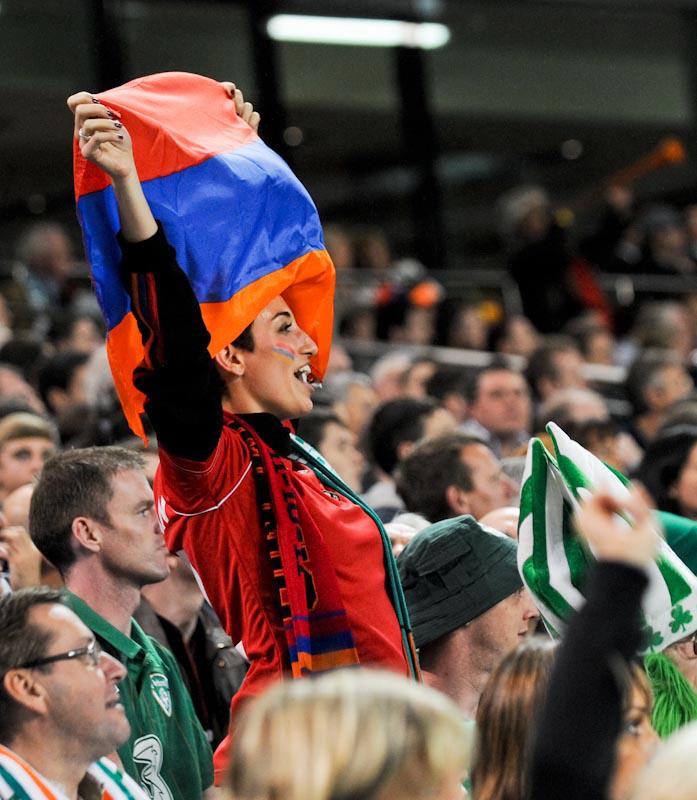
With the Irish holding a comfortable 2-0 lead, the tension around the stadium somewhat lifted as all of the work from the previous year was coming down to the waning minutes of a single match. Three minutes after the restart, however, I found myself on my feet with the tricolor aloft shouting “Getse Haiastan” as Henrikh Mhkhitaryan got Armenia on the board and back in the match. The tension once again reached fever pitch. Armenia needed to find two more goals in the last half hour.
Though still shorthanded, Armenia advanced with wave after wave of attack, forcing the Irish into a defensive shell. Unfortunately they were unable to breach the Irish rear guard again and with one shrill blow of the referee’s whistle, the Euro 2012 dream was over. The final score was Ireland 2-1 Armenia.
The disappointment I felt at the final whistle was profound; the emotions welled up inside of me. The negative emotions were tempered by the immense pride I felt for my country and for the brave young players Minasyan had assembled to represent us so well. I believe that being such a young team and learning from the pain of such a near miss, they’ll be back again soon.
Through their performances in this most recent campaign, Armenia has climbed the FIFA world rankings. They currently rank 46 in the world, up some 30 placed from the beginning of qualification. So the future is looking bright. I returned home from Ireland savoring one of the best experiences of my life and now turn my focus to Brazil 2014 and how the Hye boys will do as they mature and improve under Coach Minasyan’s tutelage.

I watched this game on the web and it was a crazy and emotional game.
But come on Ireland, you could only score 1 goal on a 10-man team with a 20 year old 2nd backup goalie?
Here’s another little stat to be proud of. Armenia scored the most goals in their group 22. Ireland had 15, Russia 17. Armenia however had 10 goals scored on, compared to Ireland 7, Russia 4.
More stats: http://en.wikipedia.org/wiki/UEFA_Euro_2012_qualifying_Group_B
Look at the stats on top scorers. Henrikh Mkhitaryan had the top goals of six in the group.