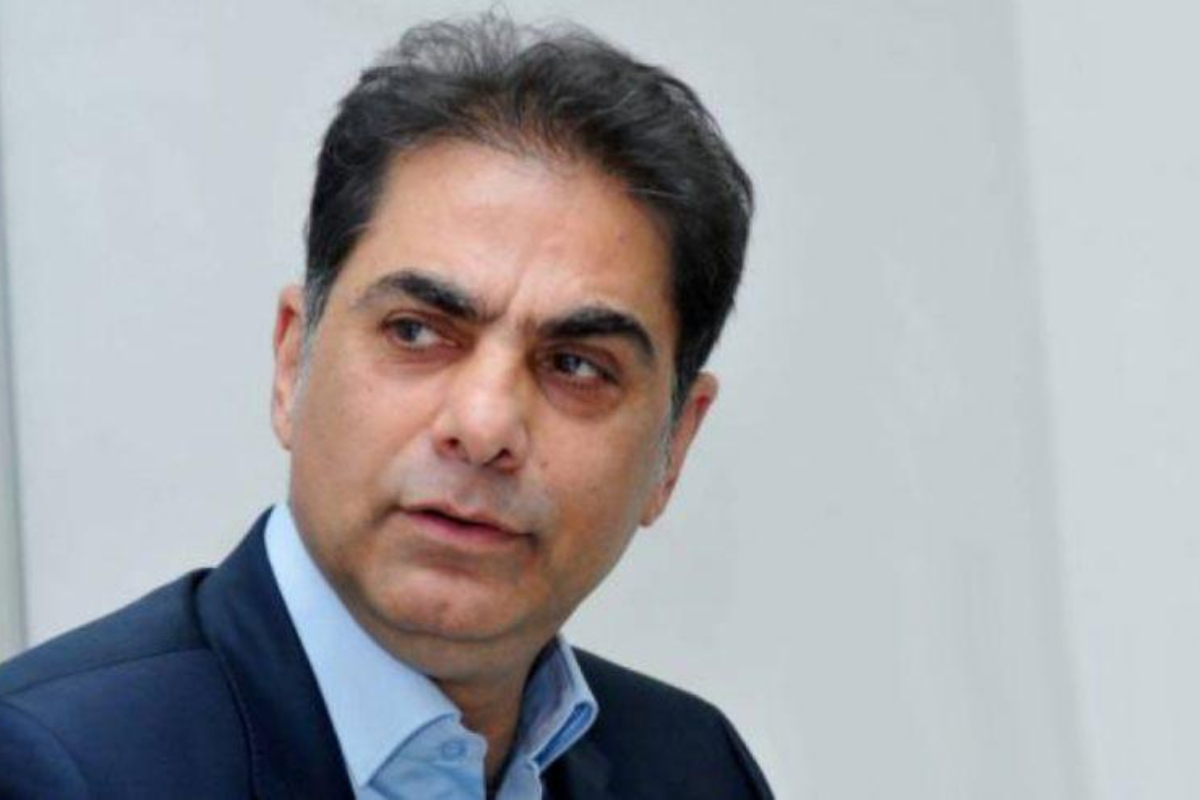



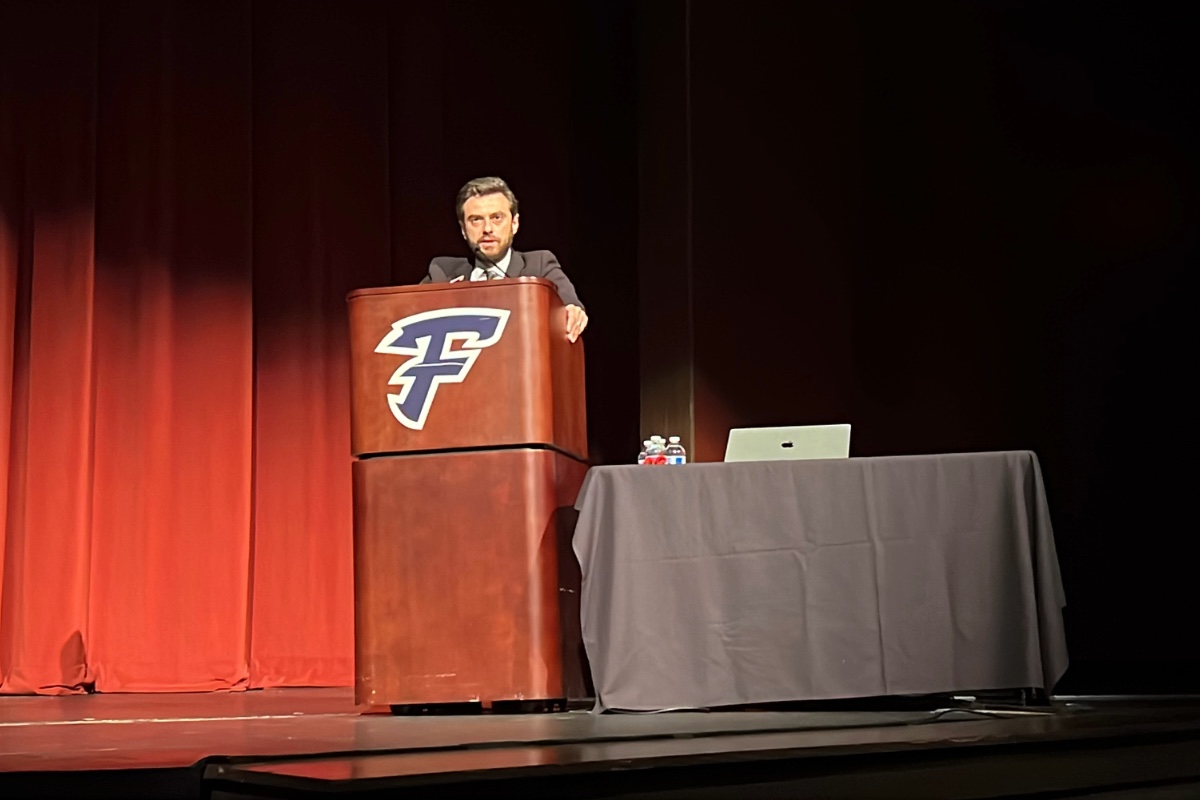
This speech was delivered by Dr. Kevork Hagopjian, Esq., at the Detroit Armenian Genocide Commemoration event held April 18, 2026.
Ladies and gentlemen, honored guests, and the Armenian community of Greater Detroit:
Ignatius Maloyan. Archbishop of Mardin. June 1915. Arrested. Tortured for days. Offered his life in exchange for his faith. He refused. And they executed him. One soul among 1.5 million.
Six months ago, the Catholic Church canonized Archbishop Ignatius Maloyan. He is now Saint Ignatius Maloyan, martyr of the Armenian Genocide, recognized before the world.
And I kindly ask you to sit with that for a moment. One hundred and ten years after his murder, the world said: his life mattered. His death was witnessed. His name will not be erased.

But here is what I keep thinking about. Saint Maloyan was one person. One name. Now I kindly ask you to imagine another human being.
She has no name — or rather, she has a name we do not know, because it was never recorded, because recording it was never the intention of those who took her life. She was roughly 30 years old. She lived in a town in Western Armenia. She had, let’s say, three children. She baked bread. She had a particular way of braiding her daughter’s hair.
On the forced march through the desert, through weeks of thirst and famine and violence, she did what most Armenian mothers did on that deportation. She sang lullabies to her children. Not to comfort them. She sang so they would fall asleep. So they would not feel the thirst. So they would not see what she was seeing.
She was one of 1.5 million.
When we say 1.5 million — and we must say it, we must never stop saying it — something happens in the mind of the listener. The number is so large that it becomes, without anyone intending it, almost abstract. A statistic. A fact to be memorized rather than a reality to be felt. But they were 1.5 humans, 1.5 million futures. Hundreds of villages, families, vineyards, libraries, schools, churches, songs, dialects, traditions. A homeland. A civilization. An accumulated wealth of culture, land and memory that took millennia to build and was deliberately, systematically destroyed in a matter of years.
We honor them tonight as human beings who deserved to live, to build, to pass something forward. We honor the survivors who carried the unsurvivable in silence for decades. And we honor their descendants — many of you in this room — who were born into a history they did not choose, shaped by a loss they never personally experienced yet carry in their bones.
And she was not a statistic. She was a mother who braided her daughter’s hair and sang lullabies in a desert so her children would not feel themselves dying. Tonight I do not want to sing you a lullaby. She deserves more than our tears. She deserves our action.
Because 111 years have passed since that indescribable tragedy. And there are things happening right now — to our people, to our land, to our history, to our institutions — that demand not our grief, but our full, clear-eyed and determined attention.
In law, a witness is not someone who feels deeply about an event. A witness is someone who saw it, who can describe it with precision, who stands and says: this happened, I saw it, here is what I know. Evidence is what counts. And the first thing any perpetrator needs — any state that commits atrocities and wishes to escape accountability — is for the witnesses to become uncertain. To begin to wonder: was it really that bad? Is there another way to describe it? Maybe we should move on. The moment a community accepts that ambiguity, it has done the perpetrator’s work for them.
But tonight I want to go further than witness. Because the people in this room are not merely observers of a historical event. You are something far more specific and far more powerful — in both legal and moral terms.
You are rights-bearers. You are claimants. Most of you, if not all of you, are the direct descendants of the victims and survivors of a crime that has never been repaired, and never been closed.
Let me be precise about what that means. Genocide is not an ordinary crime. It is, in the hierarchy of international law, the crime of crimes — recognized as such by the Nuremberg Tribunal, codified in the 1948 Genocide Convention, and reaffirmed by every major international legal body since. And unlike ordinary crimes, genocide carries no statute of limitations. Under the principles of jus cogens — the highest, nonderogable norms that bind every state whether they consent to them or not. One hundred and eleven years have not weakened your legal and moral standing by a single day. Two hundred years would not. Five hundred years would not. The crime remains a crime. The obligation to repair it remains an obligation. The demand for justice remains legitimate, legally grounded and internationally recognized — regardless of what any government chooses to prioritize in its foreign policy at any given moment.
So when we gather here tonight, we are not gathering to perform grief. We are not gathering out of habit or sentiment or ethnic loyalty. We are gathering as a community with a lawful and just claim — a real one, recognized by the highest principles of international law — to name what was done, to state the record precisely, and to make clear that we have not abandoned that claim and we never will.
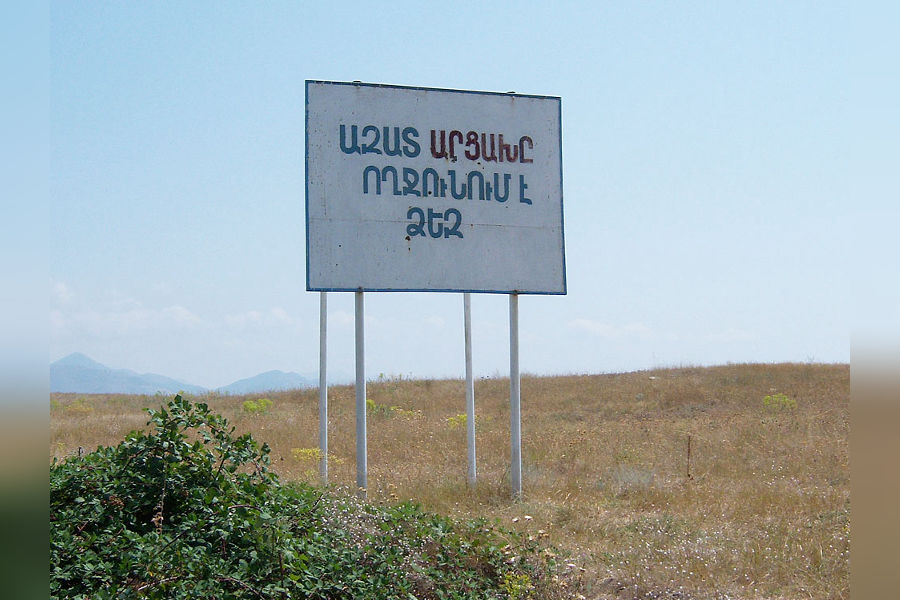
The ethnic cleansing of Artsakh in September 2023 displaced over 120,000 indigenous Armenians — a people expelled from land their ancestors inhabited for four millennia, under military assault, after a 10-month blockade designed to make life unbearable. The word for this is genocidal ethnic cleansing. Not “conflict.” Not “tensions.”
The satellite record Dr. Khatchadourian’s team is building — church demolitions, village erasures, the obliteration of Armenian inscriptions from stone — documents in real time what Azerbaijan has been doing for decades now. The buildings may fall. The documentation does not. And documentation, in the hands of claimants who know how to use it, is the foundation of every case ever won against a state that believed impunity was permanent.
Ruben Vardanyan. Davit Ishkhanyan. Bako Sahakyan. Arkady Ghukasyan. These men remain hostages in Baku. Their crime was leading their people. They are held to send a message: we have taken your land, erased your presence, and we will hold your leaders to ensure you cannot return. This is collective punishment. It violates every applicable principle of international humanitarian law. And as rights-bearers, we demand their unconditional and immediate release — not as a diplomatic request, but as a legal obligation that Azerbaijan has chosen to ignore and the international community has chosen not to enforce.
And being a witness — and a claimant — also means seeing clearly what is happening inside Armenia, not to attack, but because silence about it would make us accomplices to it. Because history shows us, repeatedly and painfully, that the greatest long-term threat to a people’s memory is not always the enemy outside. Sometimes it is the slow, quiet pressure that builds from within — when a community under existential strain begins to experience its own history as a burden too heavy to carry publicly. When an unresolved wound starts to feel, to the exhausted and the pragmatic, like an obstacle to survival rather than the foundation of identity, justice and sustainable peace.
That tension arrived at Tsitsernakaberd — Armenia’s own Genocide Memorial, in a very specific and concrete form. Edita Gzoyan, Director of the Armenian Genocide Museum-Institute, got fired after showing U.S. Vice President JD Vance the khachkars memorializing victims of the Sumgait and Baku pogroms, pointing to the graves of fighters from the 1990s Karabakh war, and handing him a book titled “Azeri Aggression against Armenians in Transcaucasia (1905-1921): Reports from the U.S. Press”. Her actions were described as contradicting foreign policy — and as “provocative.”
I am not here tonight to litigate Armenian politics. But I want us to sit with that word — provocative — because it tells us something important. When bearing witness at a genocide memorial becomes provocative, something precise is happening: memory is being reclassified from a foundation into a liability. That process — regardless of who carries it out, regardless of the pressures that produce it — is one we must recognize and resist. Eminent genocide historians such as Raymond Kevorkian and others resigned from the museum’s academic board in protest. His message was clear: an institution of memory cannot fulfill its mission under political conditions that define truth as inconvenient.
There is a concept in psychology called motivated blindness — the documented human tendency to fail to notice information that is inconvenient, even when it is directly in front of you. Governments practice it. Institutions practice it. And it is always presented as pragmatism, as realism, as peacebuilding.
The Armenian Genocide Museum-Institute does not belong to any government or any political moment. It belongs to the 1.5 million. It belongs to every rights-bearer and claimant in this room.
Currently, the elimination of the consequences of the Armenian Genocide is absent from the official foreign policy agenda of the Republic of Armenia. Some people argue that a small, landlocked country facing genuine existential security pressures must make difficult calculations. I do not question that those pressures are real. But I want to say something that I believe is both legally precise and historically important: the pursuit of justice for the Armenian Genocide was never the exclusive property of any government. It belongs to the descendants of the survivors. It belongs to the diaspora and the Republic of Armenia. It belongs to every Armenian in every country who carries this history in their name and their blood, and it belongs to all humanity as it’s also a crime against all humanity.
Governments come and go. Foreign policy priorities shift with elections, with geopolitics, with the pressures of the moment. But the legal claim and the pursuit of justice do not expire when a prime minister decides it is inconvenient. It endures. And we have the responsibility to carry what Yerevan, in this moment, has chosen to set down.
This is not defiance of Armenia. It is fidelity to something larger than any government — the unfinished obligation to the 1.5 million, every generation that came after 1915 and to every generation that comes after us. The trauma of Artsakh’s fall is real. The exhaustion, the sense of abandonment, the quiet despair spreading through parts of our community — I hear it and I will not dismiss it. But I want to offer you something more honest than optimism. I want to offer you perspective.
International law is not a police force. It never was. It is something slower and, in the long run, more powerful — it is the gradual codification of what humanity decides it will no longer tolerate. The abolition of slavery was unthinkable, then inevitable. Colonial empires were permanent, then gone. None of these transformations happened because the powerful suddenly developed remorse or conscience. They happened because enough people refused — over decades, across generations — to accept that injustice was permanent.
We are in one of those in-between moments. The moment that feels like nothing is moving. The powerful do not cross red lines with impunity forever. They cross them until the cost becomes too high — and the cost rises precisely because people like you refuse to normalize what was done, refuse to call ethnic cleansing a political solution, refuse to let the record be closed before justice is served. Your refusal is not powerlessness. It is the most consequential thing you can do in a moment like this. Every Armenian who disengages, every young person who concludes the cause is hopeless, every diaspora community that shrinks April 24 to a single ceremonial evening and returns to routine — is not doing enough refusal.
Stay. Build the record. Raise the cost of impunity — one case, one resolution, one classroom, one commemoration at a time. The arc is long. But it bends toward those who never stop pulling it.
On the other hand, there are those who argue that our pursuit of justice is an obstacle, that we are living in the past while others are building the future, that we risk jeopardizing fragile diplomatic progress from the comfort of distant cities.
The diaspora did not create the conditions that made peace fragile. We did not blockade Artsakh. We did not ethnically cleanse 150,000 people. We did not demolish churches or imprison community leaders. The instability in the region is not the product of Armenian demands for justice — it is the product of unanswered injustice. Conflating the two is not analysis. It is deflection.
But more fundamentally — the argument that justice must be silenced in the service of peace misunderstands what peace actually requires. No durable peace in history has ever been built on the deliberate suppression of legitimate legal claims. Not one. What is built on suppression is not peace — it is a temporary arrangement between unequal parties, waiting to fracture at the next provocation.
The diaspora is not an obstacle to peace. The diaspora is the guarantor that peace, when it comes, will be real — grounded in truth, built on accountability, and durable enough to outlast the diplomatic moment that produced it.
A peace that asks the descendants of genocide survivors or ethnically cleansed Artsakhtsis to abandon their claims is not asking for peace. It is asking for a second erasure. And that we will never accept — not because we are inflexible, but because we understand, better than most, what happens to people who agree to be forgotten.
And when I speak of justice, I want to be precise about what we mean — because justice for the Armenian Genocide is too often caricatured as backward-looking vengeance, as an obstacle to regional stability, as the grievance of a diaspora unwilling to accept the realities of the modern world.
Let me be clear. We are not asking Turkey to punish the grandchildren of perpetrators. We are asking the Turkish state — as a legal successor entity, as a member of the international community bound by the same norms it invokes when convenient — to do what post-conflict societies across the world have done when they chose dignity over denial: to acknowledge what happened, to make the apology, to begin the process of restitution for what was taken — lands, properties, churches, schools, lives — and to provide guarantees of nonrepetition.
We want reconciliation with Turkey. We have always wanted it. But reconciliation without truth is not reconciliation — it is capitulation.
And we will not confuse the two. The path to a peaceful, prosperous and dignified future for both peoples runs through acknowledgment, not around it. Turkey knows this. And on the day it chooses truth over denial, it will find us ready — not with anger, but with a shared commitment to building something better than what the past left us.
The United States has a unique role in this story — and a unique responsibility. American missionaries sheltered orphans. Ambassador Morgenthau documented the atrocities in real time. Generations of Armenian Americans built relationships with Congress that culminated, in 2021, in the official recognition of the Armenian Genocide by both houses. That recognition is permanent. It cannot be undone by any president’s silence. When a sitting president declines to say the word genocide on April 24, he does not reverse history — he simply reveals a gap between America’s stated values and its political calculations. We note that gap. We name it. And we continue.
But recognition must translate into policy. The United States has significant leverage in the South Caucasus — through diplomacy, through arms transfers, through trade relationships, through its role in regional security frameworks. The recent TIPP negotiations and Washington’s engagement in the region are not abstract geopolitical exercises — they directly affect whether 150,000 displaced Armenians ever return to their homes, whether Armenian hostages rot in Baku indefinitely, and whether Azerbaijan concludes that ethnic cleansing carries no cost. Washington must understand that genuine regional stability cannot be purchased by rewarding impunity. A peace built on American silence about Azerbaijani aggression and Turkish denialism is not a peace the United States should want its name on. We ask of our American partners not charity — we ask consistency. Apply to this region the same standards of accountability you invoke anywhere else. That is not too much to ask. That is the minimum that justice requires.
But justice without a people to claim it is an empty verdict. Legal cases require claimants who are alive, organized, educated and determined. International advocacy requires communities that have not succumbed to exhaustion. The pursuit of accountability across generations requires something that no law can compel: a people who have chosen, deliberately and repeatedly, to remain a people. That is not guaranteed. It is built. And it is built in exactly the places and exactly the ways I want to talk about now.
The long game is not only about legal records. It is also about people. About the community we build, the children we raise and who we choose to become in the wake of what was done to us.
Let me say something about Armenian resilience that I think is often misunderstood. We speak of it so frequently that it risks becoming a platitude — a consolation prize dressed up as a compliment. But resilience, for us, is not a sentiment. It is a documented historical achievement.
A people who lost 1.5 million souls, who were expelled from their ancestral lands, who arrived in Aleppo and Beirut and Detroit with nothing — built schools within years of arrival. Published newspapers and created diaspora institutions and communities. That did not happen by accident. It happened because generation after generation made a deliberate choice: to transform grief into construction, and to refuse the permanent identity of victim in favor of the active identity of a people with a future worth building.
Tonight, when you sit in this room, you are not just attending a commemoration. You are continuing something that began over 100 years ago in this community. And that continuity — unbroken, deliberate and deeply human — is itself a form and demonstration of resilience.
However, there is a conversation happening quietly in Armenian families across the diaspora and Armenia that I think deserves to be brought into the open tonight.
It is the conversation between generations. Between grandparents for whom the genocide is a wound so close and so raw that it requires no explanation — it simply is. And grandchildren for whom it is history: important, honored, but sometimes abstract in the way that all inherited pain eventually becomes when enough time passes. Between those who learned about the genocide from a survivor’s silence at the dinner table, and those who learned about it in a classroom or a commemoration like this one.
This tension is not a failure. It is what happens when a community successfully transmits memory across enough generations that it begins to transform — from lived trauma into learned history, from wound into part of identity.
But it does require something from us. We cannot simply hand the next generation our tragedies and expect them to carry them the way we did. We must hand them something more useful — the legal framework, the historical precision, the advocacy tools, the sense of agency that says: you are not only the inheritors of a tragedy, you are the claimants in an unresolved case, and here is what you can do about it. If we give young Armenians only sorrow, we will lose them. If we give them purpose, we will empower them to pursue justice.
This is why education is not a supplement to our cause. Every child who grows up understanding not just the date and the death toll but the geography, the resistance movements, the legal architecture, the names of those who bore witness and those who fought back — that child is immune to the amnesia that denial depends upon. Every teacher who brings the Armenian Genocide into a classroom alongside the Holocaust, Rwanda and Cambodia — building the conceptual framework of genocide recognition as a universal obligation — is doing prevention work. Real prevention. The kind that does not just honor the past but protects the future.
Our assignment extends beyond our own case. The Armenian Genocide was, as Raphael Lemkin acknowledged, the proof of concept for every genocide that followed. That is why our cause is not only Armenian. When we demand accountability for 1915, we are not pursuing a narrow ethnic grievance — we are defending the entire architecture of genocide prevention for every people standing today in the path of a state that has decided they are expendable.
We stand in solidarity with every community facing genocidal threat today, because justice, if it means anything at all, must be indivisible. A world that ignores genocide against one people has already decided it will ignore it against another. And we, of all people, cannot be complicit in that silence.
To every educator and academic here tonight: you are doing sacred work. To every parent who has explained to their child why we gather on April 24: you are doing sacred work. To every young person in this room who is choosing to carry this forward — into law, journalism, diplomacy, the arts, wherever your life takes you: you are not inheriting a burden. You are inheriting a mission.
I want to go back to where we began.
That woman on the death march. The one whose name the world did not record. The one who braided her daughter’s hair and sang lullabies in the desert.
She had no reason for optimism. She could see exactly where the march was going. She had no legal recourse, no international court, no diaspora advocacy network, no satellite above her to document what was happening. She had her voice. And in the moment when everything was being taken from her, she chose to use it in an act of love so precise and so purposeful that it is still speaking to us 111 years later.
And then, Pope Francis stood before the world and spoke the name of Ignatius Maloyan — killed in that same desert, in that same campaign of annihilation — and declared him a saint. And we, the Armenian Church, also canonized the 1.5 million victims, and she is one of them.
They could not erase him. And they could not erase her. We are the proof. Every Armenian in this room is living proof that the lullaby she sang in the desert did not die with her. It traveled — through her children if they survived, through the memory of those who witnessed, through the testimony of survivors, through the archives of scholars, through the dispatches of foreign diplomats, through the votes of legislators, through the satellite images of researchers, through commemorations in Detroit on April evenings — all the way to this room, tonight.
So when I say: build the record, defend the institutions, pursue the elimination of the consequences of the genocide, stand in solidarity with every people facing annihilation, educate the next generation, refuse despair and demand justice — I am not giving you a to-do list. I am telling you what it means to be the descendants of a woman who had nothing left but her voice, and who used it. I am telling you what it means to carry her song — not as a lullaby, but as a demand.
She sang so her children would not feel the thirst.
We remember and we demand so the world cannot claim it did not know.
She used the only instrument she had.
We use every legitimate instrument available to us.
She chose love over despair in the desert.
We choose action over silence in this room.
That is the line — unbroken, 111 years long — that runs from her to us.
She deserved more than our tears. She deserved our action. And tonight, action is exactly what we commit to.
Thank you.