



YEREVAN — Reports emerged early April 29 that an Azerbaijani aircraft had landed at Zvartnots International Airport in Yerevan, marking the first public indication of an unannounced visit by an Azerbaijani delegation to Armenia.
The presence of the aircraft was first reported by Armenian media outlets, prompting immediate scrutiny and speculation before being clarified by official sources. Armenia’s civil aviation authorities confirmed to Sputnik Armenia that a delegation from Azerbaijan had arrived in the country, although no further details were initially disclosed.
The visit was subsequently confirmed by Azerbaijan’s Ministry of Foreign Affairs, which stated that Deputy Prime Minister Shahin Mustafayev was in Yerevan, heading the delegation. Mustafayev also serves as the chairman of Azerbaijan’s state commission on border delimitation, a role closely tied to ongoing and sensitive negotiations between the two countries.
Later, Armenia’s Ministry of Foreign Affairs also acknowledged the visit, confirming the presence of an Azerbaijani delegation in Yerevan and indicating that an official statement would follow.
Separately, Armenian outlet SHAMSHYAN.com reported, citing its sources, that Mustafayev had expressed a desire to visit his birthplace, the village of Jujevan in Armenia’s Tavush region. In response, NEWS.am contacted the head of the Jujevan administrative district, Hambardzum Petrosyan, to verify whether such a visit was planned.

“I don’t see any activity in the village at the moment. It was only journalists who called and said there was such information,” Petrosyan said, adding that he had no knowledge of any planned visit.
In a separate report aired by Armenia’s Channel 5, an interview with individuals who knew Shahin Mustafayev during his school years in Noyemberyan presented sharply contrasting personal recollections.
One former classmate, who spoke on condition of anonymity, described Mustafayev as a highly capable student. At the same time, she expressed strong emotional opposition toward him in light of the 2020 Nagorno-Karabakh war, stating that she would prefer to “erase him from memory.”
She also recalled that he studied Armenian language and literature at a high level during his schooling, while alleging that his mother had at times objected to the volume of Armenian-language materials assigned to him.
The same source further claimed that Mustafayev’s sister held markedly critical views toward Armenians, including an incident in which she allegedly refused to capitalize the word “Armenia” in written work. These claims could not be independently verified.
Separately, Channel 5 also featured testimony from Samvel Beglaryan, a writer and resident of Noyemberyan, who said he knew Mustafayev’s family — locally referred to by the Armenian form of his name, “Shahen.” Beglaryan stated that Mustafayev’s grandfather was among the first members of the family to settle in the area, arriving while engaged in cattle herding.
According to Beglaryan, members of the family were fluent in Armenian in public interactions but reportedly used Azerbaijani within the household. He further expressed deeply critical views shaped by personal and historical grievances related to the conflict between the two countries, making broader generalizations about trust between communities.
Beglaryan also suggested that Azerbaijani President Ilham Aliyev had deliberately selected Mustafayev for his current role, citing his familiarity with Armenian society and what he described as an understanding of its “vulnerabilities and weaknesses.”
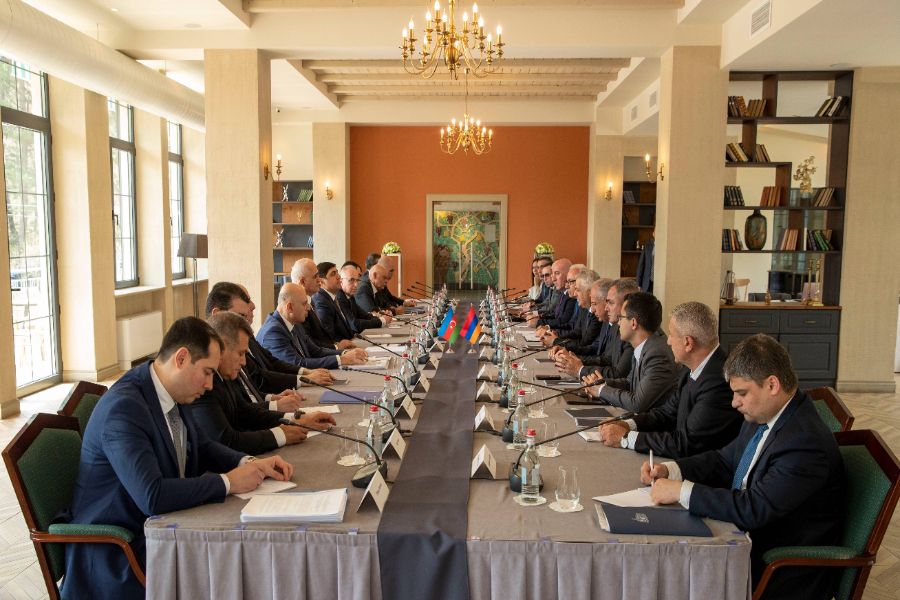
Later in the day, the developments were formally confirmed in an official statement regarding the 13th meeting of the Armenia–Azerbaijan state border delimitation commissions, held in Aghveran, Armenia, on April 29, 2026.
According to the announcement issued by the Ministry of Foreign Affairs, the meeting was co-chaired by Armenian Deputy Prime Minister Mher Grigoryan and Azerbaijani Deputy Prime Minister Shahin Mustafayev, in their respective capacities as heads of the two countries’ border delimitation and border security commissions.
The statement noted with satisfaction that the 13th meeting had once again taken place on the territory of one of the parties, specifically in Aghveran, Armenia.
During the discussions, the sides exchanged detailed views on organizational and technical issues related to the delimitation process. They also agreed on and exchanged draft texts of several key methodological guidelines governing the practical implementation of delimitation work.
These included procedures for the work of expert groups involved in the delimitation process, guidelines for the creation of border delimitation maps, and procedures for the formalization and publication of delimitation-related documents.
Both sides agreed to submit the drafts to their respective governments for approval. In addition, Grigoryan and Mustafayev held separate discussions on matters of mutual interest.
The statement highlighted that the transit of cargo to Armenia via Azerbaijani territory has been carried out successfully and continues to proceed, while also noting the delivery of petroleum products from Azerbaijan to Armenia as an indication of emerging economic links between the two countries.
The meeting also included a session with the participation of representatives from business communities on issues related to trade and economic cooperation, the mutual supply of goods and services, and transit transportation.
The statement emphasized that the progress achieved was made possible by what it described as the political will of Armenian Prime Minister Nikol Pashinyan and Azerbaijani President Ilham Aliyev.
At the conclusion of the meeting, the sides signed a protocol and agreed to coordinate the date of the next meeting in Azerbaijan through working-level channels.
The timing of Azerbaijani Deputy Prime Minister Shahin Mustafayev’s visit to Armenia has been interpreted by opposition figures not as routine diplomacy, but as a politically consequential signal embedded in a broader struggle over narrative control and domestic legitimacy.
Armenian Revolutionary Federation member and MP Artur Khachatryan advances a critique that situates the visit within an interplay of internal political vulnerability and external strategic calculation.
At the center of this critique is the assertion that Prime Minister Nikol Pashinyan’s government has constructed a communicative framework in which the notion of “peace” functions as both a political asset and a stabilizing narrative. As Khachatryan formulates it, “The main propaganda line of the authorities is that peace has supposedly already been established, and if Pashinyan is no longer in power, war will begin.” In this reading, such framing narrows the perceived range of political alternatives by linking any transfer of power to heightened security risks.
Within this analytical lens, Mustafayev’s visit acquires significance less for its formal diplomatic content than for its signaling function. Khachatryan suggests that external validation — particularly from Baku — reinforces the government’s narrative, noting that “in this situation, the Armenian government needs Azerbaijan to confirm this claim as well.” The visit thus operates as a performative mechanism, reinforcing the image of stability at a moment when its durability remains contested.
The critique further posits a reciprocal logic underpinning this interaction. According to Khachatryan, Baku’s current posture cannot be understood independently of Armenia’s internal political dynamics. He argues that Azerbaijani policymakers are acutely aware that “once Pashinyan leaves and a new government is formed in Armenia, it will — unlike the current one — defend national interests and will not carry out Azerbaijan’s instructions.” In this interpretation, Azerbaijan’s engagement is conditional and strategically calibrated. As Khachatryan puts it, “Baku is not doing this for free; in return for its support, it will extract something from the Armenian authorities.”
This line of argument converges most clearly around the issue of border delimitation. Given Mustafayev’s institutional role as co-chair of the bilateral commission, the visit is interpreted as potentially instrumental in advancing specific territorial configurations. Khachatryan contends that “Mustafayev will insist that delimitation be carried out along the route of the so-called pan-Turkic corridor,” while cautioning that expectations of alternative starting points — “for example, from Jermuk or the northwest, as outlined in the regulations of the bilateral working group” — may prove misplaced. Whether or not such projections materialize, they reflect a deeper distrust toward the process and its underlying strategic direction.
An additional dimension of the critique concerns the economic signaling embedded in Mustafayev’s meetings with business representatives. Khachatryan interprets these engagements as an attempt to construct a forward-looking narrative in which normalization is equated with economic opportunity. Yet he challenges this premise, arguing that such messaging risks obscuring asymmetry in expectations: “the illusion that the establishment of normal relations … will open up new business opportunities,” he suggests, masks a reality in which “by ‘normal relations,’ Azerbaijan understands the unconditional acceptance of its terms by Armenia.”

Pashinyan has been conducting border delimitation talks with Azerbaijan since 2021, whose details are kept secret, while Azerbaijan still occupies more than 200 square kilometers of Armenian territory. Moreover, under the guise of a “goodwill gesture”, Pashinyan unilaterally handed over four abandoned villages to Azerbaijan without a quid pro quo! This idiot is squandering even the last trump cards Armenia still has, or more precisely, had! Giving away the store and sabotaging Armenia, is this guy’s “skill”.
And no one should be surprised if Pashinyan accepts Azerbaijani Deputy Prime Minister Shahin Mustafayev’s request to visit his birthplace in Armenia, and order officials to receive him like a head of state and pamper him. Rubbing salt in the wound of Armenians is another “skill” of this treacherous Turkic-butt-kissing sycophant.
Unfortunately few here seem to realise how badly Armenia has fallen in hegemonic position in recent decades and what CONSEQUENCES of DEFEAT ARE, thus as the loser has a poor hand. The great tragedy was not to accept a compromise when in a position of strength in the 1990s and squandered it only to lose it all later. It’s the winner who dictates the terms and the loser who must comply with them.
The Azeri villages within Armenia were a legacy of the bias of the USSR and Azerbaijan simply said to Armenia to turn them over the nice way or face military attack and lose them the nasty way. Indeed Armenia as loser in the Kremlin written ceasefire was obliged to turn them over as part of the terms .
Those who believe traitor Pashinyan and his government represent Armenia and the Armenians and those who believe Armenia lost a war to artificial Azerbaijan and therefore Armenians are the losers and Azerbaijanis are the winners they live in their imaginations. Make no mistake about it, Armenia did not lose a war to Azerbaijan. Armenia was invaded by half dozen terrorist states and entities on behalf of militarily incompetent Azerbaijan. This invasion was facilitated both by our external Turkish enemies (Artakin Turker-Արտաքին Թուրքեր) and their treasonous collaborators our internal Turkish enemies (Nerkin Turker-Ներքին Թուրքեր). The devil in disguise Pashinyan and his inexperienced know-it-all delusional party members are the TRUE losers who forced their premeditated loss on the Armenian nation. That’s why the sooner they are forced out of power the better for the Armenian nation and the sooner the Armenian nation will recover and dictate its terms to the enemy like it did for three decades and not the other way around.
Furthermore, the fact that an enemy delegation today has set foot in Armenia, dirtying sacred Armenian soil, while many Armenians are held hostage in enemy prisons, those who led the struggle to free occupied Armenian territories from enemy occupation and many others who picked up arms to defend their families and fellow Armenians from annihilation, not to mention filthy and coward enemy soldiers in occupation of several hundred square kilometers of sacred and sovereign Armenian territory with terrorist Turkish support, speaks volumes about how out of touch with reality Armenia’s soon to be expelled traitor-in-chief Pashinyan is and how closely he is collaborating with our enemy at a very high cost to our nation and at the expense of everything we hold sacred in our hearts and minds.
P.S. Anyone in position of authority who as much as contemplates allowing Azerbaijan’s deputy prime minister Shahin Mustafayev, representing a terrorist state with Armenian blood on his hands, to visit his place of birth should be prosecuted as an enemy agent. These Turks and pseudo-Turkish Azerbaijanis are wolves in sheep’s clothing. Why do you think this Azerbaijani scum wants to visit his birthplace if not for propaganda purposes to portray Armenia as an insignificant piece of toy in their hands to his Azerbaijani gullible sheep back home by claiming he returned to his roots to further belittle the Armenians. Any Azerbaijani setting foot on Armenian soil should be taken hostage if you ask me!
You can always expect to hear from the fascist elements calling for purges of the “internal Turk.” These sorts who always attack fellow Armenians and label their countrymen as “Turks” are just as guilty of harming the Armenian people as any Turk.
Truth hurts. Zombies don’t like to hear the truth. They rather burry their heads in the sand, ignoring and tolerating one lie and treasonous act after another, and be totally oblivious to what is going on around them because that is convenient and is the easiest way out.
Here is just a random snapshot of some of the many things the “leader” Pashinyan of those whom you seem to be defending has said and done over his last disastrous eight years in office:
1. Artsakh was an integral part of Armenia in 2018 after he lied his way into office but miraculously it became part of Azerbaijan in 2023.
2. He as the so-called “prime minister” of Armenia was the guarantor of the security of Artsakh as he claimed and that he will always be on their side but then he washed his hands off of Artsakh and left them on their own to fend for themselves against joint Turkish-Azerbaijani armed forces who committed unspeakable crimes against fellow Armenians.
3. While Artsakh was under blockade by the enemy for 10 months and was being starved to death, he was sending truckloads of food and rescue material to genocidal terrorist Turkey next door to help with their earthquake victims.
4. While his “foreign minister” Mirzoyan was sounding the alarm bells to the world that an ethnic cleansing is taking place in Artsakh, he was assuring the world that there was no imminent danger to Armenians in Artsakh. This very same statement was echoed by enemy foreign minister while quoting Pashinyan.
5. He turned over to the enemy about a third of Armenia in size without even firing a shot in 2020-2021.
He handed over the map of tens of thousands of minefields, an effective bargaining chip, to Azerbaijan in 2021 for nothing in return.
6. He freed two Azerbaijani criminals sentenced to life in prison for crossing into Armenia and found guilty of killing a young Armenian boy while hundreds of Armenian POWs were being tortured in Azerbaijan.
7. He announced that the Azerbaijani population, many of them criminals and thirsty for Armenian blood, should have a say in the resolution of this conflict while their racist dictator in Baku was calling each and every Armenian, regardless of their place of origin, as the enemy of Azerbaijan.
8. He put into question the Armenian origin of Shushi, the centuries-old cultural capital of Artsakh, stating that in 1992 the population of Shushi was 93% Azerbaijani completely ignoring the joint Turkish-Azerbaijani destruction of Armenian quarters in Shushi, after having already committed the 1915 Armenian Genocide, and the murder of 20,000 Armenians there in 1920 emptying the town of all its native Armenians and holding it hostage for 70 years during the Soviet occupation of Armenia.
9. He equates patriotic Armenians who call “eastern Turkey” as occupied Western Armenia to Azerbaijani terrorists calling Armenia as “western Azerbaijan” and this idiot was a former journalist! How can you equate Western Armenia with its ancient Armenian kings and kingdoms, i.e. kingdom of Vaspurakan, and ancient churches and monasteries, i.e. monastery of Akhtamar in Van built by king Gagik in 10th century well over a century before the first wave of Central Asian Turkish terrorist invasion, to Azerbaijani fascist propaganda that itself never existed and was artificially invented only 108 years ago in 1918 on occupied Armenian territories?
10. According to him, the sacred Biblical Mount Ararat, the epicenter of the Armenian homeland and the national symbol of the Armenian nation, is no longer Armenian because it is under enemy occupation , as a result of the Armenian Genocide, and today it stays outside of the boundaries of contemporary Armenia and all of this because he considers himself only the “prime minister” of today’s Armenia.
The list goes on. There are too many to list here. Next time, take a good look in the mirror before passing judgments on others just because you are ignorant. I say, those who attack fellow Armenians for speaking out against and exposing evil are not only worse than the Turks themselves but that they are complicit in the destruction of the homeland!
It is nice to see the governor of Armenia come for a visit. Did he pick out a house to call home or is he going to build an erdogan-esque mansion with pashinyan backed armenian workers. Armenia gets what it deserves for allowing pashinyan into “western azerbejian” and voting him in. I bet he will give him the Catholicos’ residence. I know as an American, they really don’t care what I think.
The fact that Armenia didn’t commit all of its resources to Arktash in 2020, although there must always be a practical balance of interests and that Azerbaijan had backing of Turkey, Israel and Pakistan and tacit support from Russia is missing the point it’s a bit like the French can be inclined to believe they liberated themselves from the Nazis in 1944 , or that Iraq against Kuwait alone wouldn’t have lost but the backing it recieved from the US coalition meant for Iraq defeat and being compelled to partially disarm as a result. Similarly it’s obvious that – if – Ukraine wasn’t supported by NATO that Russia despite it’s bungling would have subdued them, to a Russian soldier falling to NATO supplied weapons and suffering support issues due to sanctions is cold comfort. Wars are never ‘fair’ . The same could be said about Israel that without support from the USA and manipulation of Europe over the Holocaust it would have less of a hegemony although the Arabs are prone to cluck and no egg posturing and dreaming of their lost hegemony from 1500 years ago as though it theocratically entitles them to success today. Thus similar sentiments regarding Azerbaijan are missing the point and ignoring reality and thus delusional escapism!
If one inch of mainland Ar.enia is given away to the Turks, PAsinyan needs to be hauled away to prison as the traitor that he is.
Pashinyan must be held accountable for the treason and his many other crimes he has already committed. His criminal record is so extensive that listing them wouldn’t fit in this comment section. His equally treacherous collaborators in his government and bureaucracy must also be held accountable, purged, punished accordingly and imprisoned along with him. That is why, the next month’s elections are so existential for Armenia. This will be either a vote for treason, capitulation, territorial mutilation and subjugation of Armenia, or a vote that will save Armenia from this situation.
Steve, who will hold him accountable? The people? They seem to be having too good of a time with all these “free” (EU funded) festivals. Like placating a bunch of children.
After reading this piece I think the Armenian side should demand to change the negotiator; it is so naive to let Shahin Mustafayev or whatever his real name is, to be in charge. Someone younger and from Azerbaijan proper would be more appropriate,
Armenia has lost all its dignity, strength, and respect with this pashoglu prime minister. He has really dragged this once proud nation into the gutter. Its become nothing more than a weak western/turkish vassal and vilayet.