



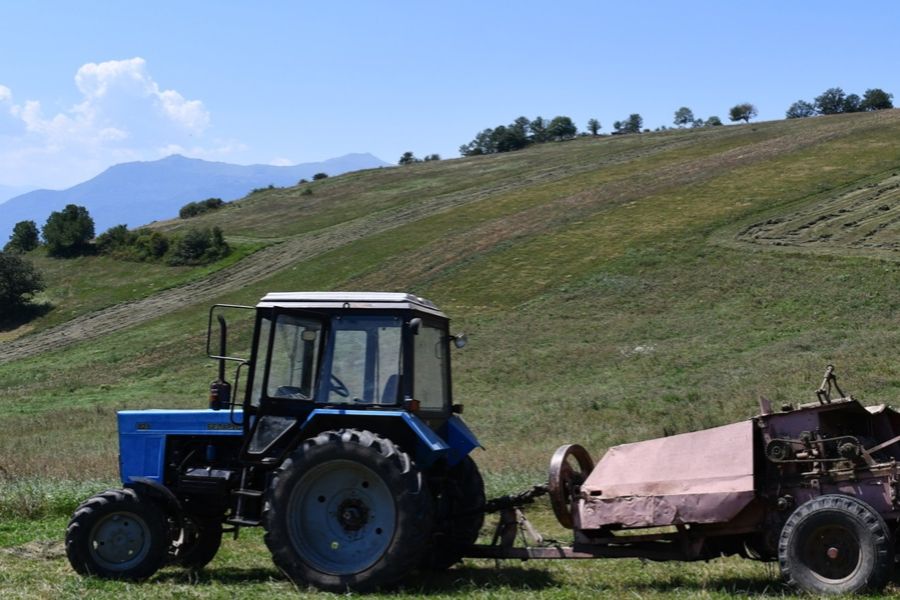
On a late-summer drive through the Ararat Valley, it is not uncommon to see crates of apricots left by the roadside — too ripe to transport, too abundant for local demand and ultimately destined to spoil. Just a few hours away in Yerevan, those same fruits — processed, packaged or imported — reappear at a higher price. This quiet contradiction captures the central tension of Armenia’s food system: a country capable of abundance, yet structured in a way that allows value to slip through its fingers.
Armenia does not have a food production problem. It has a systems problem.
Each year, Armenia produces sufficient volumes of fruits and vegetables to meet domestic demand and sustain exports. Yet an estimated 20% to 30% of agricultural output is lost between harvest and consumption, largely because of gaps in storage, logistics and market coordination, according to an EVN Report food security analysis that draws on regional agricultural loss estimates and Armenia-specific assessments.
At the same time, more than 25% of Armenian households face food insecurity or cannot consistently afford a nutritious diet, according to the “Food Security and Nutrition in the South Caucasus” report published in 2024 by the International School of Economics at Tbilisi State University Policy Institute. The report analyzes household consumption and affordability across the region.
Taken together, these figures point to a deeper issue: Inefficiency, not scarcity, defines Armenia’s food system.


A farmer unable to store peaches for an extra week loses not only income but also bargaining power. A restaurant without reliable supply chains turns to imports. A processor lacking consistent volumes cannot scale. The result is a fragmented system in which risk is borne individually and opportunity is lost collectively.
Recovering even part of post-harvest losses could unlock significant economic value while stabilizing domestic markets. A 2024 peer-reviewed study, “Food Waste Management and Sustainable Supply Chains” published in the journal Sustainability, finds that investments in cold-chain infrastructure, logistics optimization and digital coordination systems can reduce food loss by 15% to 40%, depending on the supply chain stage, while increasing profitability and supply stability. Armenia has begun experimenting with such approaches through development programs and joint initiatives with the FAO, but implementation remains fragmented rather than systemic.
Climate pressure adds urgency to this transformation. Armenia is already experiencing rising temperatures, irregular rainfall and soil degradation — trends documented in the Food and Agriculture Organization country profile on Armenia. According to FAO assessments, agriculture accounts for approximately 60% to 70% of total freshwater withdrawals in Armenia, underscoring the sector’s dependence on water resources. Yet irrigation infrastructure in many regions remains outdated and inefficient, increasing vulnerability to climate change.
And yet, Armenia’s geography offers an overlooked advantage. Its mountainous terrain and diverse microclimates allow for the cultivation of high-altitude, climate-resilient crops with distinct flavor and nutritional profiles. In global markets these characteristics are not limitations — they are differentiators. Armenia does not need to compete on volume; it can compete on identity.
This is where tradition can become a strategic asset. Armenian agricultural practices emphasize seed saving, seasonal diets and natural preservation techniques. These practices are relevant in global markets shaped by labels such as organic and regenerative agriculture. Yet within Armenia, they are often undervalued.
Producers working with heritage varieties or low-input systems frequently lack access to branding, distribution and export channels. At the same time, global demand for such products continues to grow. According to the EkoConnect Armenia Organic Sector Report, published in 2021, Armenia’s organic sector remains small-scale, with limited domestic market share and export volumes constrained by fragmentation, despite favorable production conditions and certification capacity.
The structure of the agricultural sector further complicates this challenge. More than 90% of farms in Armenia are smallholder operations, a figure reported in national agricultural statistics and reflected in World Bank and FAO datasets on farm structure in Armenia. These farmers are deeply embedded in local ecosystems and traditions, yet operate with limited access to finance, storage, processing capacity and export markets. As a result, they often sell immediately after harvest at lower prices, while consumers later face higher prices due to supply volatility.
This “missing middle” — the absence of strong cooperatives, aggregation systems and midscale processors — limits the sector’s ability to scale efficiently. Addressing it is not simply about supporting farmers; it is about stabilizing the entire food economy.
At the same time, a quieter shift is underway. A new generation is beginning to engage with agriculture. Across Armenia, young entrepreneurs are experimenting with regenerative farming, agri-tech platforms and farm-to-table models. One example is the FAO’s Digital Village Initiative, implemented in 2025. In the Lori and Tavush regions the initiative has sought to modernize traditional practices and create opportunities for youth and women.
Here, the Armenian diaspora also represents a largely untapped advantage. With its global reach, it can serve not only as an export market, but as a bridge — connecting producers in Armenia with international distribution networks, investment and storytelling platforms. In many ways, the diaspora is already part of Armenia’s food ecosystem; what is missing is intentional integration.
Reimagining Armenia’s food future, then, is not about isolated innovations. It is about alignment.
It is about recognizing food loss as an infrastructure challenge, not an inevitability. It is about treating water as a strategic resource. It is about strengthening the “missing middle” that connects small farmers to markets. And it is about telling a cohesive story — one that links Armenia’s land, traditions and innovation to global demand.
The next phase requires intention: a shift from reacting to designing, from fragmentation to strategy.
If Armenia is serious about strengthening its sovereignty —- economic, environmental and social —- then food must be treated not as a peripheral rural issue, but as a strategic national priority.





A brilliantly written and critically important topic. It should be more widely read. Every US lobbyist worth their salt should it read twice-(are you listening)???? The conclusions shine with progressive thinking – finally!!!