



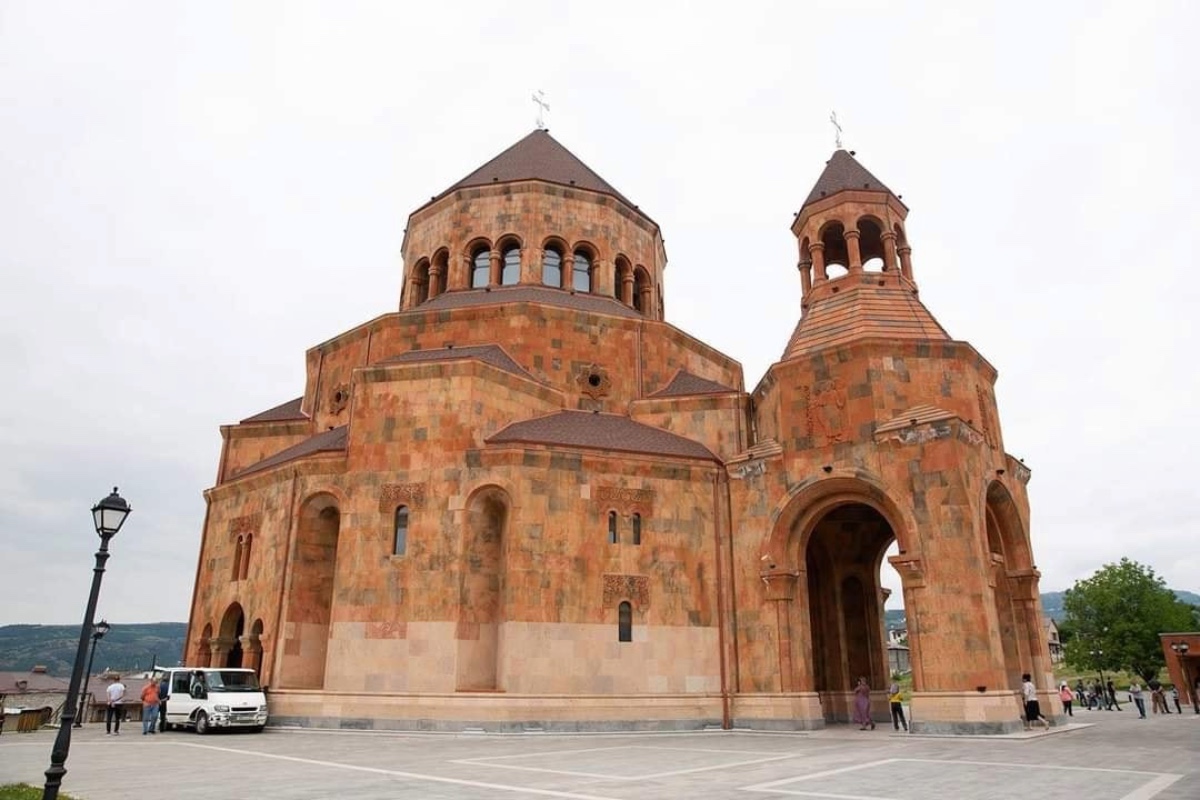
YEREVAN — A few days before the 111th commemoration of the Armenian Genocide, a new act of destruction has drawn sharp condemnation from cultural heritage observers: the reported demolition of the Holy Mother of God Cathedral in occupied Stepanakert. Experts warn that this incident is not isolated but part of a broader pattern they describe as systematic cultural erasure.
According to a statement by Hovik Avanesov, the cultural heritage ombudsman of Artsakh and deputy head of the “National” historical and cultural NGO, the cathedral’s destruction reflects a deliberate policy rather than sporadic vandalism. Writing on social media, Avanesov said developments in Artsakh can no longer be framed as a series of uncontrolled acts.
“What is taking place in Artsakh is no longer a chain of isolated incidents or random vandalism,” he wrote. “It is a clearly targeted policy aimed at erasing all visible traces of Armenian presence. The destruction of the Holy Mother of God Cathedral in Stepanakert is another calculated episode within that program.”
Avanesov underscored the symbolic timing of the demolition, saying it once again highlights what he characterized as Azerbaijan’s genocidal policy. His remarks come amid heightened sensitivities surrounding the anniversary of one of the darkest chapters in Armenian history.
The cathedral held both spiritual and architectural significance. Founded on July 19, 2006, under the auspices of Catholicos of All Armenians Karekin II and consecrated on April 7, 2019, it quickly became a central place of worship in Stepanakert. Designed by architect Gagik Yeranosyan, the structure stood 35 meters tall, with a 24-meter bell tower and a complex internal design — features that underscored its prominence within the city’s skyline and religious life.

“This was not a forgotten or secondary structure,” Avanesov said. “It was a consciously targeted sanctuary.”
He also raised alarm over reports that, prior to the destruction, Azerbaijani social media platforms had openly circulated calls to demolish the church. Such developments, he said, indicate the act was not only foreseeable but publicly incited.
“When such calls go unpunished and are ultimately carried out, this points not to isolated groups but to a systemic issue where hatred is instrumentalized,” he said.
Avanesov also pointed to similar accusations regarding the destruction of the Saint Hakob Church in Stepanakert, reported days earlier, suggesting a consistent pattern in the targeting of religious and cultural landmarks.
The outcry has widened, with civil society groups warning that the destruction of religious landmarks signals a dangerous escalation. In a strongly worded statement, the Artsakh Union called on the Armenian government to reassess what it described as “encouraging inaction and rhetoric” toward Azerbaijan in light of the ongoing destruction of Armenian churches in occupied Stepanakert.
The organization linked the reported demolition of the Holy Mother of God Cathedral to the earlier destruction of the Saint Hakob Church, arguing that together they represent the culmination of a systematic campaign to erase Armenian cultural presence. According to the statement, these acts amount to “state-level cultural genocide,” enabled by sustained impunity, the silence of the international community and an insufficient response from Armenian authorities.
The Artsakh Union urged Yerevan to undertake immediate and concrete policy changes. Among its key demands is intensifying legal action on international platforms, including renewed appeals to the International Court of Justice for additional provisional measures.
The group also called for the issue to be formally raised at the United Nations Security Council and within UNESCO, with the aim of pursuing potential sanctions against Azerbaijan for the destruction of cultural heritage.
Beyond legal and diplomatic measures, the organization said the protection of cultural and religious heritage must become a central condition in any future negotiation process. It also called on the international community to ensure the deployment of an independent monitoring mission to the territories in question, tasked with assessing the condition of remaining monuments and preventing further damage.
In its concluding remarks, the Artsakh Union said that, under current circumstances, the Republic of Armenia — as an applicant in ongoing international legal proceedings — must adopt a more proactive and consistent approach to safeguarding Armenian cultural heritage, warning that failure to do so risks irreversible loss.
The Artsakh Cultural Heritage Monitoring Platform has classified the deliberate destruction of Armenian churches in Artsakh as a violation of Article 8 of the Rome Statute, constituting a serious crime against humanity. The platform said the damage inflicted on religious sites also falls under the 1954 Hague Convention for the Protection of Cultural Property in the Event of Armed Conflict and its 1999 Second Protocol, which define such acts as “serious violations” prosecutable as war crimes in international courts.
Scholars affiliated with the platform argue that the destruction of Armenian churches must be viewed within the broader framework of genocide, increasingly interpreted to include attacks on cultural heritage as an essential component of identity.
Lernik Hovhannisyan, head of the diocesan council of the Artsakh Diocese of the Armenian Apostolic Church, said such acts of vandalism are not new but represent a continuation of long-standing policies.
“This pattern dates back to the 1960s, even during the Soviet era,” he said. “Today, it is carried out with far greater impunity.”
Hovhannisyan pointed to earlier destruction of Armenian heritage in Nakhichevan, including the well-documented eradication of medieval khachkars, as a precursor to current developments.
Beyond churches, he noted, entire settlements and historic neighborhoods — including 19th- and early 20th-century homes in Stepanakert — have reportedly been destroyed. In cases where structures are not demolished, he added, their identity is often altered or reattributed.
Hovhannisyan cited the example of the Ghazanchetsots Cathedral, whose appearance was altered and reclassified, while other sites such as Amaras Monastery, Dadivank, and Gandzasar Monastery could face similar risks, including potential destruction or historical reinterpretation.
“Azerbaijan’s actions are unpredictable—they cross red lines at will, and no one restrains them,” he said. “Only a handful of civil society actors, dedicated individuals, and academic circles continue to raise alarms. There is no consistent state policy addressing the protection of these cultural assets.”
He also expressed concern over insufficient engagement by Armenian authorities, arguing that the absence of sustained diplomatic pressure contributes to international inaction.
These tensions were highlighted by remarks from Nikol Pashinyan, who, responding to a journalist’s question following a recent Cabinet meeting, said his primary responsibility lies with cultural heritage located within the internationally recognized borders of Armenia.
The comment has fueled debate among observers and advocacy groups, many of whom argue that the destruction unfolding in Artsakh demands a broader and more urgent response, warning that without coordinated international intervention, the region’s cultural legacy may face irreversible erasure.
Armenian Revolutionary Federation Bureau member and lawmaker Lilit Galstyan issued a statement accusing the Pashinyan government of legitimizing Azerbaijan’s actions while distancing itself from responsibility.
The governments of Armenia and Azerbaijan “are operating in striking synchronization,” Galstyan said. “With one difference: in this duet, the Armenian prime minister is the executor — implementing the script written in Baku and Ankara.”
Galstyan said Pashinyan’s position effectively grants “a green light” to further destruction, linking it to the 2022 Prague agreements, when Armenia’s leadership recognized Azerbaijan’s territorial integrity, including over Nagorno-Karabakh. In her view, that decision marked the political prelude to the unfolding cultural losses.
“This is a continuation of deception,” she said, arguing that the protection of Armenian heritage is a constitutional and moral obligation that should not be abandoned in territories under foreign control. She also accused the authorities of undermining Armenian identity through what she described as institutional neglect and value erosion.
Citing Article 19 of the Constitution of the Republic of Armenia, Galstyan said the state has an obligation to protect Armenian cultural heritage beyond its borders, including in matters of preservation and advocacy, adding that current policies amount to the abandonment of that duty while also targeting core national institutions such as the Armenian Apostolic Church.
Galstyan concluded by saying the current leadership views Azerbaijan as a guarantor of Armenia’s security — an assertion that underscores the deep polarization surrounding both the political response and the cultural losses unfolding on the ground.



Of course, there is no comment, let alone any condemnation, as usual, from the archtraitor Pashinyan and his equally treacherous government ministers and bureaucrats regarding the ongoing cultural Armenian Genocide by Azerbaijan, which deliberately chose to destroy the last two remaining Armenian churches in Stepanakert, just before Armenian Genocide Remembrance Day. When treason reigns supreme in Armenia, these outrages by Azerbaijan will continue to be dismissed and brushed aside by the quisling Pashinyan and Co. who made their bed with Azerbaijan and Turkey. It would not surprise me if the sycophant and satrap Pashinyan even abolishes Armenian Genocide Remembrance Day and discontinues the official commemoration of the Armenian Genocide by the Armenian state and in schools, in order to please his two Turkic overlords. Anything can be expected from this cowardly, treacherous sellout.
That the Turks are destroying churches and cathedrals just goes to show how much of vandals they truly are.
Every Armenian should know that no mercy can ever be expected from the Turks.
As for no comment from Pashinyan, for him and the government the issue is over and an embarrassment. Bit like how Putin is surprisingly absent when Russia has setbacks in Ukraine. The incident is all part of the cycle of hatred that blights the area after all mosques in areas Armenia controlled 1994 – 2020 were often damaged or ruined. Hopefully with a peace cycles of death and destruction will be less likely. Grimly this also reaffirms that any potential return would be awkward as Armenian aspects are being erased and the area being Azerified including the aliyev personality cult onipotent, thus the essence that made it home is no more and the soul has gone and it would be a hideous dystopia.
The biggest threat to Armenia’s existence is sheeple who elected, re-elected, and will re-elect Nikol Pashinyan. Let’s call things by their right names.