ArtCulture

Zara Janibekyan’s path from medicine to canvas

Yellow represents mood, orange brings warmth, and Armenia’s landscape serves as an endless palette. For Zara Janibekyan, colors carry distinct and profound meanings. As a pediatrician and public health specialist, she knows the rules of healing the physical body. As an artist, she is certain that art can serve as a powerful form of psychological therapy.

Her first solo exhibition, dedicated to the memory of her mother, Lusik Janibekyan, summarized a long creative journey rooted in her childhood during the Soviet era.

A childhood where everything had to be done best

Zara Janibekyan recalls having a happy childhood. She was born and raised during the Soviet era. She played the violin, practiced sports and loved to draw. This was a personal preference and an integral part of the educational and upbringing system of the time.

During her teenage years, a crucial question arose within the family: Should she choose medicine or painting? Her mother, who had the greatest influence on her life decisions, advised her to choose the former. “If you choose medicine, you will always have your piece of bread. If painting is truly yours, it will eventually come out of you one day anyway, and you will pursue it.”

Years later, Janibekyan considers this advice one of the best decisions of her life. She enrolled in the pediatrics faculty at Yerevan State Medical University, later graduated from the Public Health Program at the American University of Armenia, worked as a pediatrician and eventually transitioned into health program management.

Related Articles
Advertisement

When medicine and art converged

Although her professional path leaned toward medicine, painting never truly left her. For years, family, work and raising children postponed her desire to create. Only when her children grew up that she realized she finally had time just for herself. “I wanted to dedicate that time to painting.”

She began taking private art lessons and continues to study. Janibekyan is convinced that painting can be learned. “There has to be an inner drive, but through hard work, you can learn a lot,” she said. In her words, talent alone is not enough if it is not accompanied by consistency and hard work.

Medicine and art did not become rivals in her life; instead, they complemented one another. Zara Janibekyan participated in the establishment of a children’s rehabilitation center in Sevan, where art therapy is actively used. There, during their treatment, children paint, work with ceramics, play music, develop fine motor skills and learn to express their emotions.

Talent alone is not enough if it is not accompanied by consistency and hard work.

Growing up in the Janibekyan family

The Janibekyan family.

Janibekyan grew up in one of the most prominent families in Armenian culture. Her grandfather, Gurgen Janibekyan, is one of the classics and legends of the Armenian theater, while her father, Karen Janibekyan, was a beloved film actor.

The Janibekyan family structure carries its own unique charm. Karen Janibekyan had five children. Within this quintet, Zara holds an exclusive status: She is her father’s only daughter, the sole sister to four brothers.

Zara Janibekyan and her older brother, Ruben, chose medicine, while the other three brothers pursued film and the arts. Sos Janibekyan is an actor; Mikayel Janibekyan is also a talented actor who has been creating art in Moscow for years; and Gurgen Janibekyan tied his life to the art behind the camera, working as a professional cinematographer.

When Karen Janibekyan’s health declined, all five children took turns to stay by his side. Zara Janibekyan recalls a brief but profound conversation with her father. She approached him and said, “Father, your life was very rich.” The actor opened his eyes and replied briefly, “Mainly, meaningful.”

Zara Janibekyan and her father.

Those words resonated as a grand life lesson. Today, she fully agrees with her father’s definition: A person’s life is enriched and given meaning by homeland, family, close friends and art.

Zara was about 9 years old when her grandfather, Gurgen Janibekyan, passed away. Despite her young age, the image of her grandfather remains indelible in her memory, especially his unique, husky and striking voice.

Gurgen Janibekyan

“When he would sit me on his lap, I would curl up, and he would stroke my head, saying, ‘How are you, my child, Zara jan?’ He would tell interesting episodes and stories from his life.”

During her childhood, Zara’s mother often took her to the theater to watch her grandfather’s performances. At that age, the little girl did not yet grasp why everyone within the theater walls addressed him with such admiration and reverence as “Master.” To her, he was simply her loving, kind and caring grandfather. Only years later, as an adult watching his film roles and theatrical recordings, did Zara fully comprehend and appreciate the scale of the cultural heritage left behind by Gurgen Janibekyan.

Armenia as a palette

The central theme of Zara’s paintings is Armenia. She is convinced that no other country in the world possesses the colors Armenia does. However, in her words, to see them, one must learn how to look. The art of truly seeing was taught to her by the painter and lecturer Hrant Harutyunyan, who once told her, “You look, but you do not see.”

Following those words, Zara Janibekyan says, her world and perception were transformed. She began to notice the colors hidden within shadows, the hues of the mountains and the delicate transitions between the stones and the sky. “My life became much more multicolored,” she says. Her favorite season is autumn, and her favorite colors are yellow and orange.

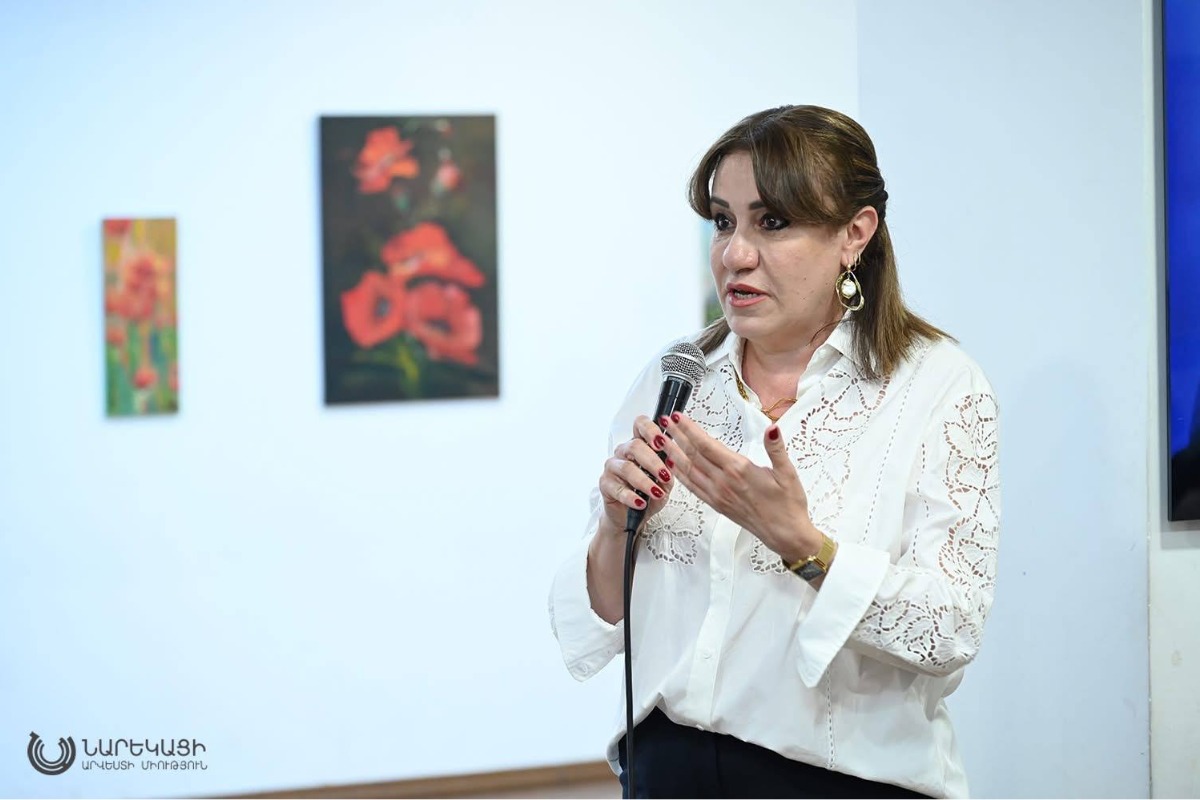
In May, Zara Janibekyan’s first solo exhibition, “The Colors of My Home: Armenia,” opened at the Narekatsi Art Union. Dedicated to the memory of her mother on the 80th anniversary of her birth, the exhibition featured 21 pieces, a number that was also highly symbolic.

Coincidentally, the opening day, May 18, coincided exactly with the birthday of her grandfather, Gurgen Janibekyan. “I realized this was a very interesting piece of symbolism.”

The exhibition’s opening day received a much larger response than anticipated, with more than 200 people visiting the gallery. Colleagues, university friends and relatives attended. The biggest surprise was the unfamiliar visitors. “I was very happy when people who had simply seen the announcement showed up,” she says. Three artworks were also sold during the exhibition.

This slideshow requires JavaScript.


For Zara Janibekyan, one of the most important values in life is human kindness. She disagrees with the notion that people have stopped being kind. “I surround myself with people who share these values.”

She is convinced that even in difficult times, a person can fight negativity through optimism, creativity and kindness. It is impossible to completely avoid external influences, but they can be transformed. 

When asked how she would like to differ from other artists, she pauses for a moment, reflects and smiles: “Perhaps by making sad colors look brighter and happier.”

Ultimately, this thought best characterizes Zara Janibekyan’s creative universe: With the precision of a physician and the sensitivity of an artist, she continues to search for the colors that can beautify the inner world of human beings and  positively transform it.

“Perhaps by making sad colors look brighter and happier.”

Anna Harutyunyan

Anna Harutyunyan is a freelance journalist from Yerevan. She graduated with honors from the Department of Journalism at the Armenian State Pedagogical University and successfully completed the one-year educational program at Hetq Media Factory. She is currently pursuing her master’s degree in journalism at the Armenian State Pedagogical University. Her main interests include data journalism, culture and social issues.

Leave a Reply

Your email address will not be published. Required fields are marked *


Back to top button