


MusicCulture

Remembering Adiss Harmandian through his daughter’s eyes

“My Dad was a man of great presence and influence — a constant protector, the mountain standing firmly behind me,” said Taline Harmandian. The youngest child of pioneering Armenian pop singer Adiss Harmandian remembers her father not only for his role in shaping modern Armenian popular music, but for the way he anchored his family and community. To her, his legacy extends far beyond the stage. 

Adiss Harmandian was one of eight children born to Armenian Genocide survivors. His father was from Aintab, and his mother from Marash. He grew up in a home where music was ever-present. His father frequently hosted gatherings at home, inviting guests and his wife’s brothers — Adiss’s uncles — to sing and play the accordion. Recognizing his son’s natural talent early on, he encouraged Adiss to pursue music, buying him his first accordion when he was just 10 years old.

By his teenage years, Adiss was already deeply immersed in music. At 16, he formed his first band and began performing at weddings and community celebrations, singing French and international songs while accompanying himself on the accordion. 

A dapper singer, composer, poet, artist, author, actor and songwriter, Adiss envisioned something new for his people: Armenian popular music that reflected contemporary styles while remaining rooted in Armenian language and identity. In 1968, he pioneered what became known as estradayin — a genre that blended European and American pop influences with Armenian lyrics.

Advertisement
Adiss Harmandian on tour in South America in 1972

“His first vinyl release, in 1965, was in French, and he wrote the lyrics himself,” Taline said. At the time, Armenian music was largely defined by folk traditions. She explained that her father closely studied Western popular music and sought to offer Armenian audiences the same range of love songs and dance music in their own language. “His true wish was always to sing in Armenian,” she told the Weekly. “He believed our people deserved modern music of their own.”

“Then came the birth of the estradayin: reinventing Armenian lyrics with jazzy pop-infused popular songs, Adiss’s music shaped Armenian identity in the diaspora and in the homeland.”

Taline noted that her father’s commitment to Armenian-language music was both artistic and cultural. He believed modern Armenian music could coexist with global trends without sacrificing identity. “He saw in Lebanon Armenians were drifting intoodar” music, and he thought, why shouldn’t we have this style of songs, too?” Taline explained. That vision would come to define the artist’s life work. “With the birth of estradayin, Adiss’s music shaped Armenian identity in the diaspora and in the homeland.”

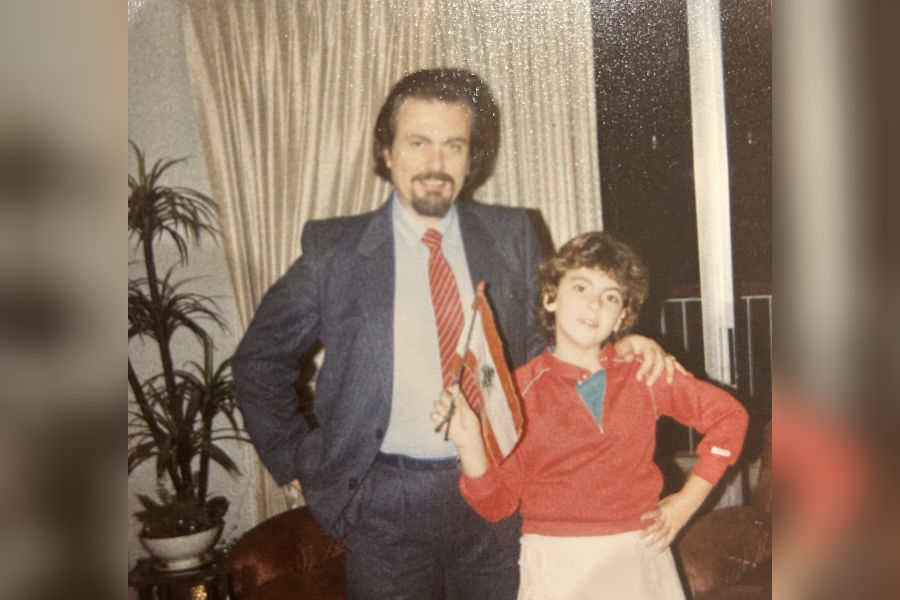
Father and daughter, Adiss and Taline Harmandian

Some of Taline’s earliest memories are inseparable from her father’s presence.

My parents told me my first word was ‘Adiss,’” she recalled.

 “When I was a few months old, we had a portrait of my dad, and when they showed it to me, I would laugh.”

In 1976, the outbreak of civil war in Lebanon prompted the family to temporarily relocate to Los Angeles for safety. What was intended as a short stay ultimately became permanent. Though Taline knew her father traveled often as a performer, she did not initially grasp the extent of his fame. 

That changed years later, when she returned to Lebanon with her parents at the age of 8. “That was the first time I realized how super famous my dad was. His posters were everywhere. People stopped him constantly for photos.”

On her first day at Armenian school in Lebanon, the principal escorted her into the classroom and introduced her as Taline Harmandian, daughter of Adiss. The students erupted in cheers. One boy even dropped to his knees and began singing, “Kisher e Kisher,” a song that had been released earlier that same year, in 1984. “It was a shock to me that all my classmates knew my dad and his songs, and I never wanted to come back to LA,” reminisced Taline. 

​​Renewed fighting soon forced the family to return to Los Angeles permanently. There, Adiss continued to perform and travel extensively, wherever Armenian communities existed. Over the decades, he toured across the Middle East, Europe, South America and the United States. According to Taline, his autobiography recounts performances in places where no Armenian singers had appeared before, including Damascus in 1966, Jordan in 1969, Iran in 1971 and Istanbul in 1972.

But, Taline said, “the younger generation doesn’t know the impact my dad had on the music they listen to today; the songs they love are Adiss cover songs — and let’s not forget the famous Adiss goatee every man was copying,” she added. 

During Adiss’s autobiography book launch in 2016, another famed Armenian singer Harout Pamboukjian said that Adiss influenced every singer after him, including himself, and if any of them says otherwise, “know they are lying.” 

Among the moments Adiss spoke most proudly of was his first concert in Armenia in 1974, held at the Opera House. The response was so overwhelming that scheduled performances by other artists were canceled for the next two weeks, and Adiss went on to perform 29 concerts — the final one coinciding with his 29th birthday. Taline recalled how often he spoke of the joy and pride he felt performing in the motherland. 

Family photo 1999: Taline, Norair, Liana, Lucy, (Adiss’s first grandson), baby Giorgio and Adiss

At home, however, her father’s life was quieter and deeply creative. He was often writing lyrics later into the night, waking up to melodies he feared might disappear by morning. Taline remembers hearing the piano in the middle of the night and finding handwritten lyrics scattered throughout the house: on tissue boxes, paper towels and magazine covers. Many of those fragments, she said, remain carefully saved. “I still have a lot of these saved,” she said. 

“My dad would write songs with substance,” Taline stated. Over the course of his career, he released 40 albums and recorded over 400 songs. “He took pride in all the songs he sang or wrote because he would approach each piece with meticulous detail,” she explained. 

Despite his public stature, Adiss was warm and humorous with those closest to him. “We were best friends,” she said. “I would call him my Daddy Cool.” He enjoyed telling jokes and riddles to family members and was widely regarded as a source of guidance within the extended Harmandian family. “Everyone loved to be around him because you always learned something from him, and although he was easy to talk to, he commanded respect. He was an anchor,” Taline explained.

She also recalled the smaller details that made him who he was: his love of animals, especially the family dogs; his fondness for classic films and science fiction; and his curiosity about the universe, from planets to galaxies. He also had a famously strong sweet tooth — a trait Taline traced to his mother’s family, who were pastry chefs.

That family tradition continued in 1998, when Addis opened the Baklava Factory in Los Angeles. Taline, her mother and brother all worked there. Today, the business is run by her brother Norair, whose son, Adiss Jr., will likely take the reins after.

But despite the knack for sugar, Adiss never smoked or drank liquor. “On rare occasions, if he was not performing at an event, he would join a friend with a cigar and whisky for a toast, but it was more like an act in public.” Instead, his preference was French pastries, orange soda and super-sweet lemonade. “If the sugar wasn’t sweet enough, you were in big trouble,” his daughter recalled.

Music, too, remained deeply personal. Adiss wrote songs for members of his family, including “Lucy Anoushes” for his wife, “Mayr Em” for his mother, “Taline Anoushig” for Taline’s 10th birthday — which later became the title of an album — “Liana, Liana” for his daughter Liana, and “Nor Hayr” for his son Norair, written as he became a father. He also composed an unreleased song for Norair titled “Im Palig.”

The family man was a doting father and extremely attentive. “You could never get away with anything from my dad; he knew what everyone was up to,” she said. “And he was very adamant that we speak Armenian at home.”

Taline said she often turns to her father’s final song, “Mi Tjkohir,” when she needs guidance. Choosing a favorite from his catalog is difficult, she added, though she finds herself returning most often to his classics from the 1970s, such as “Heranal moranal,” “Ov em yes, ov es tu,” “Saylort,” as well as the 1983 hit “Pavagan Eh.”

Adiss Harmandian with his accordion

When Adiss Harmandian passed away on Sept. 1, 2019, the outpouring of love from fans around the world underscored the breadth of his influence.

Messages, photographs and personal stories continue to reach Taline through social media, reminders of how deeply his music soundtracked people’s lives.

I’m so proud when people realize I’m Adiss’s daughter,” she stated.At his concerts, I would watch the audience be moved to tears as they were carried back to special memories his voice had soundtracked throughout their lives.”

Today, as administrator and executor of the Adiss Harmandian Estate, Taline sees it as her responsibility to preserve that legacy for future generations — not only the music, but the values and sense of cultural pride her father embodied and the sense of belonging and pride he fostered among Armenians worldwide. 

In that way, Adiss Harmandian lives on through the songs that helped define a people and a cultural moment.

All photos are courtesy of Taline Harmandian unless otherwise noted.

Follow Adiss Harmandian’s official accounts on Facebook and Instagram, and Taline Harmandian on Facebook and Instagram

Talar Keoseyan

Talar Keoseyan is a mother, educator and writer. She is the author of Vanna's Adventures (discusses Armenian traditions and customs); Mom and Dad, Why Do I Need to Know My Armenian Heritage? (a children's book about being proud of our heritage); Our Tigran and Tigran's Song (written in honor of Tigran Harutyunyan, a fedayee from the 44 Day War).

3 Comments

  1. Adiss was the legend, he was the best singer of his time, which was a very long time. Every Armenian in the world knew and loved his voice, his songs, his music, and the quality of his performance. I grew up with Addis’s songs and I am not from Lebanon, but I am not alone. The entire Armenian world grew up listening to his fantastic voice and great music. I can tell that Addis had a high class and it was reflected in his music, his songs and his performance. He also had that beautiful smile. And with that smile, I can’t imagine Addis being ever mad in his life! Today, I can still listen to any of his songs and have the same joy as I had 40 years ago. Addis may not be with us today, but his voice and his music is well alive amongst us who grew up with his music.
    May God bless his soul in Heavens.

    1. Thank you Robert! He definitely was a very classy man on stage and at home. Most of his music catalog has been recently uploaded on music platforms and available for your continued enjoyment.
      -Taline

  2. The concluding paragraph from Boghos Shahmelikian’s book, “Dawn of Armenian Pop Music”, I translated, reads as follows:

    “Adiss was 20 years old when he burst on the Armenian pop music scene. He had good looks. His overnight rise from obscurity to national fame arguably remains unprecedented in Armenian Diaspora music.
    Adiss’ baptismal name is Avedis. His name means someone who brings good tidings. Indeed, he brought good tidings to Armenian culture by popularizing Armenian music. Thanks to his stamina, good looks, drive, likable personality on and off the stage, Adiss remains an undisputed leader of Armenian pop music. His contribution to Armenian culture was formally recognized when Catholicos Aram I bestowed upon him the Order of Saint Mesrob Mashtots in 2005. Adiss Harmandyan, the first Armenian pop music singer is also the first modern Armenian pop music star to be bestowed with the ecclesiastical order.”

Leave a Reply

Your email address will not be published. Required fields are marked *


Back to top button