



The brainchild of historian Vahe Boghosian, sudanahye is a multimedia research project documenting the history of the Sudanese-Armenian community.
Boghosian recently completed sudanahye’s first-ever U.S. tour, sharing research and speaking at events across the East Coast. If you’re reading this, you likely first heard about the tour through sudanahye’s active and popular Instagram account.
Among others, the tour included a photographic conversation with Project Save in Watertown, Mass.; a talk with AGBU in New York, N.Y.; and a presentation with the Harvard Law Armenian Students Association in Cambridge, Mass.
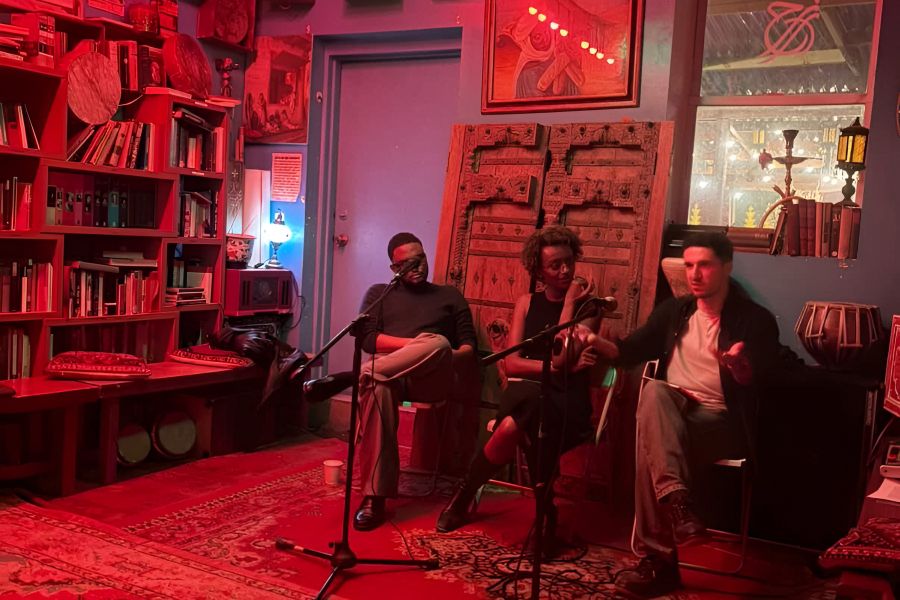
One of these events was a workshop in Brooklyn, N.Y. hosted in collaboration with Garod Collective, entitled “(Re)building a Diaspora.” The workshop aimed to offer a space to reflect on the state of the Armenian diaspora and reimagine what it could be in the future.
We caught up with Boghosian, as well as Garod Collective founders Cynthia Nahhas and Nanor Vosgueritchian, after the workshop to talk about the sudanahye U.S. tour, highlights of Boghosian’s time on the East Coast and the possibility of a West Coast tour.
This interview has been edited for length and clarity.
Rosie Nisanyan (R.N.): What was the impetus for your U.S. tour?
Vahe Boghosian (V.B.): It’s kind of funny because I made a reel before coming to promote the tour and I was just like, “Why am I going on tour? I’m not a musician; I’m not a sportsman. How many historians/researchers/digital historians/cultural heritage people go on tour?” Apparently, those who have friends in the U.S. who are willing to host them!
But the actual impetus came from Yale University. There is a brilliant Sudanese Ph.D. student there named Bayan Abubakr, who is a historian of Ottoman-period Sudan. She came across the sudanahye project and thought it was so interesting that someone was doing this history who has ties to almost two centuries of Sudanese history. She organized to bring me over to talk in Yale’s African-American Center about sudanahye.
That was an incredible experience. Growing up in West London, “Yale” and “Harvard” were high profile names you only ever heard in the movies, like “Legally Blonde.” I didn’t really process it until after the trip. The day before the presentations, I was walking around Yale’s incredible campus with museums and such beautiful buildings. It was snowy yet sunny; a beautiful crisp day as the sun reflected off the snow to give a beautiful glow to New Haven.
Since I was presenting at Yale, I figured I might as well try to cover more ground. Fortunately, I’ve made a lot of friends over the years in Boston and New York, through the Armenian community, so we were able to make this a series of events, rather than just one.
R.N.: You hosted several events for a wide variety of audiences — students, Armenians, Sudanese and more. How do you tailor your material for each audience?
V.B.: It’s a great question because it’s a challenge that I’ve faced throughout the entire project. How do you make something that appeals to both the academic and the person who just saw a nice photo? To young and old? How do you make something that appeals to Sudanese people and Armenian people, who have completely different understandings of their respective histories?
What I prefer to do is try to keep the presentation element as short as possible and make the environment more conducive to Q&A because that allows each specific event to have its own flavor. It also keeps it more interesting for me personally, because after a couple of times reading the same speech, it naturally isn’t as interesting to deliver.
At these Q&As, I’m usually there taking my own notes because, in a lot of cases, I’m learning. I’m learning because I love it when someone’s question is like a little presentation itself and then a question. I love that discussion element. I also learn about the angles and narratives that people are interested in.
The other thing I love is when there’s a space for socializing afterwards and I get to hang out with people at the event. It’s incredible to hear about their interest — how they found the project, what appeals to them about it. And of course, I get to learn about life in the place we are doing the event. These are all learning opportunities to understand the project a bit more.
R.N.: Tell me more about the Q&A element. Are there common questions you often receive, or is it more so other Sudanese-Armenians sharing their experiences and family histories?
V.B.: The best case scenario is the second one, directly finding people from the community. Across these events in the U.S., we actually met two Sudanese-Armenians, and now they will contribute to the archive of the sudanahye project.
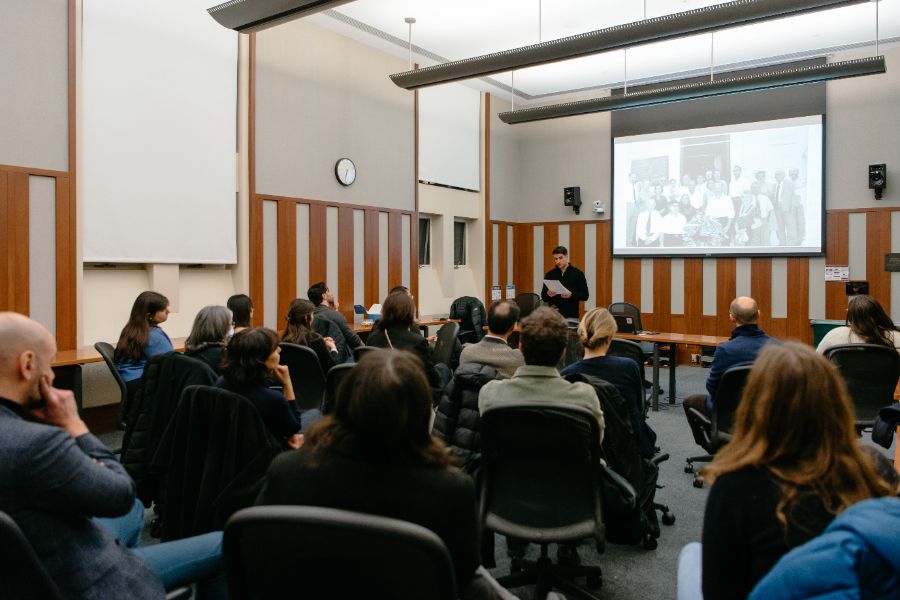
But in addition to that, there are some questions that we get time and time again, which perhaps speak to a gap in the actual presentation. More interesting for me are the unique questions, which again reflect where we are. For example, when I presented at Harvard, there was a question about the project’s value from a pedagogical perspective — I was taken aback. At Barzakh Cafe, where we had Ameen Mekki moderating a conversation between myself and Bayan Abubakr, we were discussing understandings of race in colonial Sudan and how the Armenians’ story can challenge classic assumptions.
It really is a variety. Some of the questions are more social/cultural — like, “Hey, I was in Sudan once and my question is X” — some are about the Armenian community itself and what they were physically like, in terms of demographics, and some are more thematic and linked to academia.
R.N.: I want to talk more about the workshop you led with Garod Collective, “(Re)building a Diaspora.” How did you get connected with them? What was your goal for the event?
V.B.: No surprises here; we met through Instagram. In a lot of places around the world now, Armenian collectives are starting up. These collectives often cater to a different side of our diverse communities, compared to the standard diaspora institutions. But I also think they allow for different types of events because they usually have access to different kinds of spaces. So, I was really curious to see what we could create with Garod.
When we first spoke, I told them that I’m giving a number of presentations in different places, so I would rather not stand and deliver a presentation again. New York is a city which is really pushing the conversation on many topics in terms of global culture, and I wanted to hear from people who actually live there and experience these conversations. We worked on a couple of ideas and ended up going with “(Re)building a Diaspora.”
When we were delivering our events in Cairo, some young Sudanese people in the audience asked about the Armenian diaspora and how it is organized. Many Sudanese, unfortunately due to war and displacement, are now in an early stage of the diaspora compared to us. And while I was talking about the Armenian diaspora, I started viewing it with a bit of a critical lens; the questions that came to mind were: “In hindsight, what would we do differently? If we could go back and tell the diaspora pioneers to do something differently, what would that be?”
I know it’s a very hypothetical thought experiment, but based on that, we came up with this concept of “(Re)building a Diaspora.” It’s about recognizing that the world in 2026 looks very different from the world even in 2006 or 1986 and especially different from the world in 1966.
In the Armenian case, for example, we now have an independent Armenia that we can engage with. In the global socioeconomic sense, if you’re living somewhere like London or LA or New York, chances are you’re not finishing work at 5 p.m.; you’re likely working late into the night. So, the traditional Armenian model of, “Hey, I’m going to the agoump (social club) in the evening” doesn’t always work the same way. Culturally as well, due to a rise of multi-culturalism in many countries, there has also been a rise in solidarity across ethnic minorities and understanding that we have a lot of shared elements — whereas before, Armenians were more, “We’re Armenian; we do our thing.”
Based on all of that, we came up with this idea for the workshop to critically review the diaspora that we’re part of. And so many of us are part of it in such a big way that we never actually take a step back and think, “Is any of this strange? Is any of this not as good as it could be?” It was an opportunity to use the Sudanese-Armenian story to take a step out of our own diasporas; by looking at something that was quite different and then reviewing ourselves.
Cynthia Nahhas (C.N.): Going into this, our goal was the collaboration with sudanahye in and of itself. We loved Vahe’s work and were excited to learn more about it ourselves and be involved somehow. But, in retrospect, the questions that were at the heart of the workshop are very similar to the ones Nanor and I were asking ourselves before starting Garod Collective. So, it was great to actually think through them a year into Garod, in the format of a workshop, with new and old attendees. Because, at this stage, the questions have taken on a different meaning and warranted the exploration that Vahe carved the space for.
R.N.: How did the workshop go? What did you discover?
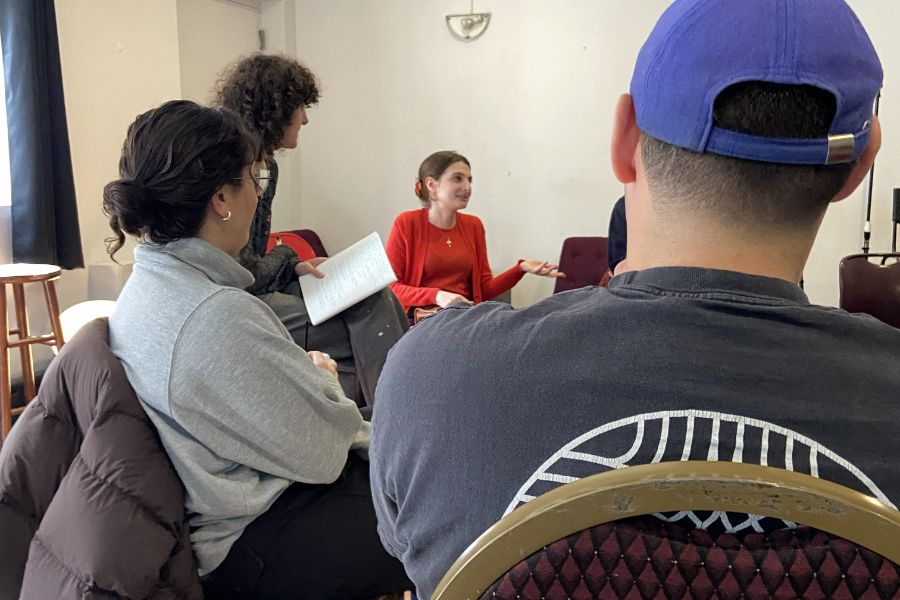
V.B.: It was really interesting and conversation-led. So many amazing people turned up with so many diverse opinions. And Garod Collective did an excellent job of finding a space in Brooklyn that was really comfortable and allowed people to express themselves.
One of the bigger points that came out of it was recognizing that, over the past century, the different stories and backgrounds the diaspora contains has fanned out compared to a century or so ago when it was mostly formed. In a lot of Armenian communities around the world, there is often a set Armenian identity, based around what I call the Armenian diaspora trinity: a church, a school and a social club. And when it works, it works great. The traditional diaspora organizations have for over a century been a vehicle for diaspora preservation and community. For example, throughout the Middle East, including somewhere like Sudan, that model worked for a long time, providing safety and belonging within the community.
But again, in the modern day, having that trinity is not as easy as it used to be. Finding space to be a community in somewhere like New York or London is difficult. One of the questions that came out of the workshop was: “How do we create spaces that cater to a diverse set of Armenians?” In New York, you have Armenians who are from different places, but you’ve also got Armenians whose grandparent moved to the U.S., and also those who moved from Armenia last year. How do you create a space that allows all these people to come together and express themselves?
Nanor Vosgueritchian (N.V.): In a sense, this is what we’re trying to do with Garod Collective — creating a space for diverse, even “offbeat” Armenians, as one participant noted during the workshop.
V.B.: Another thing that came out of the workshop was trying to find ways to translate community into action. While we have a lot of Armenian organizations in the diaspora, the link between an organization and impact has been getting more difficult. In many cases, collectives like Garod are born out of an intention to act and have impact, avoiding bureaucracy that often comes with more traditional organizations.
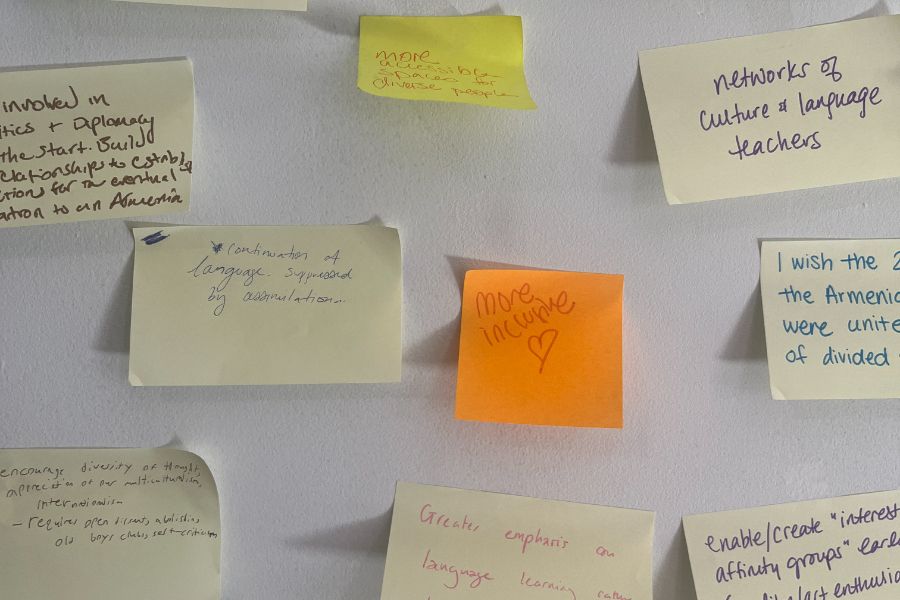
We were speaking about all these different topics, without aiming for a solution; it was a space for people to express themselves and connect with other like-minded Armenians. My big takeaway was that the desire to create spaces for Armenians that reflect the diversity of the Armenian world today are also the same spaces that speak to the different lives we live in modern multicultural megapolises like New York.
N.V.: To Vahe’s point about diversity, we have certainly noticed that there are many differences among Garod attendees. But we’ve also found that what unites us (besides being Armenian) is a genuine interest in each other’s differences and unique traits, in addition to our culture, language and history. We very consciously try to cultivate a space where people can build upon these differences together and create new ideas for what it means to be Armenian.
R.N.: Outside of the events, you had some time to explore the Armenian community on the East Coast. What were the highlights?
V.B.: I had the pleasure of taking a walk around Watertown, Massachusetts. I started off visiting Armenian churches and then the ARF Archives, which was amazing. They were really helpful and we found some interesting new archive finds for the sudanahye project which add to our understanding of the community. My walk took me further to the Armenian shops where I had some lahmajun.
All of this came together when I went to the Armenian Museum of America, a beautifully curated museum that speaks to Armenian history, and specifically to Armenian-American history. I also borrowed a book from the friends I was staying with called, “We Are All Armenian,” so I was on a deep dive into Armenian-American culture. The museum had an exhibition on Arshile Gorky as well, which is an example of an Armenian-American life finding home following the Genocide.
I was taking this opportunity to try and imagine what the world would have been like for the early Armenian migrants to America. A lot of them moved to Worcester, working in factories. I read of a letter that essentially told a family member back in the Ottoman Empire, “Hey, don’t come to America. Life is hard and not that great.” It was really interesting trying to envision that early migrant. With sudanahye, which studies a Middle Eastern diaspora, quite often it is easy to overlook that there are third-, fourth-generation diasporans — in places like America, Uruguay, Argentina — and they have a deep subculture and history of their own.
A really beautiful manifestation of that subculture is Kef music. Through the documentary “Garod,” I learned about Kef music and Onnik and Ara Dinkjian; I spent a lot of time listening to their music. You also have dances specifically for Kef music, like the Michigan Hop. I met one of the members of the band Armadi Tsayn, who are, in their own way, bringing back Kef music and mixing it with different influences.
I guess, the interesting takeaway from all of this is we see the Genocide as the major event that led to the diaspora. We view it with a very sad lens because it was a horrible, traumatic event that uplifted those who survived from their indigenous homes. But on the other side, it gave birth to these quite beautiful subcultures, whether that be Sudanese-Armenians and the hybrid culture that exists there, or in an even bigger way, the American-Armenian community with everything from new music to new food to new areas.
Walking around Watertown was like being in a mini-Armenia. There were Armenian buildings all over the place; flags and people too.
R.N.: What’s next for sudanahye? Any plans for a tour on the West Coast?
V.B.: Let me say quite clearly: I would love to do a tour of the West Coast! If anyone reading this article is part of an institution that would like to invite me, that would be great because I would love to do a similar set of events over there.
The major positive about events like the ones we had in Cairo, Berlin, Amsterdam and London is meeting people — the social element, the cultural element; it means learning a lot. The negative is that it takes a lot of time to prepare, to do and to process afterwards, which takes time away from the research. Nonetheless, as a community project, engaging our community of interest is essential.
I think what comes next is that I probably should focus on research so that the next set of events can speak about the next era of Sudanese-Armenian history we’re studying. The events thus far were all primarily based on our understanding of Sudanese-Armenian life in colonial Sudan, when the British ruled Sudan from 1899 to 1956. There’s always more to study, of course, but the next stage of the research will be from 1956 onwards. And that’s where things get quite interesting because up until 1956, Armenians were in this British colony, primarily occupying an in-between space between the British and the Sudanese. After 1956, the Armenians became Sudanese — they gained Sudanese passports and started to reflect Sudanese nationality and culture a bit more. I’m really excited to get into that.
R.N.: How can people support you and the sudanahye project?
V.B.: The project is currently funded by the Calouste Gulbenkian Foundation, which is great. Naturally, more funding means more from the project and can allow us to cover different angles and stories from the main body of research we are doing. I ask that anyone interested in helping email me.
The easier way to support the project is to open doors, engage and spread the word. Messaging in via email, Instagram or Facebook allows us to also be connected to the audiences we are trying to reach. Every like, every share, every follow really does count toward making these events, and this project more broadly, a reality. So, I would ask people to keep engaging, keep following, keep talking about us and keep sharing. I love the global community who support the project online and I’m really appreciative of everyone who is a part of that!
Visit the sudanahye website to learn more about the project and Boghosian’s latest research. Follow sudanahye on Instagram (@sudanahye) and Facebook (@sudanahye) to hear about upcoming events. You can also follow Garod Collective on Instagram (@Garod_Collective) to hear about their upcoming events.

This is a delight, a smart conversation with the organiser of the research project into the history of the Armenian diasporan community in Sudan. I am pleased the project is funded by the Caloust Gulbenkian Foundation. I visited Khartoum in February 1979 during which I had a brief reconnection with the community. Thank you for the many hyperlinks helpful to readers of this piece.