


From childhood stove to village workshop: The craftsman of Dprabak
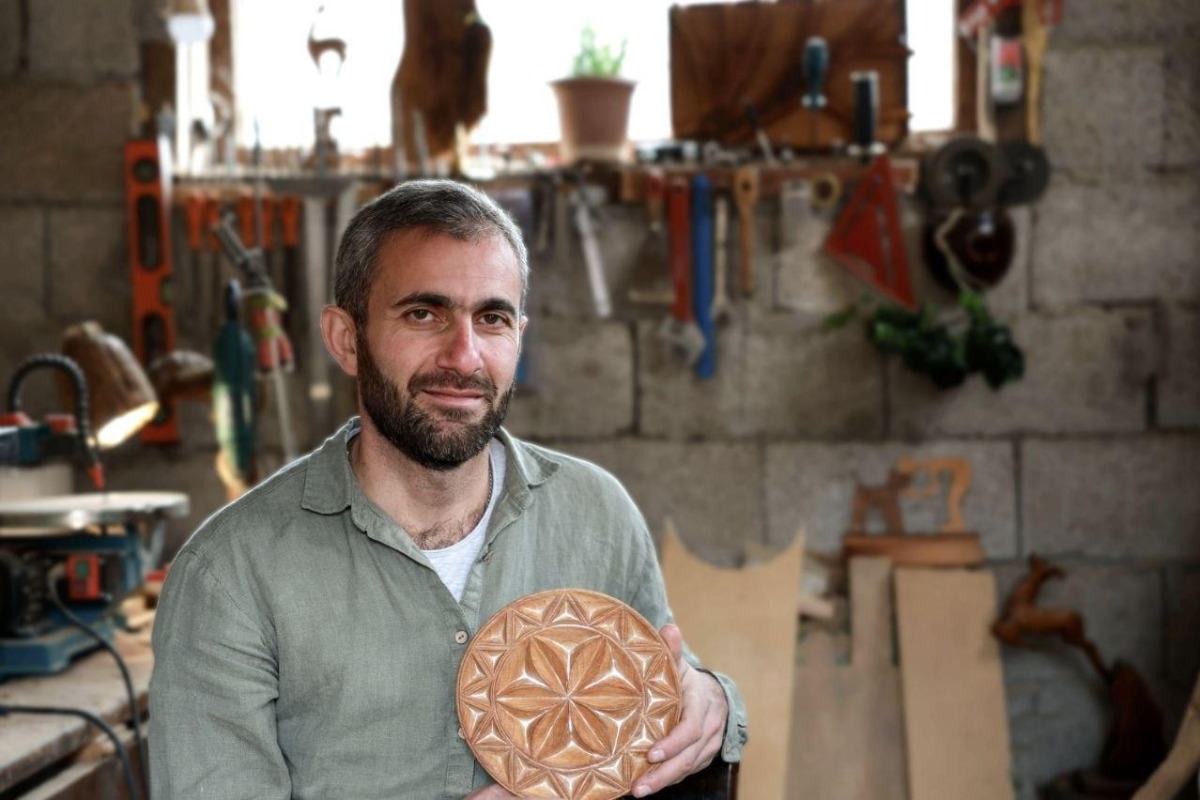
In the quiet village of Dprabak, nestled in Armenia’s Gegharkunik region, the silence is often punctuated by the rhythmic tapping of a chisel. Here, Razmik, a self-taught craftsman, breathes life into pieces of wood. His journey is a testament to the idea that building a successful brand and a meaningful life doesn’t require fleeing to the city; sometimes, all you need is the patience of the mountains and a love for your craft.
Razmik’s dialogue with wood began during the “dark and cold” years of the 1990s. Back then, while other children occupied themselves with outdoor games, Razmik spent his winter evenings by the wood-burning stove. He divided his time between the pages of a book and small pieces of wood, carving necklaces, miniature axes and mouthpieces for his grandfather.
“I don’t know why I chose wood specifically; I guess I just found a common language with it more easily,” Razmik told the Weekly. After a long hiatus, he returned to his passion in 2017. Entirely self-taught, he refined his skills by seeking advice from experienced masters and learning through trial and error. For him, the hardest part is simply starting; once there is a purpose, everything else finds its natural flow.
Choosing silence: Why stay in the village?
While many young Armenians leave rural areas in search of employment or a faster pace of life, Razmik chose to stay in Dprabak. His reason is rooted in a deep love for nature and tranquility.
“I prefer a calm life. I don’t like crowded places or the noise and hustle of cities,” he said. His daily routine is filled with sunlight, fresh air and the creative silence that allows new ideas to take root. Though many of his fellow villagers were initially unaware of his talent, today his work is cherished both within the community and beyond its borders.
In Razmik’s work, you won’t find excessive or artificial decorations. He prefers to let the natural texture of the wood speak for itself. His favorite material is ash (Hatseni); though stubborn and difficult to work with, it has a unique scent and stunning natural grain. His workshop also features walnut, apricot, cherry and apple wood.
“Every piece is a new discovery. No matter how you visualize the final result, the wood always reveals something new and distinct,” the craftsman said. While he incorporates traditional Armenian ornaments into his gata stamps (Nakhshitch), in most other items he lets the wood’s own “painting” communicate with the owner.
What is now becoming a recognizable brand began with a single knife, an old hand saw and a file. Initially, Razmik gave his creations as gifts to loved ones. However, as demand grew through social media, he began to formalize his work. The proceeds from his first sales allowed him to purchase his first professional tools.
In an increasingly digitized world, Razmik believes people still crave handmade items because they carry the creator’s soul and energy. “With handmade work, people can choose exactly what they want, rather than being limited to standard options,” he said.
Razmik does not seek fame. His dream is humble and human: He hopes as many people as possible can own a piece of his art and that they never lose interest in the beauty of manual labor.
To young people in Armenia’s villages who wish to start their own businesses, his advice is clear: “Do what you love, work hard and don’t worry about the income immediately. Every beginning is difficult, but you must never lose heart.”
Razmik’s story proves that work done with heart and love knows no boundaries. Even in a remote village, one can create something that warms the hearts of people around the world.