


FeaturedThe HomelandPhotography

The Year: Blockade, war and the unmaking of home
Editor’s note: The following is a photo story by documentary photographer and photojournalist Eugene Shalnov, tracing the events in Armenia and Artsakh from the onset of the Artsakh blockade in Dec. 2022 through the Sept. 2023 military assault and the mass exodus of the Armenian population of Artsakh. Through images of protest, war and displacement, ‘The Year’ documents how a prolonged siege unfolded into irreversible loss.

On Sept. 19, 2023, Azerbaijan launched a military operation in the Nagorno-Karabakh Republic (the Republic of Artsakh), aiming to establish control over the territory and annex it to Azerbaijan. Artsakh lacked the resources to resist. Its physically and morally exhausted population, without sufficient support for the army, faced a powerful military force that had been preparing for the operation for months. The result was capitulation, which occurred just one day after the fighting began. In the days that followed, more than 100,000 Armenians fled their homes, fearing ethnic cleansing by Azerbaijan, which had taken control of the republic.

Millions around the world watched this dramatic week unfold. Yet, this tragedy began long before the gunfire, explosions, deaths and mass exodus of Artsakh’s Armenians.

On Dec. 12, 2022, the road which connects Artsakh with Armenia — the Lachin Corridor — was blocked from the Azerbaijani side, placing Artsakh under blockade. Tensions inside Armenia intensified.

Still reeling from the 2020 war and strained further by the shelling of Jermuk in Sept. 2022, the country suddenly found itself in an increasingly precarious position. Escalation along the border exerted external pressure on society, while political and protest activity intensified in the capital. Competing political views and proposed solutions deepened public divisions.

Tatyana Ohanesyan, chair of the VIVA charitable foundation, at a rally near the UN building in Yerevan. Doctors joined the rally, demanding immediate access to food, medicine and medical assistance in order to prevent a humanitarian catastrophe. Dec. 15, 2022.
Doctors at the gates of the UN building.
Rally participants hang white coats and banners calling for humanitarian aid for Artsakh on the fence of the UN building.
Advisor to the State Minister of Artsakh, Artak Beglaryan, holds a sit-in protest near the UN building. He demanded that the security of the people of Artsakh be ensured and that Azerbaijan’s actions be condemned.
Children from Artsakh paint decorations for the New Year tree at a workshop organized by a charitable foundation. Because of the blockade, 28 children were unable to return home to their families. Dec. 23, 2022.
Commemorating the 108th anniversary of the Armenian Genocide in the Ottoman Empire: participants of the torchlight procession against the backdrop of burning Turkish and Azerbaijani flags, April 23, 2022.
March participants carry the Artsakh flag. April 23, 2023
March participants carry the Artsakh flag. April 23, 2023.

On that day, an event occurred that would come to mark a dramatic chapter in Armenian history. At the Hakari Bridge, on the Lachin Corridor, Azerbaijan established a border checkpoint — a clear violation of the Nov. 9, 2020 trilateral ceasefire agreement. The Russian Federation, the agreement’s implementation guarantor, was unable to prevent the checkpoint’s establishment, just as it had been unable to prevent the blockade of the corridor itself.

Peaceful demonstration in support of Artsakh in Yerevan. A parallel demonstration was held in Stepanakert, the capital of Artsakh. Both events were connected by live broadcast. From Freedom Square, demonstrators moved to the Yerablur military pantheon. The protesters also announced ongoing rallies and road blockages. From that time, active protests began in Yerevan. July 2023.
A man on the bridge shouts slogans in support of the protesters. July 2022.
Participants of the “Khachakirner” (Crusaders) group, veterans of the Karabakh wars, and their supporters, gathered for a rally near the government building to demand that authorities take action to unblock the Lachin Corridor. That day, there were clashes with the police, and 14 people were detained. By evening, the participants went to the Yerablur Military Pantheon to honor the memory of fallen soldiers. From there, they planned to go to the border to open the road themselves. However, the next day, the road to the border was blocked by the police. None of the participants reached the border. Aug. 2022.

This slideshow requires JavaScript.

A participant of the National Democratic Pole (Bever) rally holds a crossed-out portrait of Prime Minister Nikol Pashinyan. Bever held their rallies very intensively and had announced a major rally at the end of Aug. 2023. However, it never took place. Few people showed up, the protesters did not engage in conflict with the police and returned to Freedom Square, from where they had begun their march. Most of Bevor’s rallies were accompanied by the musical piece ‘O Fortuna,’ played through speakers mounted on a pickup truck. Aug. 2023.
The vehicle from which music was broadcast during the rallies. Similar vehicles also drove around the city during the day, encouraging Yerevan residents to participate in the protests.
A protester near the Embassy of the Russian Federation holds the flag of Artsakh. On Aug. 28, three students from Artsakh were detained by Azerbaijani border guards near the Hakari Bridge, where a checkpoint had been set up. The rally at the Russian Embassy was held because the students were traveling from Artsakh to Armenia under the escort of Russian peacekeepers. This was not the first case of Azerbaijani border guards detaining residents of Artsakh. On July 29, Vagif Khachatryan was detained at the same checkpoint. He was traveling to Armenia for surgery, accompanied by the ICRC. Aug. 2023.

This slideshow requires JavaScript.

Rally in support of Artsakh on the day of its independence celebration. More than 10,000 people visited the square. Freedom Square, Yerevan. Sept. 2, 2023.

This slideshow requires JavaScript.

Images from a sit-in strike in front of the government building. Several months before, news emerged that the Chairman of the National Assembly of Armenia, Alen Simonyan, spat in the face of a citizen who called him a traitor.

The man lying down held a piece of paper with the text, “A. Simonyan spat not at one, but at all citizens of Armenia.” Sept., 2023

Yerevan, Sept. 19, 2023

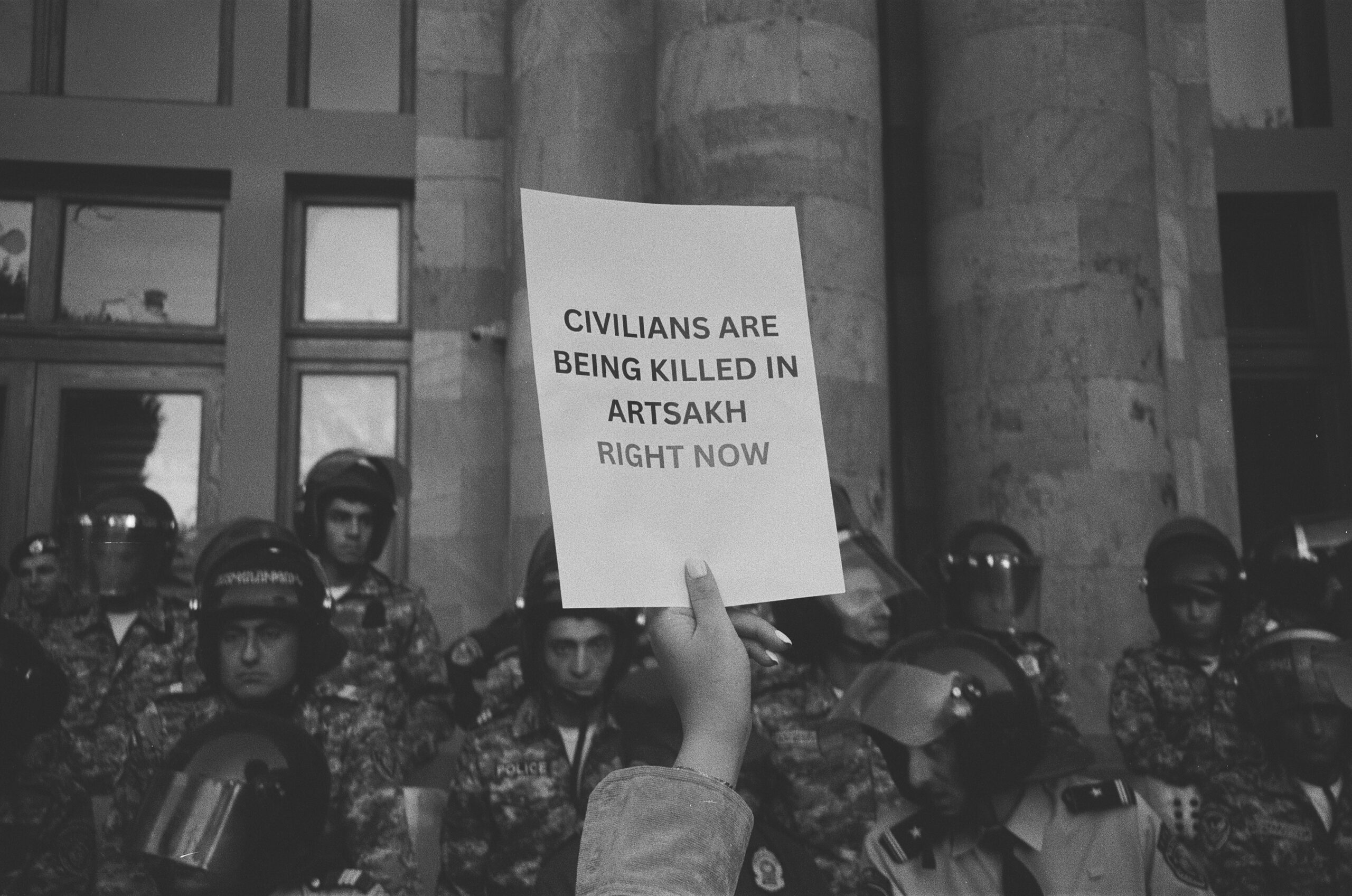
From the first day of the renewed conflict, protests engulfed Yerevan. Republic Square, home to the government building, became the epicenter. Initially spontaneous, the gatherings reflected collective anxiety, grief and exhaustion as people worried about relatives and friends in Artsakh. Many found solace in expressing their emotions together in the square.

Opposition political leaders and movements soon joined. A stage was erected each evening, protest leaders emerged and demonstrations became increasingly organized. Within a day, protests evolved from spontaneous assemblies into coordinated marches, road blockades and clashes with police.

Gradually, the dominant sentiment shifted from “for Artsakh” to more explicitly “against the government.”

This slideshow requires JavaScript.

The protests quickly spread across the city. Columns of demonstrators with differing political views moved from square to square, paralyzing traffic in the city center. Students skipped classes to join the demonstrations.

Clashes with police began on the very first day, with the most intense confrontations unfolding near the government building at Republic Square. Protesters hurled stones, bottles and anything they could get their hands on at police, who responded with flash grenades, arrests and crowd-control tactics. During moments of escalation, police lines would suddenly open as officers rushed forward to seize the most aggressive individuals, dragging them behind their shields.

During the daytime, protests were largely nonviolent, marked by marches, conversations with passersby and a constant presence in Republic Square. At night, however, confrontations resumed. From sunset onward, protesters — as long as their strength allowed — clashed with police not only verbally, but physically.

This slideshow requires JavaScript.

This slideshow requires JavaScript.

Traces of the protests in the city: overturned trash bins, benches used to block traffic, banners and broken windows in the government building.

A humanitarian aid collection point set up in the city center at the intersection of two streets. The collection took place in parallel with the protest actions. Sept. 2023.

From the earliest days of the armed conflict, alongside the protests, charitable organizations and foundations mobilized. Volunteers began collecting and sending humanitarian aid in anticipation of the refugees’ arrival. While it remained unclear how Armenia would accommodate and assist such a large displaced population, it was evident that for many, their first stop would be the city of Goris.

Volunteers from the Armenia Food Bank collect humanitarian aid. Sept. 2023.
The Armenia Food Bank is the first charitable food organization in Armenia, which gathers food and essential items and distributes them to those in need. The organization has been operating since 2020. Sept. 2023.
Volunteers load a vehicle with humanitarian aid. Sept. 2023.
Bags filled with clothing collected for refugees. The label on the bag reads: “women’s, warm.” Sept. 2023.
Humanitarian aid, hygiene supplies and medicine collected at the warehouse of the VIVA charitable foundation. From the very first day, the VIVA foundation prepared to provide medical and social assistance to refugees. With extensive experience in this kind of work, the foundation worked around the clock to prepare for the difficult days of heavy labor ahead. Volunteers helped in the warehouse, drivers delivered humanitarian aid to Goris and the foundation’s leadership instructed doctors and volunteers on how to work with refugees. Sept. 2023.
Loading one of the vehicles near the VIVA foundation’s warehouse. In addition to aid for refugees, the foundation’s doctors needed tables, chairs and everything necessary to help them set up patient reception areas. All of this was also sent by volunteers from Yerevan. Sept. 2023.
The road to Goris: the view from the window of a vehicle carrying humanitarian aid from the VIVA foundation. After the first news that refugees had begun crossing the border and arriving in Goris, numerous charitable foundations, volunteers and simply people wishing to help headed to the city. Sept. 2023.

Goris, Sept. 24, 2023

The city center of Goris, Sept. 2023. 

Goris is a city in the east of Syunik Province. It is the first major city on the route from Artsakh where it was possible to organize the reception of refugees. The population of Goris is about 20,000 people. In the following days, the city had to receive more than 100,000 refugees.

The first refugees leave the distribution center in Goris. Sept. 2023.

A distribution center for people arriving from Artsakh was set up in the Dramatic Theater in the city center. Inside, the ICRC and the VIVA charitable foundation provided medical and social assistance to the refugees. The column of vehicles, stretching for tens of kilometers, ended at this very location. The flow of people was unending, so doctors and volunteers worked around the clock for several days.

Refugees arriving in the bed of a truck collect their belongings and head to the distribution center. Sept. 2023.

The journey from Artsakh to Armenia proved to be another ordeal for those fleeing the war. A massive traffic jam had formed in front of the checkpoint established by Azerbaijan. People made arrangements among themselves, and several families would travel in one vehicle. The truck beds were always full of people and belongings. Many were injured, and many were exhausted from hunger. A man arriving in one of the trucks reported that he had spent three days in such conditions.

Belongings and a vehicle loaded onto a tow truck to be taken out of Artsakh. Sept. 2023.

The arriving vehicles were packed with belongings. Items were tied to the roofs, trunks and hoods of cars. People tried to take as much as possible with them. As many admitted, they did this because they did not believe they would be able to return home.

Unloading belongings in front of the distribution center for refugees. Sept. 2023.

From time to time, trucks would back up to the entrance, from which collected humanitarian aid was unloaded. Occasionally, cars and small buses would arrive at the entrance. People who had difficulty moving — elderly individuals or those who were injured — would get out of them.

A man entertains a child in front of the refugee reception center. Sept. 2023.

Adults tried to create a positive atmosphere for children. Volunteers distributed sweets, and relatives entertained the little ones. It was not uncommon to see someone comforting a crying person on one side of a bench, while on the other side, a child was being made to laugh.

Yeghipatrush, Dec. 2023

This slideshow requires JavaScript.

A man, a refugee from Artsakh, smokes in his living room. Dec. 2023.

On the outskirts of the village, in a small house, lives a family of refugees from Artsakh. They moved to this village at the end of September. Everything in the house is very modest. In the middle of the large, empty room stands a table. In the corner is a stove. The woman quickly placed several cups on the table and made coffee for all the guests. The man lit a cigarette and told the harrowing story of how his family escaped from Artsakh, how they searched for a new home and how neighbors helped them once they arrived. It was a terrifying, yet completely typical story for that period. The family had seven children.

A small stove in the house. Dec. 2023.
Coffee brewed on the stove for the guests. Dec. 2023.
The road from Yeghipatrush. Dec. 2023.

Eugene Shalnov

Eugene Shalnov is a documentary photographer and photojournalist based in Russia.

One Comment

  1. And while Azerbaijan was blockading and starving Artsakh, as a prelude of its long-planned ethnic cleansing and conquest – with Turkey’s help, Pashinyan was sending cash-strapped Armenia’s precious aid to Turkish earthquake victims, even though Turkey has ample resources to provide aid to its own citizens! Let that sink in!

Leave a Reply

Your email address will not be published. Required fields are marked *


Back to top button