

The Region in Brief
Armenia
On August 21, a scheduled court session in the case of Archbishop Bagrat Galstanyan and 17 co-defendants proceeded without any defense attorneys. The legal team boycotted the hearing in protest of the judiciary and presiding judge, Mnatsakan Farhoyan, citing concerns about due process and impartiality.
Despite the absence of legal representation—under which courts are typically barred from ruling on pre-trial detention—the judge reviewed and issued decisions on the defendants’ custody status. The court extended pre-trial detention by an additional three months.
“You cannot scare us with imprisonment—or even execution,” Galstanyan declared in court. “I am at peace with my brothers, my sisters, these honest people and my forefathers. I would rather be in prison or in a grave than stand with traitors,” he said, referring to the current regime.
MP Artur Sargsyan, also among the detainees, urged the court not to prolong what he termed a political performance: “Do not waste time on this farce called a trial. Just read out the rulings extending the detention of the 18 political prisoners.”
In a separate ruling, Ara Rostomyan, the father of fallen soldier Hakob Rostomyan, had his detention converted to three months of house arrest, effective after his two-month remand expired on August 25. His release is subject to restrictions on leaving his residence.
Artsakh
On August 24, the day commemorating Artsakh Hero Ashot Ghulyan, known as Bekor, his memorial in central Stepanakert was destroyed by Azerbaijani forces. The Artsakh Agency for Cultural and Tourism Development described the act as a “cultural crime.”
The monument, created in 1996 by Armenian sculptor Yuri Samvelyan, was installed at Ghulyan’s original burial site in a park bearing his name. While his remains were later moved to his birthplace, Khndzristan, the current condition of his grave is unknown.
The agency condemned the destruction as part of a broader, systematic policy by Azerbaijan to erase Artsakh’s cultural identity and historical memory.
“Such actions are not only acts of vandalism, but violations of international conventions on the protection of cultural heritage and the rights of the people of Artsakh to preserve their history and return to their homeland,” the statement read.
The agency called on the international community to hold Azerbaijan accountable, adding that the best protection for cultural heritage is ensuring the inalienable right of return for the people of Artsakh.
Azerbaijan
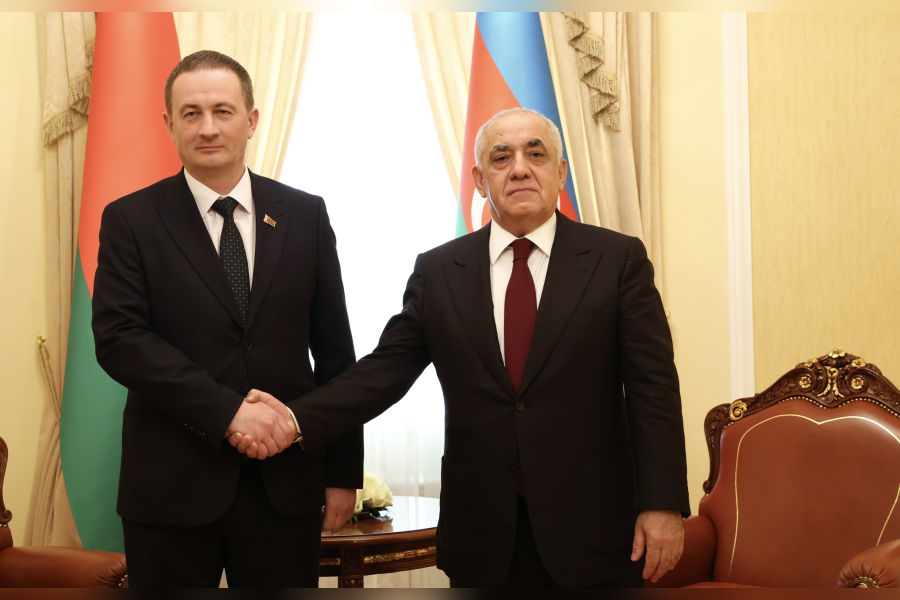
Leaked documents obtained by the Organized Crime and Corruption Reporting Project reveal that Belarus supplied weapons used by Azerbaijan against Armenian forces during the 2020 Artsakh war—despite Armenia and Belarus being allies in the Collective Security Treaty Organization.
Belarusian defense firm Tetraedr signed at least 16 contracts with Azerbaijan, worth more than $13 million, to upgrade air defense systems. An internal report confirmed that the systems were “actively used” during the conflict to destroy Armenian drones.
Many of the deals were routed through a British Virgin Islands-registered intermediary, N.P.O. Navigation Systems, linked to two Azerbaijani businessmen in the Pandora Papers. Experts said the secrecy raises corruption risks. Armenia’s Defense Ministry declined to comment and Azerbaijan did not respond.
Iran
Iran considers the “3+3” format an effective way to address conflicts in the South Caucasus, said Foreign Ministry spokesperson Esmail Baghaei, stressing the need for regional platforms to reduce external interference.
“Countries of the South Caucasus must reinforce regional mechanisms to prevent extra-regional interventions. Iran is actively working in this direction,” he said.
Baghaei called the initiative “historic,” noting that it brings together Armenia, Azerbaijan and Georgia—though Georgia has yet to participate—along with Russia, Turkey and Iran. He stated that several rounds of talks have already been held, beginning in Tehran.
“This format has proven to be an effective regional platform, particularly in facilitating dialogue between Armenia and Azerbaijan,” he added.
Iranian President Masoud Pezeshkian also reaffirmed his support in a recent call with Russian President Vladimir Putin, saying that the format could offer a more efficient framework for resolving challenges in the region.
Russia
Azerbaijani President Ilham Aliyev’s description of the war in Ukraine as a “Russian invasion” has drawn sharp criticism from Russian State Duma deputy Konstantin Zatulin, who called the remark “a direct attack on Russia.”
Speaking to Lenta.ru, Zatulin said, “From the beginning, Baku held a position different from ours—at times even hostile. The fact that Aliyev used the term ‘invasion’ means we must stop deceiving ourselves and viewing Azerbaijan as a partner. That was a mistake.”
Zatulin noted that while Azerbaijan has long supported Ukraine’s territorial integrity, it had previously been less vocal. He suggested that Aliyev now feels less reliant on Moscow due to growing ties with the U.S. “He no longer needs a mediator in the form of Russia,” Zatulin said.
Aliyev recently reaffirmed Azerbaijan’s support for Ukraine’s sovereignty and again referred to the war as a “Russian invasion.”