


ArtCulture

An underwater village and silenced pain in Senia Baloyan’s art

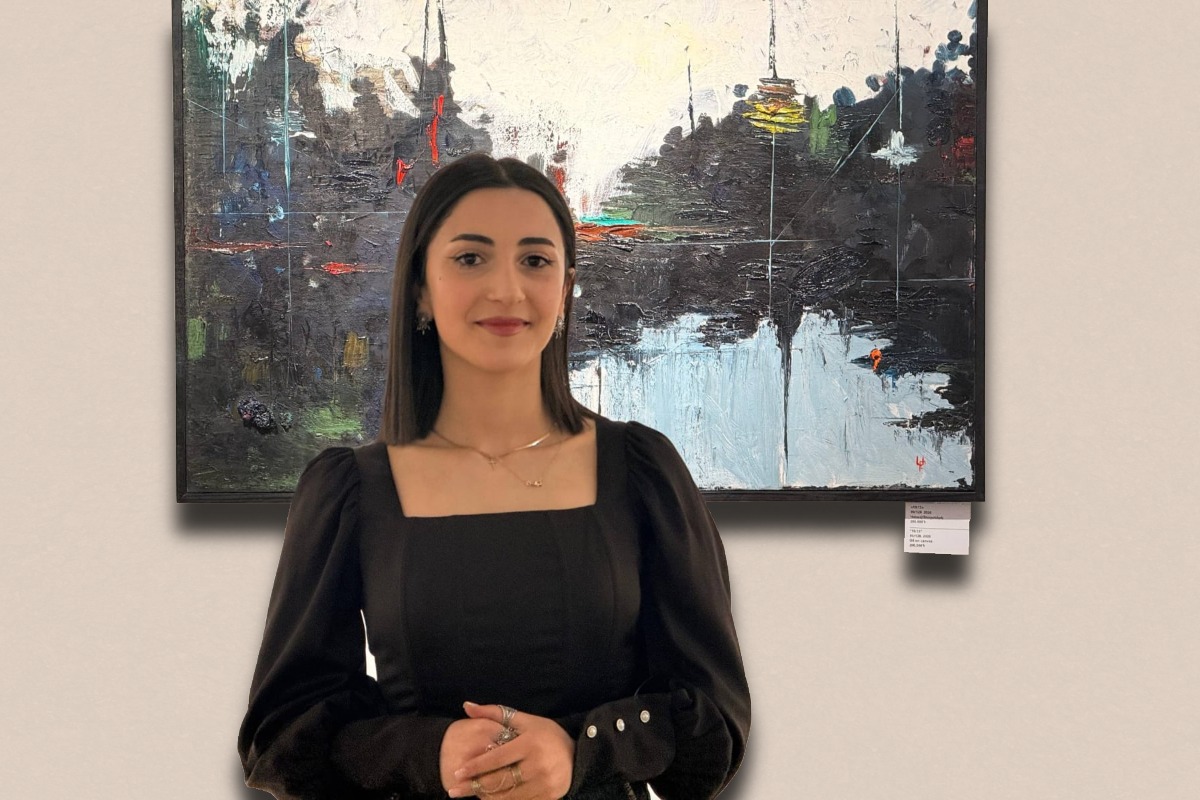
The story of artist Senia Baloyan involves the border, a childhood home gone underwater, parental love, and silent tragedies voiced through canvases.

Baloyan’s roots are in the village of Shirakavan in Shirak Province, which borders Turkey and lies adjacent to Gyumri. Here, the past and the present collide along the Akhuryan River. Baloyan grew up in that borderland environment, listening to her father’s stories about his old childhood village, where her ancestors once lived almost side-by-side with the Turks, until it went underwater due to the expansion of the Akhuryan Reservoir.

Becoming an Artist

Baloyan entered the world of painting under her father’s guidance. Her father had an artist friend and admired the work of that friend’s son. Those artistic influences inspired him to take her to painting classes at age 17. Today marks only the fourth year of her creative journey. As she admits, the choice might not have been conscious at first, but was rather filled with great love for her father and a warm desire to please him, to do something for him through art.

She took her first professional steps under the guidance of artist and mentor Samvel Galstyan. She then continued her education at the Gyumri Branch of the State Academy of Fine Arts of Armenia.

Baloyan’s artwork.

Her primary medium is oil on canvas, though she also sketches on paper. Although she loves watercolor, she says she has not attempted to master it. Baloyan’s works are born while walking in the city, watching people, or from intense emotions relating to her native village. For this reason, she often titles her works “Impression” — as they are reflections of lived emotions.

Baloyan does not have a separate studio; her studio is her room. She paints in one corner and sleeps in another. After the chaos of the city, this is her place of tranquility, where thoughts are expressed freely.

In addition to studies (etudes), Baloyan dedicates a significant place to character-driven works. She studies human psychology at length, and when someone interests her deeply, they become the subject of her work. Her father has been a frequent model; she knows his facial features by heart. Recently, she created a conceptual series titled “Mama” (Mother), which expresses a mother’s memories, experiences and the generational gap in mindset.

From Vanished Homeland to Violence and Silenced Pain

The painting “15 Past 19” holds a special place in Baloyan’s art. It was born from an immediate impression when, at a specific hour every morning and evening at the border, she heard Turkish music (mugham) while having the ruins of Ani before her eyes. Only after creating the painting did she comprehend her work even more deeply: her father’s ancestral home lies beneath the Akhuryan Reservoir, and beyond the border are their lost territories.

Baloyan’s artwork.

Baloyan’s art is also a form of social protest. She addresses themes that are widely discussed yet simultaneously silenced in society, particularly violence against women. The catalyst for addressing this theme was an exhibition showcasing the garments of abused women and children, which left an oppressive impact on her.

Her father’s ancestral home lies beneath the Akhuryan Reservoir, and beyond the border are their lost territories.

The three large and three small works of her “Mama” series, as well as her installations, address the role of women, their silence and its consequences. The artist does not depict violence literally or graphically. For one painting, she spoke with a victim of violence and depicted the person’s memories through black and white abstract forms, while her own perspective came in the colors on top. Each symbol — whether in the form of a fish or a woman’s body shaped like a fish — is connected to those memories. “Violence is not an action taking place in the present moment; violence resides in upbringing,” she said with apparent grief.

Baloyan’s artworks.

A Debut Exhibition and Future Plans

Baloyan’s artwork.

Speaking about her faith, Baloyan says she grew up in a Christian family, but approached the Bible and faith more consciously as she grew older. In her work, faith appears not as religious dogma, but as a phenomenon — a faith that through her art, she can change something in society.

The result of this faith and dedication was her first solo exhibition, titled “Antes” (Unseen). It was organized at the Pyunik Development Center at 3/1 Buzand Street, where Baloyan’s 25 works were exhibited from April 12 to 19. Now, the artist is preparing for a new presentation. A three-person exhibition is currently underway in Gyumri, which she also considers a personal creative report. She will present herself to her hometown not only with paintings but also with installations and works created using the photographic cyanotype technique. Her strictest and most decisive critic remains her father, based on whose constructive remarks she always tries to improve her work.

Baloyan’s work transforms personal memory, societal pain and loss into color and symbol. Her canvases compel the viewer to look at history submerged underwater, listen to the silenced voices of women and consider that art still holds the power to change something in the world.

Senia Baloyan shares her art on her Instagram.

Anzhela Sedrakyan

Anzhela Sedrakyan is a journalist and master’s student in journalism at Khachatur Abovian Armenian State Pedagogical University. She writes on cultural, social and political topics, combining research and analytical approaches. Alongside her studies, she continuously deepens her professional knowledge and participates in trainings to further develop her skills in the field of journalism.

Leave a Reply

Your email address will not be published. Required fields are marked *


Back to top button