




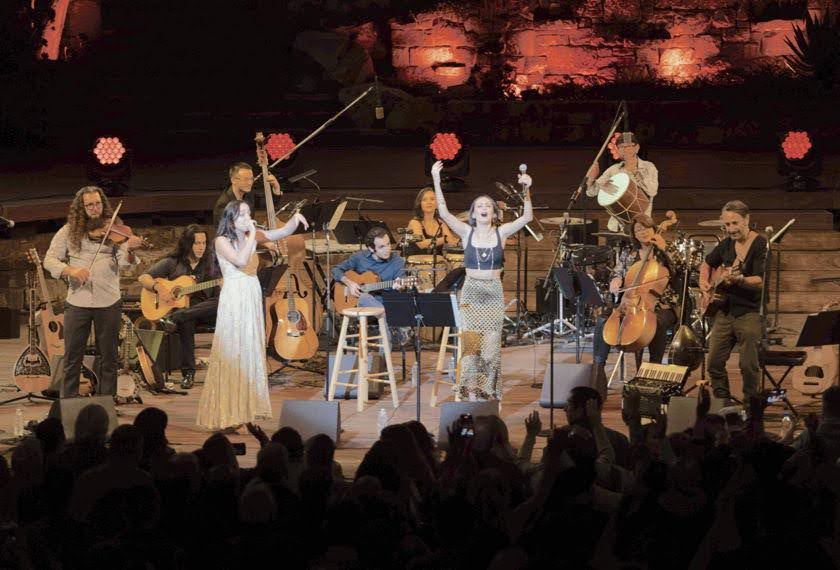
Founded by Ara Dabandjian in 2005, Element Band began as a world music ensemble with a mission to popularize traditional songs. Under Dabandjian’s direction, the band reimagines traditional Armenian music for today’s audiences, balancing nostalgic melodies with contemporary instrumentation. 20 years on, Element Band remains a mainstay of the Armenian community, performing regularly throughout the Los Angeles area.
The ensemble features the arrangements and instrumentations of Ara Dabandjian, singers Soseh Aramouni and Natalie Avunjian, violinist Shant Mahserejian, guitarist Aragas Abramian, cellist Mahsa Ghassemi, pianist Jonathan Sindelman, bassist Eric Klerks and percussionists Emilia Borja and Noriko Terada.
We caught up with Dabandjian ahead of the band’s 20th Anniversary Celebration to talk about composing versus arranging, making music for contemporary ears and the leap of faith that led to Element Band’s creation.
This interview has been edited for length and clarity.

Rosie Nisanyan (R.N.): How did you get started in music?
Ara Dabandjian (A.D.): I have played music since I was a child. My grandparents played music, but no one did it professionally back in those days, being genocide survivors in Lebanon and whatnot. My dad played the accordion and the mandolin; my maternal grandfather, interestingly enough, also played the accordion and mandolin and my mom sang—so I grew up with music in the house. That is what I wanted to do all my life, but we immigrated to the U.S. during the Lebanese Civil War, and it never came to fruition. Although it was in my heart, I was never able to do music.
I went to college, I owned businesses, this and that, and as I approached 40, I said, “That is it. I am going to be a musician.” So, I left everything—this was about 21 years ago—and ended up forming the band.
R.N.: That is a huge leap! You have to believe in yourself so much to make that transition.
A.D.: Since about 21, I had run several businesses—from a bicycle shop to a fiberglass factory. Some failed, some succeeded. In the end, I was getting frustrated because my calling was music. It was a very difficult decision because it is not easy to make a living in music. To make a living in Armenian music takes it to another level. Obviously, we are not a wedding band, so we do not have gigs every weekend. It was challenging, and the challenge continues, as it does with all of our lives and all of our careers; music is not any different. It was difficult, but I am very happy I made the transition.
R.N.: What inspired you to form Element Band and focus on Armenian folk music?
A.D.: In Lebanon, I grew up with a lot of Armenian music: from ashoughagan (minstrel) music to Komitas. But after moving to the U.S. at age 14, nothing was inspirational and I would get very annoyed. When I owned my business, I would have long drives—one of my factories was about two hours away. So, I would arrange these songs in my head in the car a lot of times and would think, “This should be this way. This should be that way. Oh my God, why are they doing it like this?” Those are the thoughts that kept ringing in my head. That went on for a few years.
My biggest inspiration as a child was HarTar, a ‘70s duo from Beirut comprised of singer Vicken Tarpinian and guitarist Harout Bezdjian. These two were maybe in their early 20s and they transformed familiar songs in ways that made them palatable to our ears. We had not heard things that way, and that was a huge inspiration.
In the U.S., during the ‘90s and early 2000s, no one was interested in our music, and I worried that kids would not listen to any Armenian music at all. When the thought came about how to introduce this music to younger ears, I could relate to my own story when I was young and nothing was appealing to me—the huge orchestras from Soviet Armenia were not appealing to 12-year-old me.
So, that was part of the inspiration. The other part is that I have always aspired to make this music palatable to non-Armenian ears. I believe it is very possible, and I have proven it to a certain point. We do have non-Armenian followers who religiously follow us at every concert. It is a small percentage, but I have always wanted to expand on that because this music does deserve it. We listen to other languages. Everyone listens to Latin music; why can’t they listen to Armenian?
R.N.: I have been hearing more and more in these interviews that we need to stop talking only to ourselves to bring in that wider non-Armenian audience.
A.D.: 100%. 20 years ago, we just served ourselves. And mind you, no one was touching this kind of stuff back then. In the beginning, the musicians I gathered really resisted doing Armenian music. We were doing world music, a bunch of English songs and then throwing a couple of Armenian songs in there. So, it took a while to push that.
R.N.: What is your process for breathing new life into Armenian folk songs?
A.D.: The biggest challenge with any older person is trying to relate to the younger minds, the younger ears, the younger palates. It is very hard for us older folks to relate to their taste. What do they like? What are they going for? For example, when I formed Element Band, I went the route of, “Okay, let us bring in these types of instruments.” Today, it would not work. The kids of today have a different ear. Now again, I do not mean to contradict myself, but organic music, such as the one we perform, will never die. Just like classical music. The audience may dwindle down, but still, people appreciate good music, real music.
And production is very important. It has to sound modern. It has to sound new. It has to sound present. I think instrumentation had a lot to do with it. You cannot just stick a duduk in music and call it Armenian. No offense to the duduk, I obviously love the duduk. But that is what I tried to veer away from—the keyboards, the electronic stuff. People do not give enough credit to kids. They are smarter than we think and their ears are much purer than ours, so they hear everything.
R.N.: What can audiences expect from Element Band’s 20th anniversary concert?
A.D.: Consistency. You can rely on us to give you what Element Band is. You can always bet that you will see a million instruments on the stage! And I always bring in a new one—there will be a new one this year, maybe two.
At the same time, surprises! I know that we play a lot of slow songs. We love the really, truly beautiful Ashoughagan songs. But we also know that people come to party, especially at The Ford Amphitheater, where you can bring your picnic basket and bottle of wine and it is open air. So, I have added some more upbeat songs to the repertoire and a couple of surprises.

R.N.: What have been some of the most memorable performances with Element Band?
A.D.: We did a Dubai and Lebanon trip. That was special for me, especially Lebanon, because I performed in my hometown. We performed in Armenia. I was there for the first time—this was a few years back—on my birthday. Performing in Armenia and getting a standing ovation from local Armenians was really, really important to me. The other one would be the Skirball Cultural Center, which is a Jewish institution here in Los Angeles. We were invited by them back in 2007/8. That was another highlight because it was mostly odars (non-Armenians), so that was inspirational. And then, one of my dreams was to play at the Hollywood Bowl—and we did!
R.N.: How do you approach composing versus making music with Element Band?
A.D.: It is interesting because I am more of a composer than anything else behind the scenes. I have done a number of documentaries and composed for the theater a lot. I have worked with Tim Robbins several times, touring China with him and The Actors’ Gang, which is a theater company here in Culver City, California.
I have also composed for other theater companies. One that stands out was one by Alex Dinelaris Jr., who wrote the Academy Award-winning Birdman. His maternal grandmother was Armenian and he wrote a story about her, which was turned into a play. They actually performed it here, in LA, and I composed the music for that, as well. I have done a few films here and there, too.
I do not think [composing] is any different; each project requires a different approach. On the one hand, composing is a similar approach. On the other hand, it is totally different. It is very much visual for me, which is why I work great with theater. I love the spontaneity of composing, as I see things changing.
As far as Element Band is concerned, you heard me say a little while ago that I arranged a lot of this music in the car. So, it all depends on the inspiration and the moment. I could hear a piece of music and, with a snap of the finger, go, “Oh, this applies great to one of these pieces in Element Band. We should do it this way.” I think that applies to all forms of art. You get inspired by the most wonderful things and then the weirdest things. I do not set any rules for that.
R.N.: Any advice for aspiring Armenian musicians?
A.D.: We are brainwashed and programmed in a way where we think we have to impress non-Armenians to be successful. At least, that is what I see. I would encourage young musicians to stick to Armenian music and make a career out of Armenian music. That is what Armenian music and our culture need.
R.N.: How can people support your music? What can we expect next?
A.D.: Follow us on social media, listen to us on Spotify, become members, subscribe to us. Every little bit helps because it is a numbers game. We would love to be in your playlist and whatnot. What is coming up is a new album that I have been working on slowly, and I hope to release it next year. No tours are set up yet, but we will see what the new album does.
Tickets are available for Element Band’s 20th Anniversary Celebration on August 24 at The FORD in Hollywood. You can stream Element Band’s music on Spotify and buy merchandise on their website. Follow them on Instagram and Facebook to learn about upcoming events and releases.
All photos are courtesy of Element Band.

Congradulations. Thank you for making our songs alive again with such a talent and love.