


A 15-year walk across a 35-year Republic
Fifteen years ago today, on the 20th anniversary of Armenia’s re-independence, I sat down as a young man fresh out of university and penned an earnest reflection, accompanied by a headshot of me sporting a look of naivety and a full head of hair (both long gone). I was in Yerevan volunteering through Birthright Armenia at a newly founded think tank, swept up in that intoxicating blend of pride and discovery that so often embraces diasporans when they first spend an extended season living in the homeland. That night in 2011, I stood among tens of thousands of people filling Republic Square, watching fireworks explode into the midnight sky. I wrote then that the sounds of explosions had shifted from the terrifying echoes of a war from years earlier to bursts of joy and national pride. With the characteristic certainty of youth, I concluded that after two decades of post-Soviet hardship, our young republic was finally stepping onto an inevitable path toward democracy, stability and enduring statehood.
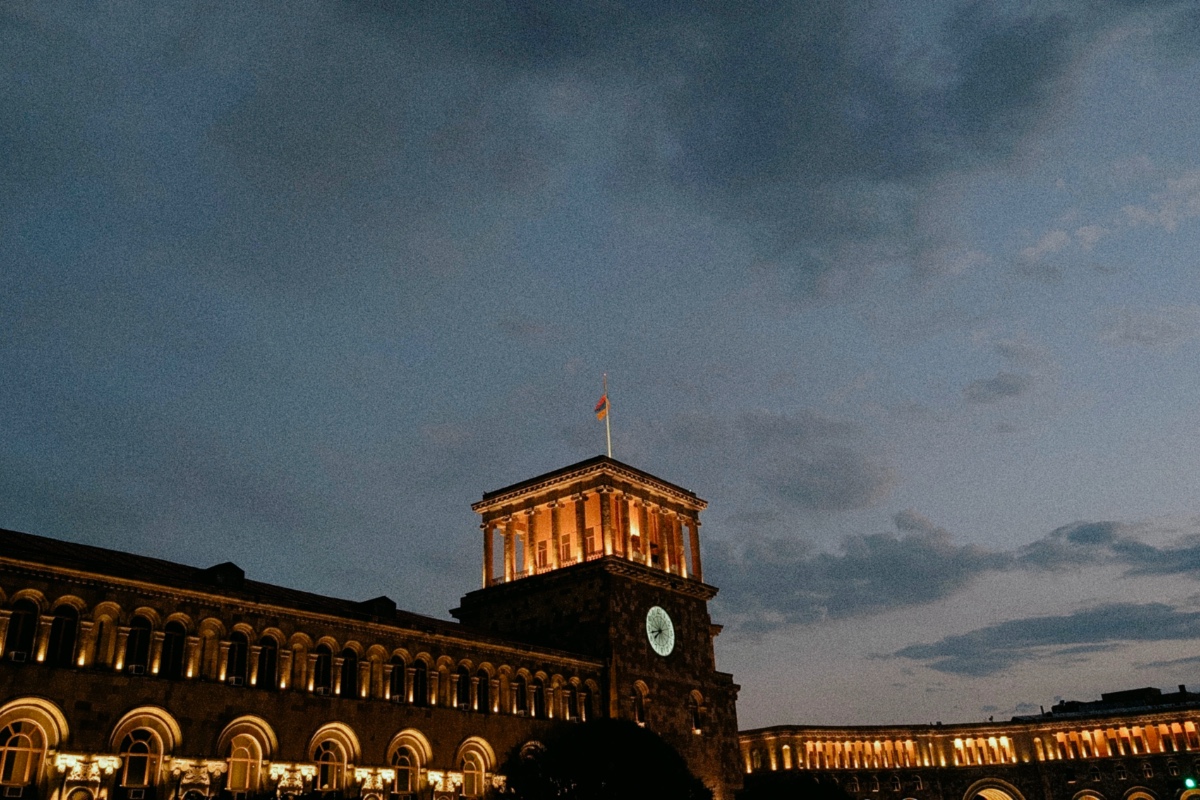
Today, on the 35th anniversary of that same republic, I find myself sitting by my window just a few short streets away from that very square, listening to the muffled, repetitive thud of sound checks for tonight’s concert. The stage lights are sweeping across the facades of pinkish tuff, and within hours, the square will fill with music and celebration once again. Yet looking out at the city that has become my home for the past six years, the optimism of that 20-something volunteer feels like it belongs to another lifetime.
It is tempting to look back at those earlier words with a forgiving smile, dismissing them as the innocent musings of someone who had not yet seen history show its teeth. Of course, now I know that real reflection requires a colder, more sober, more uncomfortable honesty. That innocence was not mine alone, nor was it entirely accidental; it was part of a comfortable, collective atmosphere we all chose to inhabit. In writing so confidently about the end of war and the permanence of our triumph, wasn’t I giving voice to an unwritten consensus that an entire generation had unspokenly agreed upon? If we search our memories honestly, weren’t there unsaid, persistent doubts that we actively chose to brush aside? Those brief moments when we wondered if the post-1994 reality was truly sustainable, if time was actually on our side, or if our adversaries were methodically preparing for a reckoning while we treated a fragile ceasefire as a permanent verdict of history? We told those pesky internal voices to shut up. Confronting them would have forced us to face our own vulnerabilities, our institutional stagnation, and the terrifying possibility that our hard-won victory was gradually decaying into an existential trap. We preferred the warmth of the status quo, of perceived certainty, and in doing so, we allowed our collective vigilance to deteriorate.
I’ve said it before, and I’d be remiss not to say it again: Living here strips away almost every romantic idea about Armenia. It does not resolve one’s relationship with the Armenian condition; if anything, it makes that relationship far more demanding, intimate and unsettled.
And so, I ask myself: How do we celebrate 35 years of independence against the backdrop of catastrophic, generational loss? The booming bass of tonight’s concert rehearsals feels profoundly disorienting when held up against the silence of Artsakh — an indigenous cradle of our civilization for millennia. It was during these very days, exactly three years ago, on the eve of this very anniversary, that the final, devastating blow was struck. In a matter of days, after months of agonizing starvation, Artsakh was forcibly emptied of its entire Armenian population while the world watched on with sterile diplomatic statements. Over 100,000 of our people now walk among us as displaced in their own land, carrying the crushing grief of lost homes, abandoned ancestral graves and churches left to be vandalized or systematically rebranded by state-sponsored falsification. Meanwhile, Armenian soldiers, civilians and political leaders remain locked in Baku’s prisons, their ongoing torment treated as an inconvenient speed bump on the road toward signing hollow, one-sided diplomatic treaties.

Yet what is perhaps most disorienting is not the hostility of our neighbors, but the profound intellectual and moral fatigue that has settled here domestically. Fifteen years ago, I celebrated the idea of a society striving toward democracy despite the difficulties. To be fair to my younger self, I was not completely blind then; I voiced some criticism (perhaps far too gently, or not critically enough) of the ruling regime of that era, lamenting an oligarchic order where hyper-privatization enriched only a select few while deepening the public’s disenchantment. Yet even with those critiques, I still clung to the conviction that democracy was the self-evident antidote, the promised horizon toward which we were slowly, but surely, inching.
To walk through Yerevan today is to see undeniable signs of modernization: public spaces reclaimed as illegal structures and garish billboards are systematically dismantled; routine, petty corruption is nearly eradicated; digital e-governance is streamlined; and a thriving, innovative tech economy has lent the city a bright, cosmopolitan confidence. But beneath the pristine banner of democratic branding and westward-facing slogans, that promise feels profoundly warped, and our civic landscape increasingly fragile. We watch pretrial detention normalized as an everyday instrument to neutralize political rivals. We see an aggressive, unprecedented campaign aimed at discrediting historical pillars, most visibly Armenian national symbols and the Armenian Apostolic Church, as the state attempts to intrude upon ecclesiastical boundaries and demands unconditional conformity from a public that is already emotionally exhausted.
Even that new cosmopolitan glow comes with an unsettling cost: Yerevan, in its haste to look outward, often no longer feels like Yerevan at all. It is steadily shedding its distinct Armenian character — that unmistakable, lived-in warmth and collective memory that once defined its sidewalks — in favor of a sanitized modernity that could belong to almost any gentrifying hub in Europe. And this is not the grievance of an old-timer clinging to the past; it comes from someone whose relationship with this city dates back only to 2000. Yet even across those two and a half decades, the shift is palpable: A city that once drew its magnetic pull from being the raw, beating heart of a global nation now feels eager to sand down its own edges, as if its particular heritage were something awkward that needed to be smoothed away for international consumption.
A city that once drew its magnetic pull from being the raw, beating heart of a global nation now feels eager to sand down its own edges, as if its particular heritage were something awkward that needed to be smoothed away for international consumption.
Underneath these political maneuvers lies an even more troubling philosophical shift: an attempt to condition our society into accepting historical amnesia as the price of survival. The authorities increasingly promote an artificial contradiction between the “real Armenia” and the “historical Armenia,” suggesting that our shared memory, our cultural heritage and our collective consciousness are dangerous impediments to statehood. We watch Mount Ararat removed from official border stamps, hear talk of rewriting the constitution to strip away foundational references to our declaration of independence, and listen to proclamations of a “Fourth Republic” meant to sever us from the very statehood declared in 1991. What, then, are we celebrating tonight in Republic Square? How can we commemorate 35 years of an independent republic while the ruling philosophy treats the inception of that very republic as an error that must now be expunged? True sovereignty cannot be built on erasing identity, and a state that demands its citizens forget who they are in exchange for stability is not building peace, but managing its own retreat.
At the same time, looking toward the political opposition offers no clarity or reassurance. Trapped in personal rivalries, outdated rhetoric and an inability to present a credible, ethical alternative for the nation, the opposition remains largely adrift. It offers neither the vision nor the institutional trust required to heal a fractured society, leaving the public caught between an administration eager to dismantle historical continuity and an opposition unable to step into today’s reality. In the middle sits a population weary of both, retreating into routine from sheer exhaustion and disillusionment.
How can we commemorate 35 years of an independent republic while the ruling philosophy treats the inception of that very republic as an error that must now be expunged? True sovereignty cannot be built on erasing identity, and a state that demands its citizens forget who they are in exchange for stability is not building peace, but managing its own retreat.
This domestic crisis is intimately tied to a broader, global rupture. For more than three decades, the diaspora oriented almost all of its resources, imagination and institutional energy around Armenia. In making the newly independent state the singular focal point of our national identity, did we inadvertently neglect our own communal health? Did we allow our diaspora schools, cultural foundations and independent intellectual spaces to erode under the assumption that a sovereign state would automatically secure our cultural survival?
Now, finding ourselves on the losing end of recent history, the disconnect between Armenia and the Armenian diaspora feels deeper and more fraught than ever. That divide is worsened when state officials adopt a patronizing, transactional view of our communities, casually declaring that the diaspora is destined for annihilation — that “undoubtedly the Armenian diasporas will go extinct” — unless it packs up and moves to Yerevan. To frame the relationship between the state and the diaspora as a zero-sum competition, arguing that one cannot be strong if the other thrives, reveals a staggering lack of historical imagination. It reduces a global, multilayered civilization into a mere demographic reservoir. The diaspora is not a temporary anomaly waiting to vanish, nor is it a subordinate cheering section for the government of the day; it is an enduring pillar of Armenian existence, one that has carried our literature, our institutions and our political consciousness across generations.
On Sept. 20, my own community in Toronto took to the streets in a jubilant parade, marching from its home base since the late 1970s to officially inaugurate a new (third) centre—the Nareg Armenian Educational and Cultural Centre. It was a massive, historic investment in our community’s future — a state-of-the-art expansion with dozens of new classrooms, labs and gathering spaces designed to house generations of students and community life. Yet here lies the haunting question that tears at me every day: How connected are these two worlds today? How can a diaspora community be marching through the streets of North America, dedicating tens of millions of dollars to build vibrant new institutional homes for our language and heritage, while the political leadership here in Yerevan dismisses those very communities as doomed relics waiting for extinction? How do we reconcile that enormous investment in the Armenian future thousands of miles away with the retreat, self-censorship and historical erasure unfolding right here beneath my window? We exist in parallel realities, speaking past each other, bound by blood and history, yes, yet fundamentally alienated in our immediate sense of purpose.
These questions do not leave me as I look out my living room. How did we reach a point where statecraft is defined by what we are willing to concede? How did the hopeful republic of my youth evolve into a system that lectures its citizens on the necessity of diminishing themselves, while alienating the global nation that stands ready to support and uphold it?
How did we reach a point where statecraft is defined by what we are willing to concede?
The afternoon is slipping into dusk, and the crowds are steadily making their way down the street toward Republic Square. From my window, I can see young families walking hand in hand, children holding small tricolor flags, and groups of teenagers laughing as they move toward the stage. The evening air carries that familiar late-September coolness; the music will begin shortly, the tuff stone will glow with fancy, high-tech 3D projections, and the midnight sky will likely burst with violent, beautiful color once again. But I can no longer look down at that spectacle with the unburdened, uncritical gaze of 2011.
Thirty-five years into our independence, we are navigating a profound, agonizing crisis of purpose. We are being tested on whether we dare to demand a peace rooted in genuine dignity rather than anxious submission, and whether we can love this country without severing it from within. Living in Armenia today means living with these unresolved, often painful realities every hour. It means accepting that true patriotism does not belong to the curated fanfare on the stage, nor does it reside in the rehearsed soundbites of leaders who ask us to trade our memory for stability. It lives, instead, in the unwavering resolve to tell the truth about where we are, what we have lost, and what it truly takes to move forward with dignity and to endure.
Even amid this heavy reckoning, I refuse to surrender to despair. Despair is the easy path — it asks nothing of us except our withdrawal into cynicism. But the hope we need today is not the cheap, naive optimism of my youth that assumed progress was automatic and triumph was permanent. It is a much harder, battle-tested hope. It is a hope born of defiance, grounded in the undeniable spirit of a people who have outlasted every empire, every catastrophe and every historical script written for their demise.
Even amid this heavy reckoning, I refuse to surrender to despair. Despair is the easy path — it asks nothing of us except our withdrawal into cynicism.
That hope is tangible. I see it when a displaced family from Artsakh, stripped of everything except their dignity, starts a new business outside of Yerevan, choosing to build anew rather than break. I see it when a teacher in a border village enters a classroom each morning with unyielding dedication, and when young entrepreneurs and scholars stay here, working relentlessly to anchor this fragile state in modern excellence. And I see it across oceans, in moments like the Sept. 20 inauguration in Toronto, where an entire community poured its soul and its resources into a new community hub, proving that thousands of miles away, our language, heritage, and love for Armenia are not fading into extinction, but building new sanctuaries to educate the next generation.
We are a nation that spans the globe, and that has continually refused the fate assigned to it. Our survival has never been clean or easy; it has always been exhausting and across generations. The leaders who govern Armenia today — and the opposition figures who vie to replace them — are temporary stewards who will inevitably pass into history. What remains is the land itself, the culture that breathes life into it and the shared covenant between our people here and across the diaspora.
In a little while, the fireworks will echo between the stone facades of the square, and my dog, Srjeni, will withdraw to our bathroom floor out of fear. But we will watch the sky light up, not as an illusion of victory, but as a witness to our continued breath. Armenia is our home — wounded, imperfect, heartbreaking and beautiful. Independence at 35 is not a completed triumph, but an ongoing struggle to defend our country’s right to exist on our own terms. And our greatest act of loyalty to this land is not to avert our eyes from its pain, but to stay, to speak and to love it enough to believe that its story is still ours to write.