



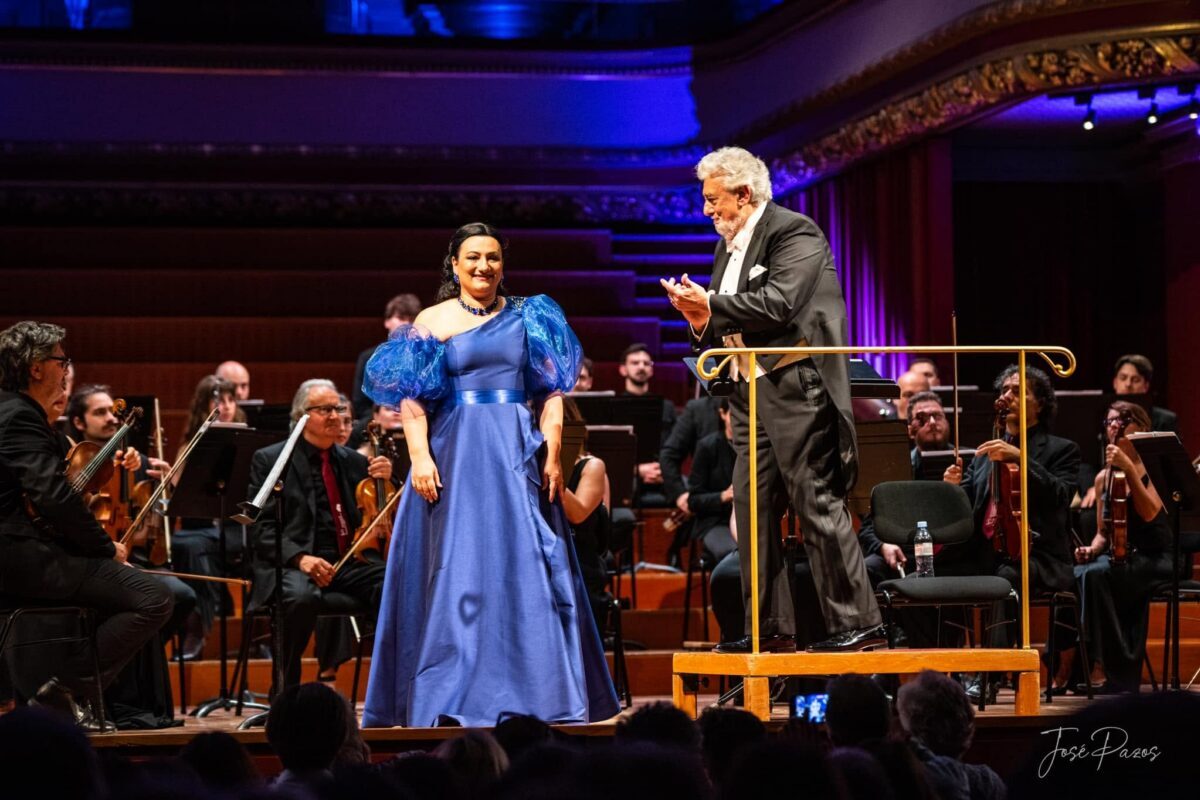
When Varduhi Khachatryan was 6, she would wait for her father at the Armenian National Opera and Ballet Theatre after performances of “Arshak II.” As the audience filed out, the lights in the auditorium gradually dimmed and the last traces of conversation faded. Khachatryan loved watching the theater transform after the curtain fell.
Decades later, she returned to that same stage, making her debut as Queen Parantzem in “Arshak II,” the same opera she had watched her father perform when she was a child. From there, her career took her to stages across Europe, where she has worked with some of the best-known musicians.
Today, Khachatryan lives in Switzerland, where she heads the Avetis Association and the Geneva Festival. Her career has brought her into contact with artists including Plácido Domingo and Andrea Bocelli. Alongside her work as a singer, she has spent much of the past two decades pursuing another goal: bringing Armenian music into Europe’s established classical music scene.
Behind the scenes and among Armenia’s intellectuals
Music was part of Khachatryan’s life from the beginning. Her father, Albert Khachatryan, was a soloist at the Armenian National Opera and Ballet Theater. He was particularly known for his portrayal of Vasak Mamikonyan in Tigran Chukhajian’s opera “Arshak II.”
“My father would take me to the opera and leave me in the auditorium while he went to costume and makeup. I would wait until the performance began. Little by little, the hall lights would dim, the musicians would take their places in the pit and begin tuning their instruments. I loved watching that process. Afterward, I would sit and watch the hall empty and the lights go dark. I saw the entire spectacle in reverse,” the singer recalled.

The artistic world extended beyond the theater. Their home was a gathering place for prominent figures in Armenia’s cultural and intellectual life, including singer Gohar Gasparyan, tenor Tigran Levonyan, art critic and cultural figure Henrik Igityan and Khachatryan’s uncle, painter Rudolf Khachatryan. “There were fascinating conversations and debates about art. I was too young to join in, but that atmosphere left a lasting impression on me and shaped how I saw the world,” she said.
A student at 14
Khachatryan’s formal musical education began early. After completing vocal studies at a preparatory music school, she was admitted to the vocal department of the Romanos Melikyan Music College at 14 by special permission. At the time, the college generally admitted students beginning at 18 because of the importance of vocal maturity.
As a first-year student, she started appearing in concert programs usually reserved for graduating students. Her principal teacher was Vladimir Khachatryan. “He laid the foundation for my entire vocal technique. To this day, I still rely on what he taught me,” she said.
She went on to graduate from the Yerevan Komitas State Conservatory and pursue postgraduate studies under professor Gohar Gasparyan. At 23, she made her debut at the Yerevan Opera Theater as Queen Parantzem in “Arshak II.” She was now standing on the same stage where, as a child, she had watched her father perform the opera.
Bringing Armenian music into the European classical tradition
Khachatryan has lived and worked in Geneva for two decades. Soon after moving to Switzerland, she noticed a recurring pattern in how Armenian cultural events were presented abroad: They were often attended primarily by members of the Armenian diaspora.
She wanted to reach a broader audience, which led her to establish the Avetis Association in Geneva and begin working with Victoria Hall, one of the city’s concert venues, to organize annual cultural programs. The challenge, she said, was to make Armenian music part of the musical experience European audiences were already seeking.
“European audiences don’t typically attend standalone Armenian events; they go to hear European classical repertoire. We take that reality into account,” she said.
Rather than organizing separate Armenian concerts, Avetis incorporates Armenian works and stories into programs built around familiar European classical repertoire. A Vivaldi program, for instance, might include selections from his opera “Il Tigrane,” alongside historical material about the composer’s connections with Armenian Mekhitarist monks on the island of San Lazzaro in Venice. Ancient coins and historical maps become part of the presentation, providing audiences with historical context for the Armenian connection.
Over the years, the association has also provided Swiss stages for Armenian performers. For Khachatryan, the goal is to place Armenian music within the broader European classical tradition, where it can be encountered by audiences who might not otherwise seek it out.
Sharing the stage with Plácido Domingo
One of the defining chapters of Khachatryan’s career has been her recurring collaboration with Plácido Domingo. The two have performed together across Europe since 2023. She remembers their first joint appearance in Geneva especially vividly. They were preparing to perform a duet from Giuseppe Verdi’s “Il trovatore.”
“Right before we walked out, Domingo turned to me and asked, ‘What are we singing now?’ I answered, ‘My dream is coming true right now — we’re singing the Verdi duet together.’”
There was an unexpected moment during the performance. Domingo made a minor mistake on his entrance, briefly disrupting the tempo. The two singers recovered quickly, and the audience appeared to notice little, responding to the finale with thunderous applause. Domingo himself was less willing to let the mistake pass.
“He came up to me and said, ‘I didn’t fulfill your dream completely; I made a mistake.’ I replied, ‘It’s nothing, Maestro, everything was fine.’ But he turned to the conductor and announced they would repeat the piece. The audience assumed it was an encore. The second time, everything went flawlessly. Afterward, he told me, ‘Now my conscience is clear; I couldn’t leave your dream flawed.’”
For Khachatryan, the moment revealed something beyond Domingo’s technical standards as an artist: his generosity toward a fellow performer and the seriousness with which he approached the experience they were sharing onstage.
From Charles Aznavour to cinema
Khachatryan’s years in Switzerland also brought her into contact with another major figure in Armenian cultural life: Charles Aznavour. During Aznavour’s tenure as Armenia’s ambassador to Switzerland, he supported several initiatives organized by Avetis. Khachatryan remembered him as warm, approachable and notably humble.
Her work has also occasionally extended beyond the concert hall. After a production of Bellini’s “Norma” at the Yerevan Opera, director Boris Hayrapetyan adapted the opera into a feature film. Khachatryan played Adalgisa. It remains her only film role, but she remembers the experience fondly and says she remains open to returning to cinema in the future.
Through the Avetis Association and the Geneva Festival, her work continues offstage: weaving Armenian compositions into mainstream European programs and securing a permanent place for Armenian artists on Switzerland’s premier stages.
Follow the Avetis Association at https://www.avetis.ch/ and the Geneva Festival at https://geneva-festival.ch/index.htm.

I love that Domingo asked “What are we singing now?” right before walking out — and then insisted on repeating the piece because he couldn’t leave her dream flawed. That says more about him than any review could.