Şahan Arzruni is an accomplished pianist, composer, and teacher based in New York City. Born in Istanbul, he came to the U.S. in 1964 to attend Juilliard.
His illustrious career has included performances at the Metropolitan Museum of Art, the Library of Congress and the White House; appearances on the The Tonight Show and numerous PBS specials; a long-running performance alongside comedian Victor Borge; and a five-year radio program on WNYC.
Arzruni’s passion lies in the music of Armenian composers, from Komitas to Khachaturian and beyond. As a result, much of his work has focused on celebrating and sharing Armenian music with the world.
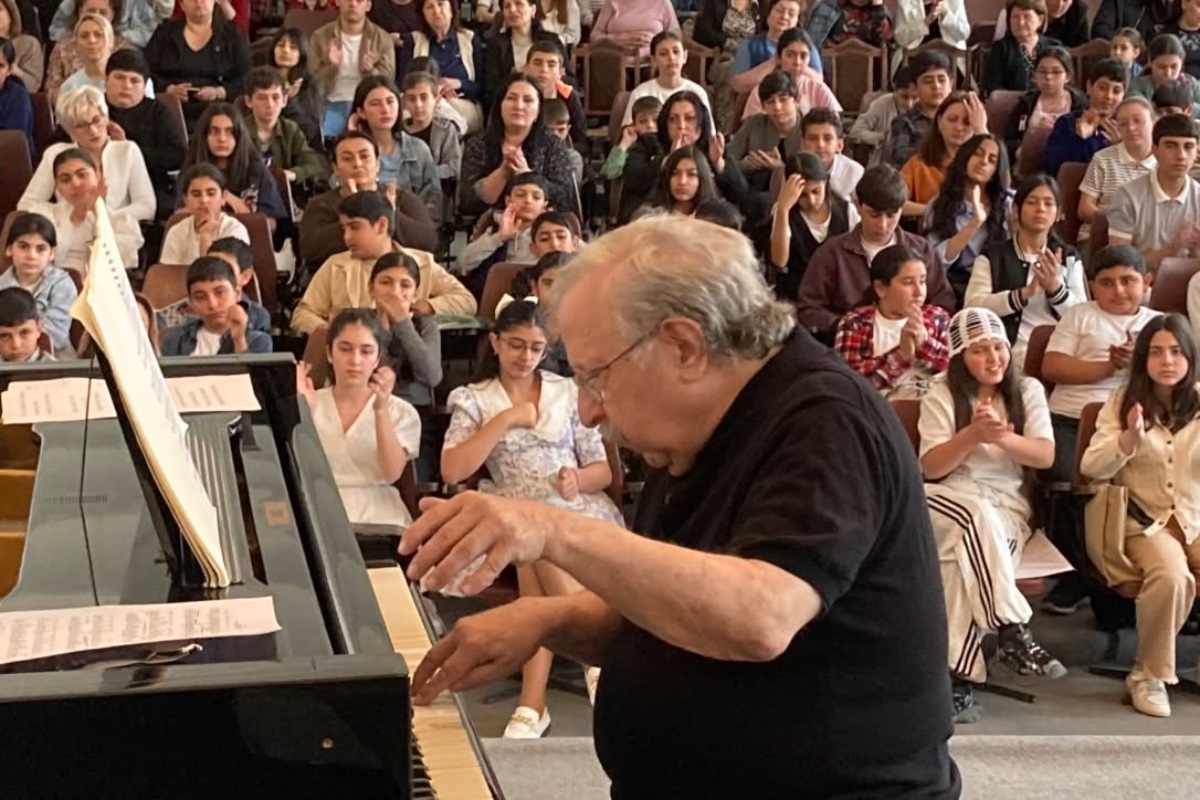
We caught up with Arzruni to talk about the history of Armenian music, what it’s like to play in front of an audience and his album of music by Armenian women composers. We also had the pleasure of seeing him perform Arno Babajanian’s “Elegy” live.
This interview has been edited for length and clarity.

Rosie Nisanyan (R.N.): What kind of preparation do you do before performing a piece for the first time?
Şahan Arzruni (Ş.A.): I practice very little because my finger muscles have a terrific memory. They remember. Something that I played two months ago, I can sit down and play for you almost perfectly now and I can play it at a concert in one or two days. That’s a big advantage. So I don’t sit in front of the piano and spend four or five hours playing. There are weeks I don’t touch the piano. And then when I get back, it’s there. That is my general approach at home toward the piano.
At this point, I kind of know what appeals to me. And what appeals to me are works written by Armenian composers. I hardly ever perform Beethoven, Mozart, Chopin, or anything like that. Because there are other pianists who do all that stuff as well as I would ever do. But nobody’s going to play Armenian pieces. My whole point is to disseminate Armenian music to the world. So at most, I would play half-western, half-Armenian in a program, otherwise, I will do all Armenian.
Or now, I will put together a program of Armenian women composers and I will play all of that. It’s fascinating, nobody has ever done anything like that. But my repertoire of Armenian composers is absolutely huge, so I can play most anything.
“I practice very little because my finger muscles have a terrific memory. They remember.”
There are basic things like Komitas’s “Seven Dances for Piano” — if you don’t play those, then you have no business playing other piano works by Armenian composers. Komitas is the root of everything.
I’m 83, so there are very few things that I am interested in learning. What I have is good enough for me. I have 40 recordings and, if I live long enough, the last eight recordings together will be an outline of Armenian piano music.
R.N.: Tell me more about these final eight recordings. What are you planning to include?
Ş.A.: The first of the eight was the complete works of Komitas. The second one was devoted to works of Komitas’s contemporaries, whom nobody knows about.

The third one was devoted completely to Alan Hovhaness. Before he passed away, he had given me a bunch of music that he had written, but had never been performed. And he said, “Is there a chance you could do that?”
And with the fourth one, what I wanted to do was to concentrate on diaspora composers. And obviously, you need money for all of that. So for the fourth one, I went to the AGBU and asked if they would finance it. The head of the AGBU, Anita Anserian, said yes but only if I did all women composers.
I was going to do women composers, but for the seventh recording. The order I was planning was going to be diaspora for the fourth, then [Aram] Khachaturian, then major Armenian composers like [Eduard] Mirzoyan, [Alexander] Arutiunyan, [Gazaros] Saryan, [Adam] Khudoyan and Arno Babajanian. Then, I would do the women composers. And the final of the eight would be Armenian masters writing for children. This was my original plan, so I just went out of order.
I suppose it’s like all the arts. When you look at a painting for the first time, you say, “Isn’t this interesting?” But when you spend time with it, you find all kinds of incredible things which you hadn’t seen the first time around. If you see the same painting over and over again exactly the same way, there’s something wrong with you, I’m sorry.
Music is exactly like that. You play the notes the first time — okay, fine. When you play it a second time, if you don’t find something new in it, you’re wasting your time. The Komitas “Dances” I’ve been playing for 50 years and I still find new stuff.
But playing on the stage, it’s a totally different experience. That is a sexual interaction — not actually, but virtually, emotionally. When I go on stage to present a program, I am one partner and the audience usually is the other partner. If I’m not communicating with the audience, then it’s a miserable experience for me. If you want to satisfy the audience and the reaction of the audience satisfies you, then something wonderful is going on. So a stage performance is on a different level.
“Komitas is the root of everything.”
R.N.: Does that mean you will play a different way based on how you’re feeling with the audience?
Ş.A.: Yes, based on how they’re reacting, what they’re doing, and how I’m feeling. I mean, there’s also a certain professionalism, I will do it at a certain level no matter what, but the point is to go above it and that depends on the interaction.
R.N.: That’s one thing I love about live arts, like theater, music, anything like that. You can go see the same show night after night after night and it’s going to be different each time.
Ş.A.: Yes, it’s going to be different. For example, if you play a CD, it’s the same thing over and over again. You know, I worked for about 18 years with Victor Borge and I learned something from him. The audience would do something, like laugh at an inappropriate moment, and Victor Borge would take that and make a whole joke out of it. That’s what I need to do on stage when I’m playing a piece.
R.N.: Your latest album “By Women” features only works by Armenian women composers. What made you choose these specific composers and pieces?
Ş.A.: Did you know that the first woman composer in the world was an Armenian? In the eighth century, there were actually two: Sahakdukht and Khosrovidukht.
Sahakdukht was very famous because she had a unique way of singing liturgical chants. And all the clergy wanted to learn how she did that. She would hide in a cave behind a curtain. She would be on one side and the clergy on the other side of the curtain, and she would teach them like that.
Khosrovidukht — that’s a totally different story. The ending “-dukht” in Armenian means “daughter.” Khosrovidukht’s father was the king. She had a four-year-old brother, Prince Vahan. It was a very dangerous time because the Arabs invaded Armenia and they abducted both of them. Despite his age, Vahan had an incredible intellect. The Arabs recognized this immediately and wanted to take advantage. They converted him from Christianity to Islam, took him to Damascus, and made him the counselor to the Sheikh of Damascus.
In the meantime, they took Khosrovidukht to a town called Amasya and imprisoned her for years in a tower called Ani-Kamakh.
“Did you know that the first woman composer in the world was an Armenian?”
When Vahan turned 18 and was an adult, he said that he wanted to go back to being Christian. And for that, he was beheaded.
When Khosrovidukht heard about this, she was very upset and wrote a poem, “Zarmanali e indz.” Poems at that time were always sung; they had a melody. So that melody, which today is sung once a year in church, is the oldest living music in the world.
R.N.: And that is “Ode to Vahan” on the album?
Ş.A.: Yes. However, the problem is that historically, it’s sung, but I play the piano. So, an Argentine-Armenian composer, Alicia Terzian, converted the whole thing and made it kind of modern sounding for video, and for the actual poetry being read, and me playing the piano.
As far as melody is concerned, that’s the oldest one. But otherwise, there are a lot of Armenian women composers in Armenia and in the diaspora. I knew many of them, and then I have a lot of friends around the world who have made me aware of other artists, like Lusine Hazarabedian.
R.N.: You’ve released several albums of children’s music. Was that decision at all influenced by your aunt Sirvart Kalpakyan Karamanuk’s “Children’s Songs?”
Ş.A.: No, I was always interested in the way major composers would write that would be suitable for young pianists. When I was with Victor Borge, his Broadway producer Lewis Friedman said that he would talk to WNYC — New York City’s municipal radio station — and see if I could have a weekly radio program. I told them that I was interested in disseminating children’s music, which was a novel idea, and they okayed it.
I knew at that point that Khachaturian had written two albums specifically for children. I told myself, “Şahan, you better sit down, learn this thing, and open the whole program with an Armenian piece.”
Two weeks prior to the recording, Khachaturian came to New York. And I said to myself, “This is an extraordinary opportunity. I have to play for him so that he can make any observations that he had about his own piece and the way I was executing it.”
So, he came here to my house. I didn’t have a grand piano at the time, only an upright piano. And he was very upset about this. He said, “How come you don’t have a grand piano?” I said, “I don’t have the money to buy one.” He said, “You know, if you were a good pianist, the government would have given you one.” Of course, he didn’t think the way a capitalist country thinks. Anyway, he spent three hours with me and I think it was a successful performance.
I did the radio show for five years. I think it was extremely important in my advancement as a personality, not only in America, but also all over the world.
“I told myself, ‘Şahan, you better sit down, learn this thing, and open the whole program with an Armenian piece.'”
Later, I got involved with Louise Simone, Alex Manoogian’s daughter, who had become the head of the AGBU. She wanted me to work on the cultural matters of AGBU. Almost every month, we would go to Armenia. At this point, I’ve been to Armenia about 60 to 70 times.
With AGBU, we made recordings called “Positively Armenian.” We had people like Ani Kavafian and Ara Berberian playing Armenian music. And we were going to continue, except that in ’88, there was the earthquake, so Louise turned her attention to helping Armenia.
But in ’89, the Fund for Armenian Relief started to help Armenia also and I got involved with them. Every year in May, I go to Armenia for three or four weeks. We go to nine or ten towns and villages, and meet with students. I would play, they would listen, and then they would play, I would listen and make my commentary.
R.N.: Last year, when the Patriarch of Constantinople visited the U.S., you organized a concert in his honor. How did you develop the program?
Ş.A.: The Primate asked me to do it, so of course, I would do it. I wanted to present a variety of Armenian music. For example, Sami Merdinian, who is a violinist in a quartet; you don’t hear too many Armenian quartets. Or on guitar, João Kouyoumdjian. Again, you don’t often hear Armenian music played on the guitar. So, it was for the sake of variety.
R.N.: You’re going to play Arno Babadjanian’s “Elegy” for us. Why is that piece special to you?
Ş.A.: In Armenia, there is a museum called the Aram Khachaturian House Museum. I was one of the musicians who got very close to the museum and the director, Gohar Harutiunyan. A few years ago, I helped to rebuild the piano, my aunt fixed the roof and this and that, so I have a special connection there.
In the ’30s, Khachaturian was studying and working in Moscow. But every summer, he would come to Yerevan for a month and would live in the house where the museum is now. His friends would bring from various towns and villages people who were familiar with Armenian folk songs. Khachaturian would listen to them and take notations.
One day, there were about 20 to 25 musicians, and it just so happened that among them was a 16-year-old kid named Arno Babajanian, listening and witnessing. Someone on the duduk played a melody that excited Khachaturian so much that he jumped up and said, “It is impossible that this melody was written by a human being. It has godly qualities.” Actually, it was a melody that Sayat Nova had written in the 18th century, “Qani Vur Jan Im (As Long As I’m Alive).”
In 1978, Babajanian was in Moscow when he heard the announcement of Khachaturian’s death. That immediately brought to his mind that incident when he was 16 years old and Khachaturian’s almost violent reaction to the music that was played. Within three or four hours, based on that Sayat Nova melody, he wrote this piece and called it “Elegy.” It became one of Babajanian’s most famous pieces and people just love it.
Learn more about Şahan Arzruni by visiting his website and following him on Facebook. You can listen to his music on YouTube and Spotify.