



‘A Willingness of the Heart’
Editor’s note: This article appeared in the Armenian Weekly’s March 2026 special magazine issue, “America at 250: An Armenian American Retrospective,” guest edited by former Weekly editor Dr. Khatchig Mouradian and dedicated to the 250th anniversary of Declaration of Independence and the history of Armenian American life.
The last link with my immigrant Armenian grandparents died last summer: Rose Mary Muench, my aunt, daughter of Levon Nazareth Bohjalian, originally of Kayseri, and Haigoohi Sherinian, originally of Istanbul (Constantinople, when she was born). She lived to 88, dying in the care of two of her remarkable children, my cousins, in tony suburbs of New York City.
I have joked often about how my Swedish mother called the magnificent brick home my grandfather built in Tuckahoe, New York, in 1929 the “Ottoman annex of the Metropolitan Museum,” because it was rich with Armenian carpets, Armenian books and my grandmother’s magnificent Armenian lacework. When my father started kindergarten in 1933, he was fluent in Armenian and Turkish but hadn’t the English yet to ask where the boy’s room was.
But here is the thing about the immigrant experience, whether you are Armenian, Somali or Japanese: the newcomers walk a tightrope, living with the traditions they know best while trying to ingest the elements of this strange new world that has drawn them here.
To wit: As Armenian as Levon and Haigoohi were, if my brother or my cousins and I look through the old black and white family photos from the first half of the last century, we see the quirkiness of assimilation and the seductive lure of what it means to be an American. (As Scott Fitzgerald wrote in his short story, “The Swimmers,” “France was a land, England was a people, but America. . .was a willingness of the heart.”)

Whenever I think of my grandfather, a jeweler, I see him in a suit and tie. One time I asked my Aunt Rose Mary if, when she was growing up, he was always wearing a suit. She laughed and joked, “Of course not. When he was fixing the furnace or pruning the fruit trees, he might take off his jacket.” (The implication, of course, was that he was still wearing that necktie.)
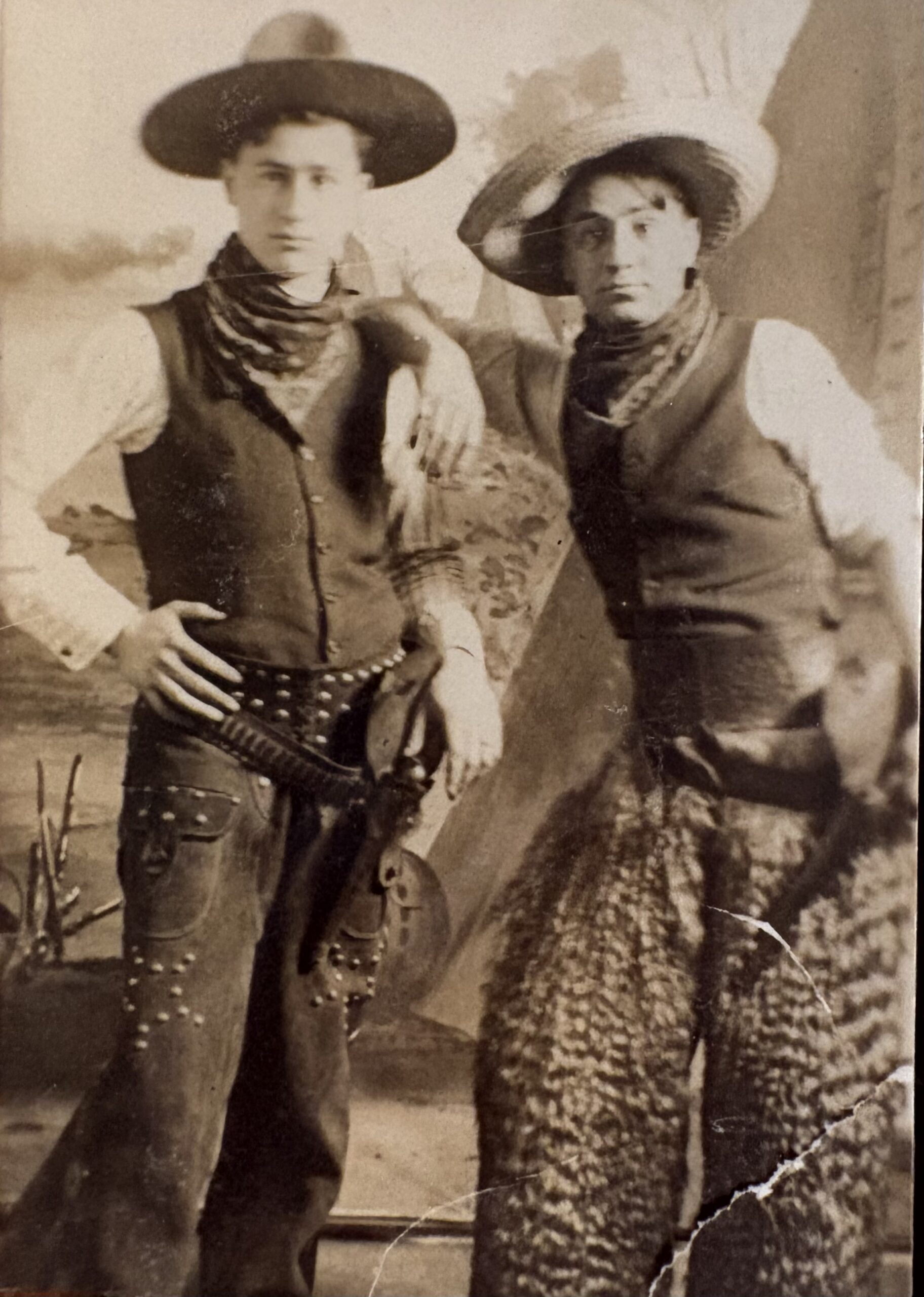 And yet among the most surprising images we have of Levon Nazareth, who became Leo in America, is one of him as a very young man in full 19th-century Western gunslinger regalia with his Armenian pal, Parsig. Was it taken at a photo studio in Coney Island? Perhaps. What matters is that Levon Nazareth from Kayseri, Ellis Island still close in the rearview mirror of his mind, is dressed up like Wyatt Earp or Wild Bill Hickok.
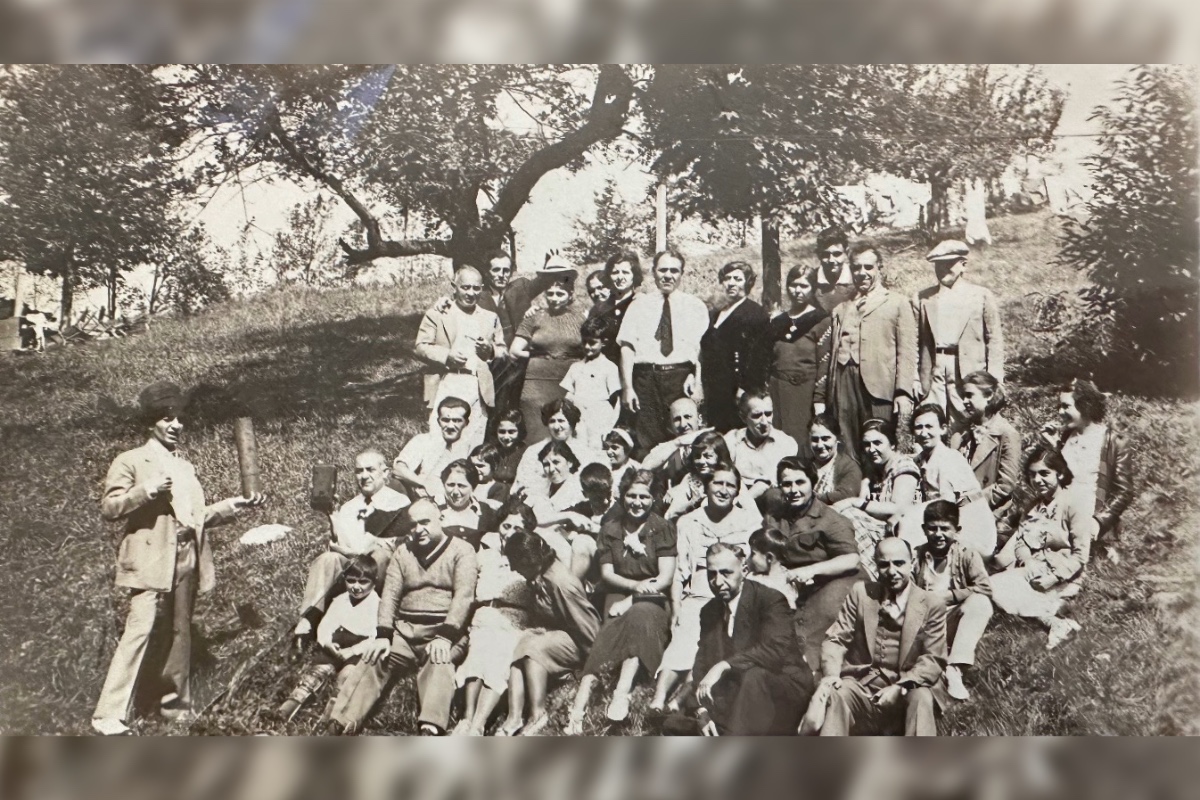
Photos from Tannersville, New York, where the Bohjalians and so many of their friends would vacation together in the summer, are similarly surprising. Tannersville is a small community in the Catskills, the lake there named for Washington Irving’s Rip Van Winkle. But in those hills and that archetypally christened lake, Armenians from New Jersey, Westchester County and the Washington Heights neighborhood in Manhattan would retreat for weeks at a time in the late 1940s and 1950s. In one group photo in which I can spot my grandmother, there must be 40 revelers.
In my Aunt Rose Mary’s memory, the little cabins where everyone stayed were so ramshackle that it looked like a single match could burn them all down. It cost a whopping $5 per day to vacation in one. But there was ice cream and boating and, in the evenings, the men — including my grandfather — would climb into their dark suits and create impromptu kef bands, Armenian jam sessions with my grandfather playing his beloved oud. (In one photo that seems lost to history but I see vividly in my mind, four men in black suits are gathered around the outside of what might have been a black Packard, a Catskills meadow behind them, all of them holding their instruments in their cases so they look like members of the Clyde Barrow gang — Must be guns in those cases! — who’ve just robbed a bank.)
According to my Aunt Rose Mary, my grandmother wore more jewelry in the evenings in the Catskills than she did at their parties at the Bohjalian home in Tuckahoe (of which they had many), as if those modest cabins in Tannersville were the Newport “cottages” of the Vanderbilts or the Astors.
And, certainly, in my Aunt Rose Mary, who was always like a second mother to me, you could see the epigenetic combination of Armenian DNA and learned American attributes. Though raised by a traditional, culturally conservative Armenian patriarch, she convinced him to allow her to parlay her innate talents as an illustrator and painter into a job in a Manhattan ad agency; she was driving as a teenager, though her own mother never learned to pilot a car; she married a man who not only was not Armenian, he had been divorced. And, yes, she rocked a bikini on Fire Island into her 40s.
But her kitchen? Armenian.
Years ago, I had a conversation with His Holiness Aram I, catholicos of the Armenian Church, when I was visiting Beirut. When we were discussing how a diasporan people could retain its culture, he observed that in addition to the church and language and literature and music, there was the kitchen: what he called the Armenian kitchen. Food as heritage. And I will always associate both my grandparents’ home and my aunt and uncle’s home with the aroma of lamb and pilaf and dolma and my aunt’s magnificent cheese boregs. (One time when I was in Yerevan, I texted my brother that I was having rice pilaf for breakfast, because it was part of the hotel’s breakfast buffet. He texted back how fondly he recalled the way, as boys, we would devour our aunt’s leftover cold rice pilaf for breakfast.)
The last time I saw my aunt, she had recently turned 88, and her mind was not as sharp as it had been even a year earlier when I had visited. My cousin Kat brought her mother and me doughnuts. The two of us chatted about 90 minutes, and now my aunt was tired, and so I was getting up to leave. She took my hand and said, “I’m glad you made it here.”
Here.
I know she was referring to my dropping by to see her. But I am less sure she knew it was me, given the different people I had been before her over the last hour and a half. She might have thought I was one of her two beloved older brothers, Aram and Andy, or my brother (also Andy), or even one of her cousins. This part I will never know. But I want to believe that unconsciously she had been plumbing something more, something deeper, something about her family’s place on this planet.
Leo and Haigoohi. Aram and Andy and Rose Mary. The first generation to come from the old world to the new and their three children born in the United States. All of them now gone, leaving just us: the grandchildren and the great-grandchildren. Leo and Haigoohi’s Armenians in America.
Chris Bohjalian is a novelist. His new book, “The Amateur,” arrives this summer.

Please accept my condolences. I was fortunate to have been acquainted with your aunt Rose Mary around the late 1970s / early 80s. My family, the Markarians, lived a few blocks away from her. We had a treasured, and prolific grapevine in our backyard, transplanted from my grandparents’ home in Rockaway Park. Your aunt would come over each year to pick grape leaves from our vine – no doubt to use for dolma (which I’m sure was delicious). On those occasions, she and my late mother Sonia would sit for coffee, conversation, and no doubt, Armenian food, in our sunroom. I don’t know how they initially met – maybe at a neighborhood gathering, or through a mutual friend who thought that two Armenians should meet, but witnessing their time together each season made me feel more at home in my neighborhood. We Armenians always seem to find one another; in the most unexpected ways and places. Across time and geography, we are bound to each other. I am thankful that your lovely Aunt Rose Mary and my dear Mother Sonia found a piece of home in one another. Asdvadz hokinernin lousavore.
Elizabeth Markarian Vanklian