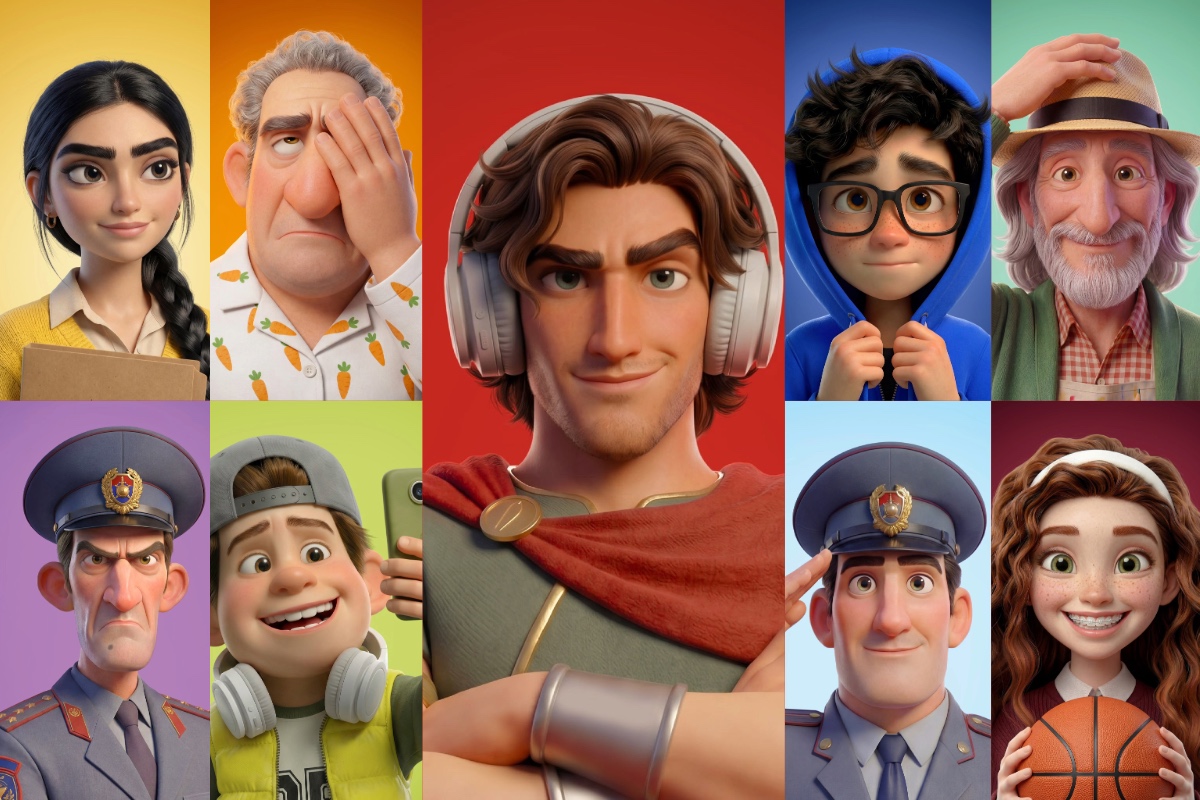
The legendary hero Mher, from the Armenian epic, has emerged from the Cave of Ravenstone, or Agravakar, and entered the era of artificial intelligence.
On May 31, the premiere of the feature-length animated film “Little Mher” took place in Yerevan. The filmmakers describe it as one of the first such projects in the region. Based on the Armenian national epic “Daredevils of Sassoun” (Sasna Tsrer), the 80-minute film presents one of the epic’s most mysterious heroes through a contemporary interpretation. The film is already being screened in movie theaters across Armenia, and the creative team plans to introduce it to international audiences in multiple languages.
Little Mher is the central character of the fourth branch of the “Daredevils of Sassoun” epic. He is the son of David of Sassoun, the last representative of the heroic Sassoun lineage and one of the most symbolic figures in Armenian folklore. According to legend, Mher seals himself inside the Cave of Ravenstone, waiting for the day when justice will once again prevail in the world. However, the film does not retell the epic’s traditional storyline. Instead, the authors imagine what would happen if Mher emerged from the cave today and found himself in contemporary Armenian reality.
“We realized that it would be more interesting to bring Mher into our world than to transport ourselves into the world of the epic,” director and producer Hovhannes Margaryan said during the film’s presentation.
The project represents a unique combination of Armenian cultural heritage and cutting-edge technology. According to the creators, artificial intelligence was used exclusively to generate visual imagery and animated movements, while the creative team handled screenplay, voice acting, music, artistic direction and overall creative supervision.

“We turned to artificial intelligence solely for image generation and motion creation,” Margaryan said.
The creators emphasized that the project should not be viewed as a fully automated production. Actors, musicians, screenwriters, artists, cinematographers and AI specialists all worked on the film, collaboratively shaping the final result.
One of the biggest challenges was synchronizing AI-generated visuals with Armenian speech. According to Margaryan, most artificial intelligence systems are trained primarily in English and other widely used languages, making accurate Armenian lip-syncing particularly difficult. “The actors helped solve many of those problems. At times, it was also necessary to make minor adjustments to the dialogue so that it better matched the characters’ facial expressions and movements,” he said.
The film features a cast of well-known Armenian actors. Khoren Levonyan voices the narrator, while Sos Janibekyan, Levon Harutyunyan, Arus Tigranyan, Arevik Gevorgyan, Harutyun Khachatryan, Rafael Yeranosyan, Areg Gevorgyan and others bring the characters to life.
For several of the actors, this was their first experience working on an animated film.
According to Levon Harutyunyan, what attracted him most to the project was its connection to the Armenian epic tradition. “For many young people, our epic seems to have been pushed into the background. I hope this film will help a new generation discover it. The epic contains meanings and symbols that we still need to decipher,” he said.
Other actors also view the project as an opportunity to present Armenian stories to children in a format that is both understandable and engaging.
According to Arus Tigranyan, the first thing she imagined when she received the offer was her daughter. “The first thing I pictured was my daughter watching an Armenian cartoon and hearing her mother’s voice,” Tigranyan said.
Although the film is primarily aimed at children, the creators said it was designed for three audiences: children, teenagers and adults. Alongside humorous and adventurous episodes, the film also incorporates deeper themes and underlying layers of meaning.
Beyond technological innovation, the authors also prioritized cultural and historical authenticity. During production, they consulted ethnographer and designer Vahe Kotanyan to ensure that Mher’s character remained genuinely Armenian. Even the smallest details, from traditional arm guards to the cloak, were discussed extensively.
According to Margaryan, the creative team spent months collecting photographs of Armenian villages, courtyards and architectural monuments so that AI systems could learn to recognize authentic Armenian environments. “At first, the artificial intelligence generated images that looked more like Greece or Italy. We had to teach it what Armenian tuff stone, courtyards and rural architecture actually look like,” he said.
The project was created by the 485 Center for Generative Technologies, whose mission is to combine Armenian identity with technological innovation.
Although the creators said the use of artificial intelligence significantly reduced production time and costs, they stressed that technology is not a replacement for human creativity. “AI does not replace creators; it simply opens new possibilities for creative teams,” Margaryan said.
In this sense, “Little Mher” stands as one of the more intriguing experiments in Armenian filmmaking, seeking to merge innovation with tradition by introducing one of the most iconic heroes of the Armenian epic to a new generation growing up in the digital age.