




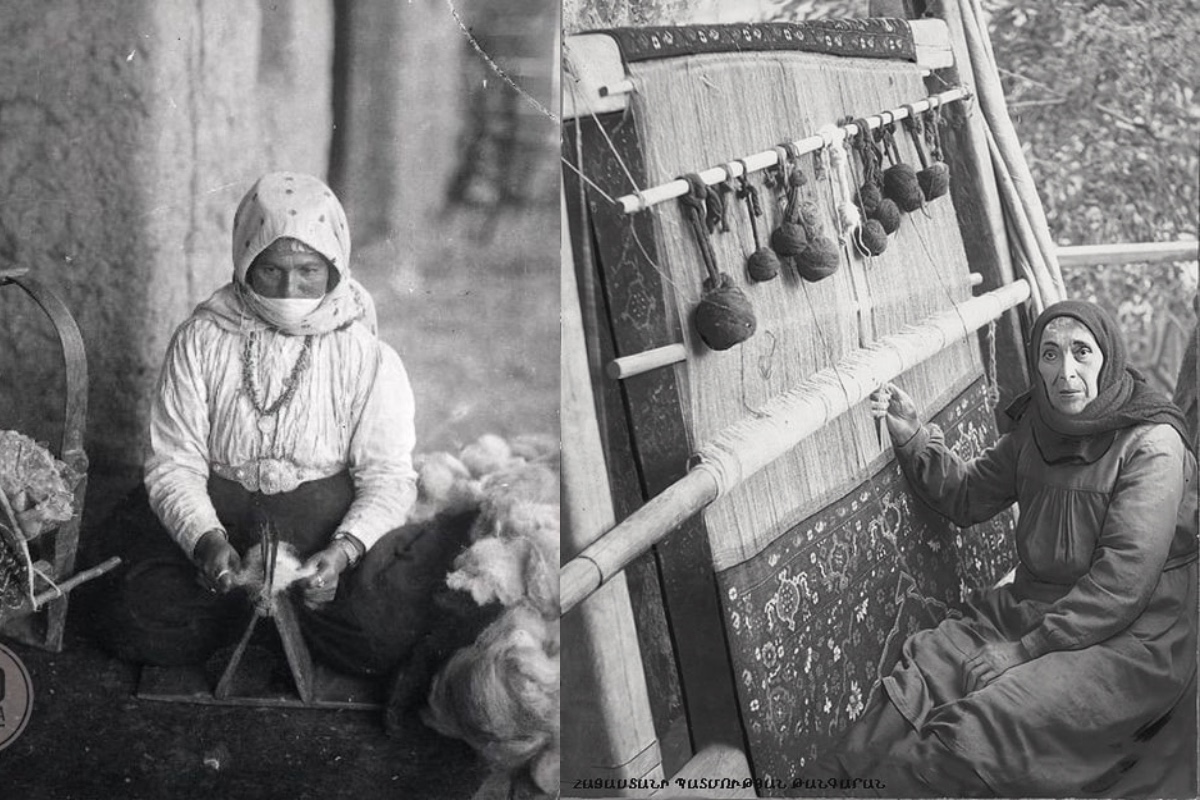
At international auctions and museums, carpets with intricate geometric patterns, dragon motifs and stylized crosses are frequently mislabeled as “Anatolian,” “Caucasian” or “Azerbaijani.” This systematic cultural appropriation has virtually erased the name “Armenia” from the global history of Oriental rugs.
Reclaiming our heritage begins with us. A carpet is a chronicle written in threads, with its own distinct passport. Here is a practical guide to identifying an authentic Armenian carpet through careful observation.
1. The Armenian double knot: Structural DNA
When experts determine a carpet’s origin, they examine its reverse side. The strongest, oldest and most durable knotting technique is professionally recognized worldwide as the “Armenian Knot,” or double knot.
Unlike Persian knots, which loop around a single foundation thread once, the Armenian technique loops the yarn twice around a pair of warp strings, securing it like a double lock.

How to verify this:
- Examine the back: Flip the carpet over. At the position of each knot, you will see two distinct, even bumps pressed side by side.
- Test the flexibility: Fold the carpet. Because the double-wrapped yarn completely seals the empty space, the vertical warp threads remain invisible.
This technique allowed the world’s oldest surviving piled rug — the fifth-century B.C. Pazyryk Carpet, kept at the Hermitage Museum — to survive for millennia, proving the ancient roots of the Armenian weaving school.
2. Material quality and the secret of eternal colors
The nature of the Armenian Highlands has dictated the raw materials and palette of this craft for thousands of years.
Wool quality
Armenian carpets are woven from local sheep’s wool. Spun by hand, the wool retains its natural lanolin, giving the carpet a silk-like softness and a subtle sheen while helping prevent dust or water from easily penetrating the fibers.
Color palette
Authentic Armenian carpets feature a noble balance of colors derived from natural dyes.
- Vordan karmir (The royal crimson): Sourced from a scale insect native to the Ararat valley, this legendary dye does not fade. Over centuries, it matures into a deeper, velvety dark red hue.
- Lapis lazuli (Blue): A deep blue derived from the indigo plant or lapis lazuli stone powder, symbolizing the sky and the divine.
- Browns and yellows: Obtained from walnut husks, wild chamomile or pomegranate rinds.
Abrash: The mark of authenticity
In old Armenian carpets, you will notice subtle horizontal color variations within the same field, such as, light and dark red tones. Known as “abrash,“ this occurs because yarns were dyed in small, natural batches. This effect gives the carpet visual depth, a characteristic completely absent from uniform chemical counterfeits.
3. Symbolism and written traces
A carpet’s iconography presents overt signs that cannot easily be forged or attributed to another culture.
Armenian inscriptions
The most undeniable proof is the presence of Armenian texts and dates woven directly into the fabric. Weavers often embedded their names, prayers or the names of loved ones into the borders. These letters were integrated into the carpet from the start, forming part of its inseparable DNA.
Cross symbolism and talbot safeguards
- Hidden crosses: Geometric medallions are often built on a four-directional layout. Connecting the endpoints reveals equilateral or vertical crosses, which served as protective talismans for the home.
- Dragon carpets (Vishapagorgs): These feature stylized S-shaped dragons representing the guardians of water and life.
- The tree of life: Depicted as branching patterns, it symbolizes lineage and eternity.
While Islamic-influenced rugs often restrict the depiction of living creatures to geometric or floral motifs, Armenian carpets are filled with birds, horses, humans and crosses, reflecting a distinct Christian and secular worldview.
4. The dialogue of stone and thread
Armenian carpet ornaments replicate the visual language of medieval architecture, khachkars (cross-stones), and illuminated manuscripts with astonishing accuracy.
The structure of a lace-carved Khachkar — a large central cross framed by complex vertical borders — was transferred identically onto the carpet layout. The eternity symbols, including hooked crosses, found on the walls of Geghard or Sanahin became central motifs of Armenian rugs. It is a unique dialogue in which the pattern of hard stone is translated into a living thread.
5. The sacred relic of the home
For an Armenian family, a carpet was never a mundane floor covering; it was a spiritual anchor. People were born, baptized and married upon it. During times of forced migration, families abandoned heavy possessions but carried their ancestral carpets alongside the Holy Bible.
Defending the authenticity of the Armenian carpet is a civic responsibility. By learning to read its cryptograms, we ensure that our cultural code remains unbreakable against the winds of time.



Thank you for providing this information about the unique and valuable aspects of Armenian carpets in a simple and easy to understand way. If possible, I’d love to see images of the knots, color variations, and symbols you’ve described.
Where can I bey a carpet from you?
If you are interested, I can provide you with the contact information for a carpet weaver. You can message me on Instagram at armikgrigoriann.