


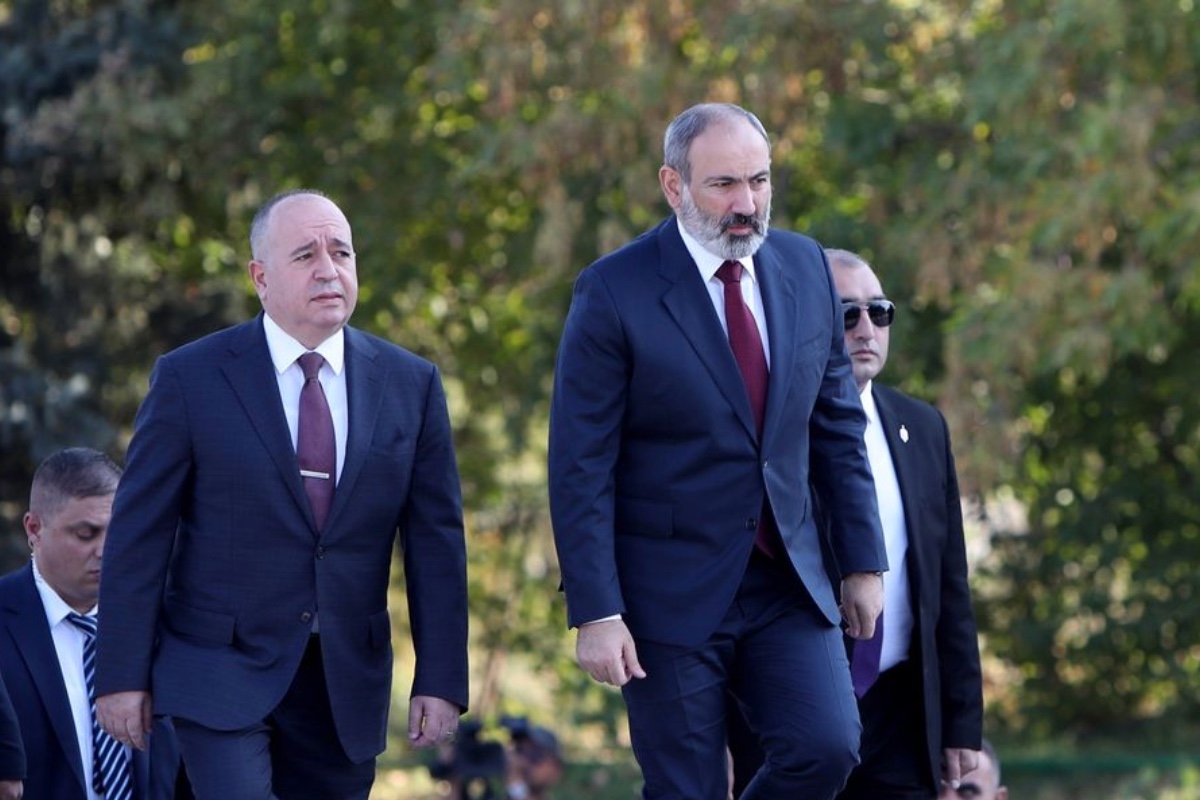
In the political drama currently unfolding in Armenia, there is no longer room for truth or grief, only an endless reexamination of the past. A country that, in the space of three years, has endured military defeat, a blockade, the exodus of an entire people and diplomatic retreat on all fronts now finds itself drawn into a toxic spectacle. Its main protagonists are not merely political opponents, but former comrades-in-arms who now stand on opposite sides of the state’s barricade.
On one side, Prime Minister Nikol Pashinyan is advancing the narrative around the need to create a “Real Armenia” and portraying the former Artsakh elite as the main culprit behind the country’s current disasters. On the other, former Defense Minister Arshak Karapetyan has turned his refuge in Moscow into a platform for accusing the authorities of deliberately surrendering Artsakh and broadly criticizing the current government’s decisions.
The essence of the published evidence, which Karapetyan has presented as authentic, points to a single, unequivocal conclusion: Pashinyan took premeditated diplomatic and bureaucratic steps that prevented the Collective Security Treaty Organization, or CSTO, in which Russia plays a leading role, from activating its collective defense mechanism in Armenia’s defense. Karapetyan suggests there was collusion in which Yerevan deliberately tied the hands of its own military-political bloc to give Baku the “green light.”
The logic behind the general’s accusations is straightforward. Karapetyan claims Pashinyan deliberately delayed Armenia’s appeal to the CSTO. He also said Pashinyan changed the legal basis of the appeal from Article 1 to Article 2, which would imply consultations rather than direct intervention on Armenia’s side. In doing so, Karapetyan argues, the prime minister deprived the country of its last diplomatic safety net. Screenshots of private WhatsApp correspondence between Karapetyan and Pashinyan are cited as evidence.
However, questions should also be raised about Karapetyan, a controversial former general who has little support within Armenian society. If he understood that Pashinyan was deliberately paralyzing the defense bloc through his actions, why was this information not immediately passed on to the military prosecutor’s office, CSTO allies or international courts while there was still time to address the situation? Publishing compromising material after the event, when territories have been irretrievably lost, transforms the accusation from an act of rescue into an act of political revenge.
For its part, the Pashinyan government’s actions give rise to serious suspicions. Armenian forces received no centralized support at a critical moment, and Yerevan’s diplomatic efforts toward the CSTO were ambiguous. For months, Pashinyan publicly criticized the organisation for its “inaction,” yet he failed to initiate the formal procedures that might have placed Moscow and other allies under a legal obligation to intervene. The impression is that the prime minister used the CSTO’s inaction as a pretext for his own geopolitical maneuvering.
Against this backdrop, the post-conflict state policy appears even more damaging. Pashinyan has launched a systematic campaign to delegitimize the very idea of fighting Azerbaijan. The notion that defeat in the conflict with Baku is inevitable features prominently in his rhetoric. Moreover, the prime minister is seeking to impose on society the view that revanchist sentiments are harmful to the building of a “Real Armenia.” This is reflected in his inflammatory statements directed at soldiers who defended their homeland against enemy aggression. Harsh remarks directed at veterans, such as “Why didn’t you die?” from the nation’s leader, are perceived as deeply cynical. Moreover, Pashinyan uses administrative resources to suppress alternative narratives, labeling the very attempt to ask questions as treason.
Instead of taking responsibility for his inability or unwillingness to protect the civilian population, Pashinyan shifts the blame onto those who have already lost everything, perpetuating the trauma and driving society into an existential impasse. For a significant part of the nation, whose pain over the loss of sovereign territories still throbs like an open wound, these “revelations” sound like a long-awaited truth. It is simple and clear: It is all down to the betrayal of one man.
Instead of taking responsibility for his inability or unwillingness to protect the civilian population, Pashinyan shifts the blame onto those who have already lost everything, perpetuating the trauma and driving society into an existential impasse.
At the same time, the prime minister promotes a convenient myth about a “peaceful era” that supposedly dawned after capitulation, while remaining silent about the human cost of that capitulation. Pashinyan refuses to acknowledge that his “peace agenda” is a continuation of military defeat. Moreover, by demonizing patriots, he is depriving an entire nation of its legitimate right to history. To the great regret of the Armenian people, what has come to light raises the gravest questions about whether Pashinyan’s actions formed a chain of deliberate political decisions raising accusations of betrayal among his critics.


Stay united Armenians, you all want the same thing: what’s in the long-term best interests of Armenia’s residents
Unite on this principle and strategize for this. You need and deserve peace, and stable relations with neighbors.
Don’t blame each other, don’t infight. It’s not your fault what happened. It’s not an equal fight. I see a beautiful country called Armenia on every map. You need to be united and focus on Armenia’s long-term best interests.
Armenians should learn to work as a team.
“Unity”. I’ve been hearing that word for 35+ years, probably ever since the word “Armenian” was typed into the first Armenia-related thread on the first-ever online message board! What it means, and what it has always meant, is “everyone should be united in doing what I want!”. Calls for “unity” only promote disunity. What is needed is truth and realism and a bit of respect for others – Pashinyan is uninterested in truth, displays contempt for anyone who is not one of his yes-men, making his claims of acting out of realism very dubious.
This can only happen when Pashinyan leaves the scene, and is not replaced by a Pashinyan 2.0. No Armenian leader has been so divisive and controversial like Pashinyan, in contemporary Armenian history.