


The HomelandCulture

Shakart, the artist turning Charbakh into an open-air gallery
Sharur Street begins beneath the stern gaze of Alexandre Cabanel’s famous painting “The Fallen Angel.” The massive mural watches over the entrance to Charbakh, one of Yerevan’s most distinctive neighborhoods. Looking down the street, you see endless overhead wires stretching across the sky, while the sounds of everyday life drift from garages and gardens where locals gather and talk.

“The Fallen Angel,” after Alexandre Cabanel

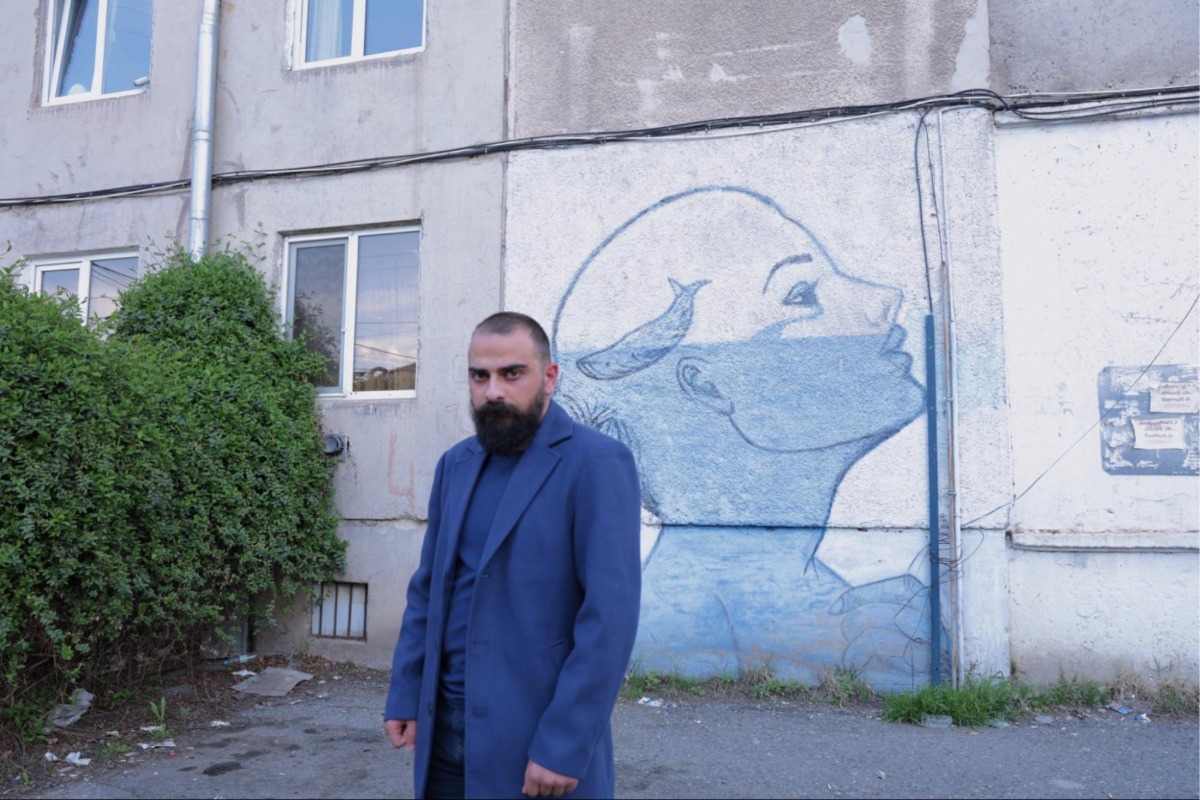
The artist behind the angel is Shant Karapetyan, better known as Shakart. He first studied medicine but later left that path to fully dedicate himself to art. Today, his work covers an unusual range of surfaces and scales. He paints on pills, matchboxes and leaves, works in body painting, and creates large street murals that have made him a well-known name in Armenia’s street art scene. “Charbakh is a serious art center,” he says with a smile. “After Florence, it comes second.”

Shant lives on Sharur Street and often says his work to beautify Yerevan started right outside his own home.

Street art, Shant explains, belongs to the public the moment it is finished. People react to it in many ways. Some appreciate it, others respond in unexpected ways. Shant recalls one night in particular, with irony, when some drivers crashed into the wall beneath his “The Fallen Angel” mural, as if the fallen figure had ended up there to protect them.

Walking through Charbakh with Shant feels like walking through an open-air gallery. Near a small fruit and vegetable stand, children play in the street. Behind them, on a garage wall, is Vincent van Gogh’s “Starry Night.” Or perhaps it is Shakart’s version of it — or maybe Charbakh’s.

Related Articles

Locals say the old garage kiosk was once broken into and later closed, leaving only one entrance. The children say this is where “the stars came to Charbakh,” together with Shant.

A little farther on, he painted Johannes Vermeer’s “Girl with a Pearl Earring.” Time and weather have changed it. Shant looks at it simply and says, “The red lips of my ‘Girl with a Pearl Earring’ turned blue. She’s kind of faded away.”

The courtyards here feel like a maze, but the paintings connect them. One work leads to another, as if they are linked by invisible threads.

“Girl with a Pearl Earring,” after Johannes Vermeer

Not all of his works have survived. A mural of Zeus, once painted on a wall in the neighborhood, disappeared when the building was demolished. Even so, the experience did not stop him. Over time, his work moved from Charbakh’s walls into some of the city’s most respected galleries. Today, his ambition is to exhibit at the National Gallery of Armenia.

After a 17-month break from creating, he returned to his practice. He says every artist eventually reaches a point where they need to stop and refill themselves before moving forward.

What is taking shape in his studio remains unseen for now. But Charbakh once turned into an open-air gallery without warning, and what is forming today is unlikely to remain hidden for long. Walls, sooner or later, have a way of finding him.

Nare Arushanyan

Nare Arushanyan is an Armenian journalist and visual storyteller dedicated to amplifying the voices of her homeland. She began her work during the blockade of Artsakh, documenting the hunger, isolation and resilience of her people when foreign media were absent. At 16, just before Azerbaijan’s attack, she felt compelled to capture the memory of mass displacement, destruction and human loss. Her photographs have been featured in exhibitions and publications in Armenia and worldwide. After moving to Yerevan, she continued documenting her people’s stories and the sacrifices of fallen heroes, ensuring their voices and memories endure.

Albina Manukyan

Albina Manukyan is an aspiring journalist and a student at Yerevan State University. She is passionate about storytelling, with a particular interest in culture and art. Through her work, she explores topics related to cultural heritage, contemporary society and the role of art in shaping communities and preserving memory.

Leave a Reply

Your email address will not be published. Required fields are marked *


Back to top button