



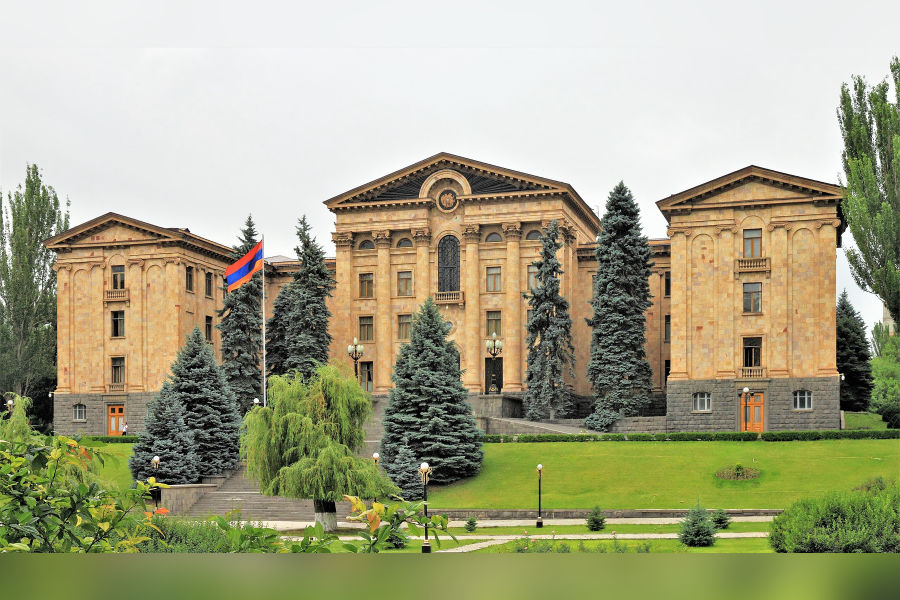
Armenians around the world are closely following Armenia’s parliamentary election campaign to see whether Prime Minister Nikol Pashinyan’s party will retain its majority in parliament, allowing him to remain in office for another five years.
These elections could have two major consequences: one for Armenia’s future and the other for Pashinyan himself.
Consequences for Armenia
Given Pashinyan’s disastrous record over the past eight years, many Armenians fear that if he remains in power, Armenia’s very survival could be at risk. Here are some of his major failures:
- Mismanaging the 2020 war with Azerbaijan, which resulted in the loss of most of Artsakh and the deaths of thousands of Armenian soldiers;
- Allowing the Azerbaijani army to invade and continue occupying parts of the territory of the Republic of Armenia since 2021 and 2022;
- Declaring in 2022 that Artsakh is part of Azerbaijan, despite previously proclaiming that “Artsakh is Armenia, period”;
- Failing in 2023 to prevent the forced displacement of 120,000 Armenians from Artsakh;
- Treating the Artsakh issue as closed and referring to Artsakh refugees as “escapees”;
- Claiming that surrendering Artsakh strengthened Armenia’s independence;
- Interfering in the internal affairs of the Armenian Apostolic Church in violation of the constitution and imprisoning several senior clergymen;
- Failing to secure the release of Armenian detainees and Artsakh leaders held in Baku;
- Repeatedly complying with President Ilham Aliyev’s demands for concessions on major Armenian issues.
Consequences for Pashinyan personally
Pashinyan’s future may depend entirely on the outcome of these elections. Because of his violations of Armenia’s laws and constitution, he could face arrest and persecution if he loses power. For that reason, he will do everything possible — legally or otherwise — to secure victory in the June 7 elections and avoid imprisonment.
Despite widespread dissatisfaction, Pashinyan may still remain in office because incumbents typically benefit from extensive resources of the state during election campaigns. In addition, because of the concessions he has made, he has gained support from Azerbaijan, Turkey, the European Union and the United States. They understand that if the opposition forces win, many of Pashinyan’s policies and concessions could be reversed.


Nevertheless, Pashinyan’s political standing has declined dramatically. His approval rating, which stood at 82% in 2018, has fallen to slightly over 10% in 2026. This sharp decline could create an opportunity for opposition parties to take power.
However, the opposition faces several serious obstacles.
Fragmented opposition
Armenia, despite its small size, has an astonishing 123 registered political parties, many consisting of little more than a founder and a small circle of followers. Fortunately, not all of them are participating in the June 7 elections. Still, 19 political entities have officially registered: 17 individual parties and two coalitions. This fragmentation benefits the ruling party because the opposition becomes divided among numerous competing groups.
Coalition possibilities
If opposition parties collectively secure slightly more than 50% of the vote and successfully form a coalition in parliament, they would have the power to nominate their prime minister and remove Pashinyan from office.
Armenia’s complex electoral system
Armenia’s electoral system combines elements of Israeli-style proportional representation, a German-style stability mechanism and post-Soviet Eastern European reforms.
Under current law:
1) A political party must receive at least 4% of the vote to enter parliament.
2) Coalitions of two or three parties must receive at least 8%.
3) Coalitions of more than three parties must receive at least 10%.
Votes cast for parties that fail to meet these thresholds are redistributed proportionally among the successful parties.
The opposition’s biggest problem
The most controversial aspect of this system is that if Pashinyan’s party receives the largest share of the vote, it will also receive a significant portion of the redistributed votes from failed opposition parties. Ironically, voters casting ballots against Pashinyan could unintentionally help strengthen his parliamentary majority. For that reason, many smaller parties with little realistic chance of crossing the threshold should not have entered the race. By doing so, they risk splitting the anti-Pashinyan vote and indirectly benefiting the ruling party.
One unusual safeguard
One unusual feature of Armenia’s electoral system is that parliament must contain at least three political parties. Therefore, if only one party crosses the required threshold, the next two highest-performing parties may still receive representation even if they failed to reach 4%. In such a case, those additional parties collectively would receive one-third of the parliamentary seats regardless of their actual vote totals.
What the opposition must do
If opposition parties want to improve their chances, they should focus less on persuading loyal Pashinyan supporters to switch sides. Many government supporters benefit from state employment, large bonuses and privileged contracts and are therefore unlikely to abandon the ruling party. Instead, opposition groups should concentrate on mobilizing the large number of eligible voters who currently say they do not plan to vote.
If opposition forces succeed in gaining a parliamentary majority, one of their first priorities should be reforming Armenia’s electoral laws and replacing the current system with a more conventional voting structure similar to those used in many other countries.
In the meantime, every registered Armenian voter should participate in the June 7 elections to avoid leaving the country’s future in the hands of others.
Armenian citizens living abroad who retain voting rights should also make every effort to travel to Armenia and cast their ballots. Those unable to travel should encourage their relatives and friends in Armenia to vote on June 7.




Pashinyan knows that he has no chance of winning an election fairly and squarely anymore, and his only option to stay in power, is to go into dictator mode, which he is certainly attempting to do by trying to crush and silence the democratic and patriotic opposition by any means.
Since he wants to stay in power at all costs, he will do so and is already doing so by going after all his opponents, will (have to) rig the elections for the abovementioned reasons, and will persecute the opposition even more.
It is the playbook and trajectory of every dictator and wannabe dictator.
Since free and fair elections, and a fair playing field for the opposition, let alone winning them, are impossible in Armenia under these circumstances, the only way to get rid of a traitor and dictator like Pashinyan (and he undeniably has become one), is through force; either through a revolution or through a coup d’état.
The so-called “international community”, especially the self-righteous and preachy West, condemns the overthrow of an elected leader and government through a revolution or especially through a coup d’état, even if that leader has become authoritarian or even a full dictator.
But when this leader and government, usurps power, engages in treasonous activities, appeases the nation’s archenemies, which threatens the territorial integrity and even the existence of the nation-state, and worse, is meekly accepted by the majority, who will not overthrow such a leader and government in a revolution, then a coup d’état is the last option left to save the nation before the demise.
Who cares what the reactions of the so-called “international community” and the “holier-than-thou” West are, when Armenia is at stake.