



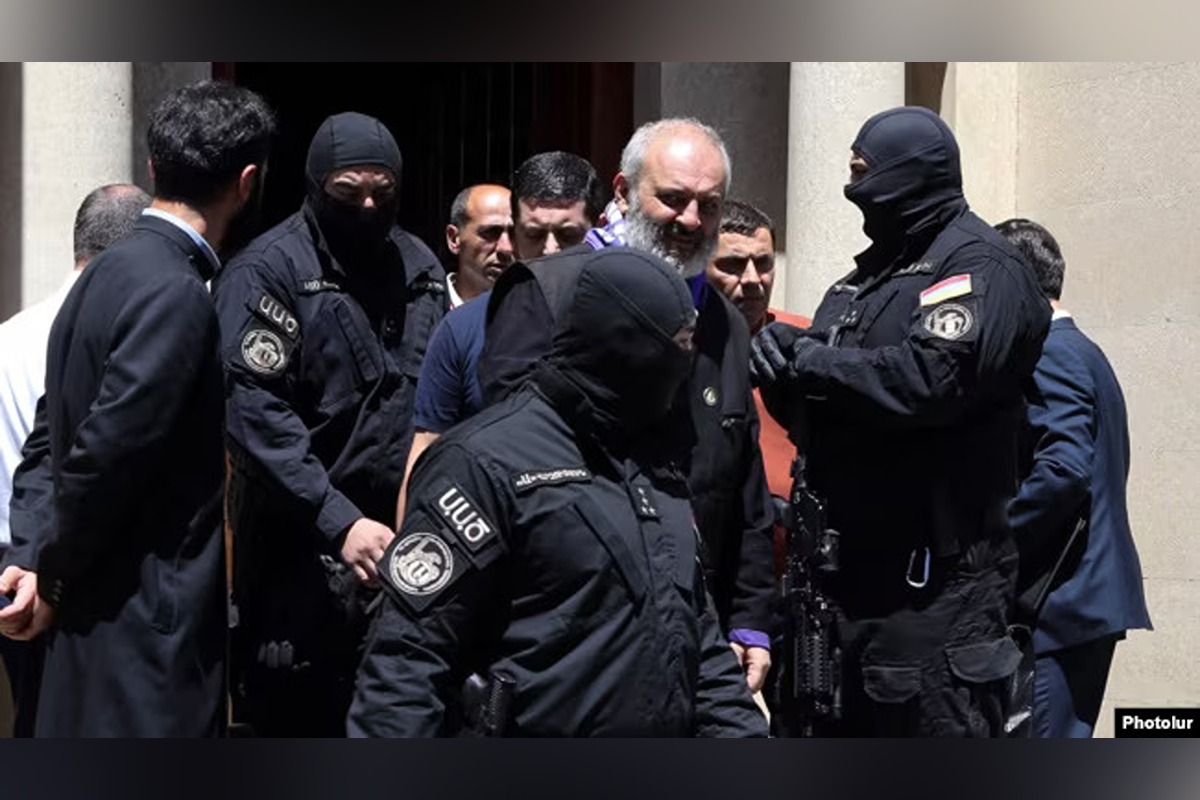
YEREVAN — The Armenian government says Archbishop Bagrat Galstanyan and members of his opposition movement were preparing acts of terrorism and a violent seizure of power. Six United Nations human rights experts are not convinced.
In an official communication to Armenia, the U.N. mandate holders questioned whether the authorities had taken political organizing, civil disobedience and anti-government protest — and recast them as threats to national security. Armenian authorities insist that the prosecutions are based on evidence rather than politics.
Yet viewed together, the cases have produced a consistent result. The government’s most prominent opponents are removed from public life, restricted from campaigning, deprived of resources or forced to defend themselves in court
When opposition becomes terrorism
Archbishop Galstanyan rose to national prominence in spring 2024 after leading protests against Armenia’s border delimitation agreement with Azerbaijan. What began as a movement rooted in the Tavush border region soon expanded into a national campaign demanding Pashinyan’s resignation. The movement, known as Holy Struggle, brought tens of thousands of people into the streets and briefly presented the government with a real problem: a protest leader with national recognition, institutional backing and the ability to mobilize citizens beyond traditional party structures. A year later, Archbishop Galstanyan and 17 associates were charged with preparing terrorist acts and attempting to seize power.
The severity of the accusation transformed the political meaning of the movement. Discussions of civil disobedience were presented as operational planning. Protest organizers became alleged members of a violent conspiracy. The leader of an opposition campaign became a terrorism defendant.
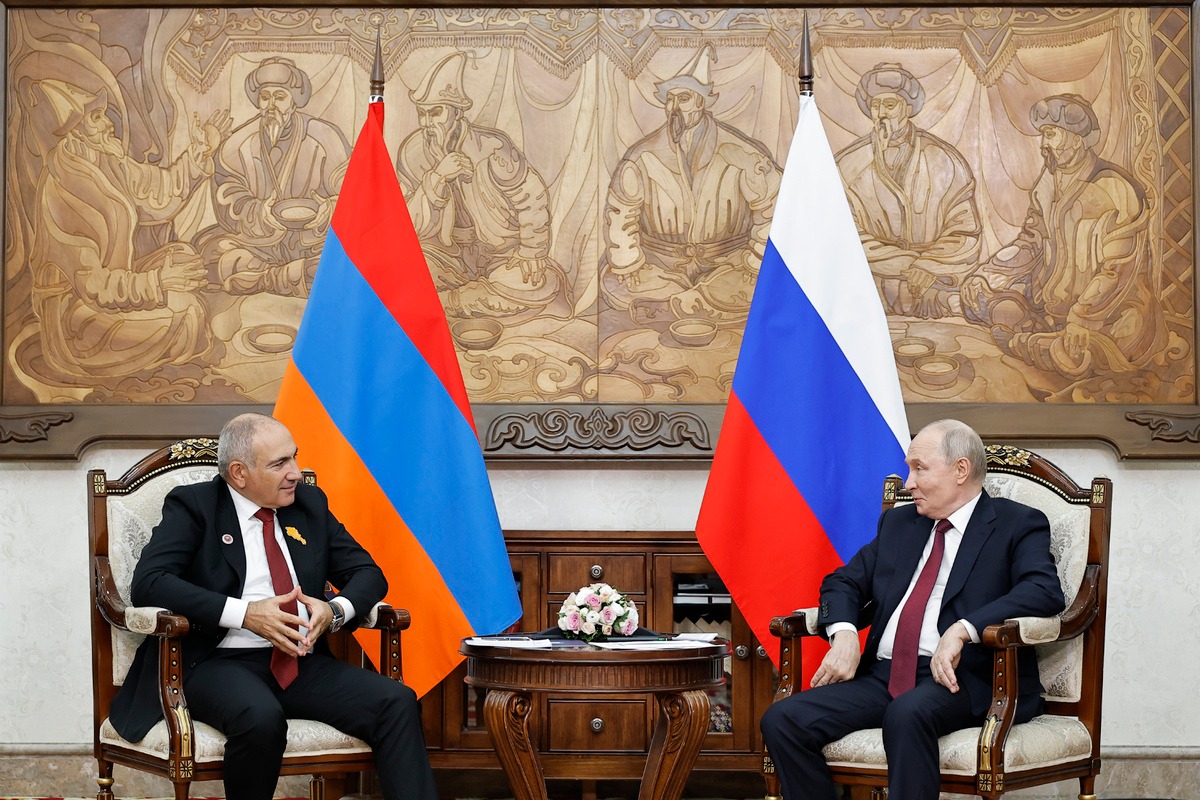

The official U.N. communication raised concerns that much of the conduct described to them involved political opposition rather than preparations for violence. They questioned whether Armenia’s counterterrorism legislation was being applied so broadly that activities protected under international human rights law could be criminalized as national security offenses.
The experts asked the question that Armenian courts must now answer: What specific evidence turned a political movement into a terrorist organization? That question becomes especially important when the state controls the investigation and the public presentation of the evidence.
Defense lawyers have alleged that investigators selectively released portions of intercepted conversations while preventing the defense from publishing recordings in which movement members rejected violence.
If that account is accurate, the prosecution has enjoyed an enormous advantage before the trial has even resolved the basic facts.
The government’s case
Armenia rejects the suggestion that Archbishop Galstanyan and his supporters were prosecuted because of their political or religious affiliations.
In its 30-page response to the U.N., the government said investigators had obtained evidence through covert surveillance and intercepted communications. Authorities alleged that members of the movement planned to establish coordinated strike groups, acquire pyrotechnic devices and metal spikes, gather information about strategic sites and carry out actions intended to paralyze public institutions.
The government’s response presents the prosecution’s interpretation of the evidence. It does not give the public access to the complete recordings.
Words such as “terrorism,” “treason” and “seizure of power” carry immense political force. They alter how the public is invited to understand dissent itself.
The precedent of June 2024
The Archbishop Galstanyan case cannot be separated from the police crackdown outside Armenia’s National Assembly on June 12, 2024.
The government says the demonstration ceased to be peaceful when participants threw objects, damaged property and attempted to breach the parliament’s security perimeter. Police responded with sound-and-light grenades and other crowd-control measures.
Journalists and human rights organizations documented injuries among protesters and media workers. Approximately 100 people were reported injured, and many were detained. The government says the use of force was lawful, necessary and proportionate. It also says an investigation into possible police misconduct remains open. That investigation has now continued for roughly two years without a final public accounting.
Criminal cases against government opponents have advanced rapidly. The investigation into whether the state itself used excessive force has moved far more slowly.
Citizens watching the process receive a clear message about which forms of conduct are likely to bring immediate consequences — and which allegations can remain pending almost indefinitely.
A system that repeatedly neutralizes challengers
The Archbishop Galstanyan prosecution is only the most internationally visible example.
Across Armenia, opposition politicians, church leaders, civic organizers and politically active businesspeople have faced accusations carrying some of the gravest labels available to the state.
When an opposition figure acquires the resources, visibility or organizational strength to challenge the ruling party, criminal proceedings tend to follow.
Gagik Tsarukyan, the billionaire businessman and leader of the Prosperous Armenia party, possesses what few Armenian opposition leaders can claim: an established party organization, extensive financial resources and decades of public recognition. He was arrested in July and placed in pretrial detention for two months over allegations that businesses connected to him fraudulently imported approximately $21 million in goods from Iran. Authorities searched dozens of locations associated with his business network. Tsarukyan denies wrongdoing and says the prosecution is politically motivated. Days after his arrest, an Armenian court transferred control of his cement company to the state as part of a broader asset-confiscation case.
Armen Ashotyan, deputy chairman of the Republican Party and one of the government’s most persistent critics, has likewise spent prolonged periods in detention and under house arrest. After facing years of proceedings in an earlier corruption case, he was detained again in June over allegations connected to the handling of university property during his tenure as education minister. His detention was extended by another month in July. Ashotyan rejects the charges and describes the proceedings against him as politically driven.
Pretrial detention is formally described as a temporary measure intended to protect an investigation. In political life, its consequences can become indistinguishable from punishment. A leader does not have to be convicted to miss an election, lose control of a movement or spend a decisive political season behind bars.
The case of Narek Karapetyan shows how rapidly electoral legitimacy can collide with prosecutorial power. Soon after he was elected to parliament as the leading candidate of the Strong Armenia Alliance, prosecutors sought authorization to initiate criminal proceedings against him and deprive him of his liberty.
On July 22, the Central Election Commission consented to the initiation of criminal prosecution, effectively removing the immunity that had protected Karapetyan as an elected lawmaker. The commission separately rejected the request to detain him.
That distinction is legally significant. Karapetyan remains free while the prosecution proceeds. Politically, however, the sequence is unmistakable: the mandate he won at the ballot box was followed almost immediately by an effort to expose him to criminal prosecution and imprisonment. The fact that the imprisonment of an opposition leader was considered at the Central Election Commission only weeks after an election shows how deeply criminal procedure has entered Armenia’s system of political competition.
Samvel Karapetyan’s trajectory is even more revealing. The Russian-Armenian businessman was arrested last June and remains under house arrest after publicly defending the Armenian Apostolic Church during its escalating confrontation with Prime Minister Nikol Pashinyan’s government. While under house arrest, he became the central figure behind the Strong Armenia opposition force and campaigned through remote appearances and digital messages.
The sequence again matters. A businessman with immense resources openly challenges the government and supports an institution capable of mobilizing resistance outside the ruling party. He is arrested under a national security provision. Financial investigations follow. His company and political network come under pressure. His physical participation in public life is restricted at precisely the moment he emerges as a major electoral challenger.
Archbishop Mikayel Ajapahyan’s case demonstrates how the process can impose irreversible consequences even when a conviction does not survive appellate scrutiny. He was arrested and later sentenced to two years in prison for public statements interpreted by prosecutors as calls to overthrow the government.
In June 2026, the Criminal Court of Appeal overturned the judgment and returned the case for a new trial. However, that does not restore the months Archbishop Ajapahyan spent imprisoned or confined. Nor can it recreate the political time lost while a senior cleric critical of the government was removed from public life.
Aregnaz Manukyan, a former member of parliament, journalist and member of the Mother Armenia party’s governing board, is now experiencing the same machinery from inside detention.
Investigators initially questioned her as a witness in the case against Mother Armenia leader Andranik Tevanyan, who is accused of treason and espionage. Her home was searched in June. On July 9, authorities detained her and initiated prosecution under Article 427 of Armenia’s Criminal Code, alleging that she published information containing a state secret. A court ordered her held for two months and also prohibited visits.
The restrictions imposed on Manukyan extend beyond removing an opposition figure from public activity. According to her lawyer, her 13-year-old daughter was prevented for at least 12 days from communicating with her mother, including by telephone. The child could neither visit Manukyan nor hear her voice.
The treatment of Avetik Chalabyan adds another layer to the pattern. Chalabyan, the coordinator of the HayaQve civic initiative and a longtime government critic, was arrested on June 24 and remanded in custody for two months. Investigators allege that, before Armenia’s June 7 parliamentary election, he met officials of another country and encouraged them to use their influence to interfere with the free exercise of Armenian citizens’ voting rights.
The arrest was not Chalabyan’s first encounter with criminal prosecution under Pashinyan’s government. In 2022, he was detained over an allegation that he offered a material incentive to mobilize university students for anti-government demonstrations. The conviction was later overturned and returned for reconsideration, and in December 2025 the Court of Cassation again sent the matter back for a new appellate examination.
On July 22, people close to Chalabyan reported that he lost consciousness during a court hearing, where his pretrial detention was extended for two more months. Chalabyan has previously reported cardiovascular health concerns during court proceedings, including the need to undergo heart examinations.
Viewed collectively, these cases reveal a system whose burdens fall with remarkable regularity on the government’s most organized and consequential opponents.


Opposition parties, including the ARF, must make contingency plans in case Pashinyan shuts them down and declares them illegal. This threat is not just a scenario, it is a real possibility. His persecution will not be limited to opposition figures, he will certainly soon target opposition parties and organizations as well; he is already persecuting the Armenian Apostolic Church and its clergy. The question of “if” has already passed; it is a matter of “when”.
what a shame on Armenian’s that allow this kind of power to survive
The cowardly, shady Armenian Bar Association stays silent…
I wonder why?
Mendacious headlines, such as the claim Hoory Minoyan makes that the Armenian “Government frames opposition as a national security threat”, should have no room in the Weekly. Yes, the Armenian government alleges that Archbishop Bagrat Galstanyan is a national security threat. The authorities accuse him in court of plotting a violent overthrow of the government and preparing terrorist acts. The Armenian court will render its verdict and we will hear it.
On August 2, 2026, the newly elected National Assembly representatives will convene. The PM Nikol Pashinyan led government will face the fierce opposition of the 41 representatives of Armenia Alliance and Strong Armenia party. Not Nikol Pashinyan, or anyone for that matter, in his or her right mind should state that the government frames the opposition a “national security threat” and hurl it to the concerned reader.