


Art

A path to restitution: Armenian Genocide looted art
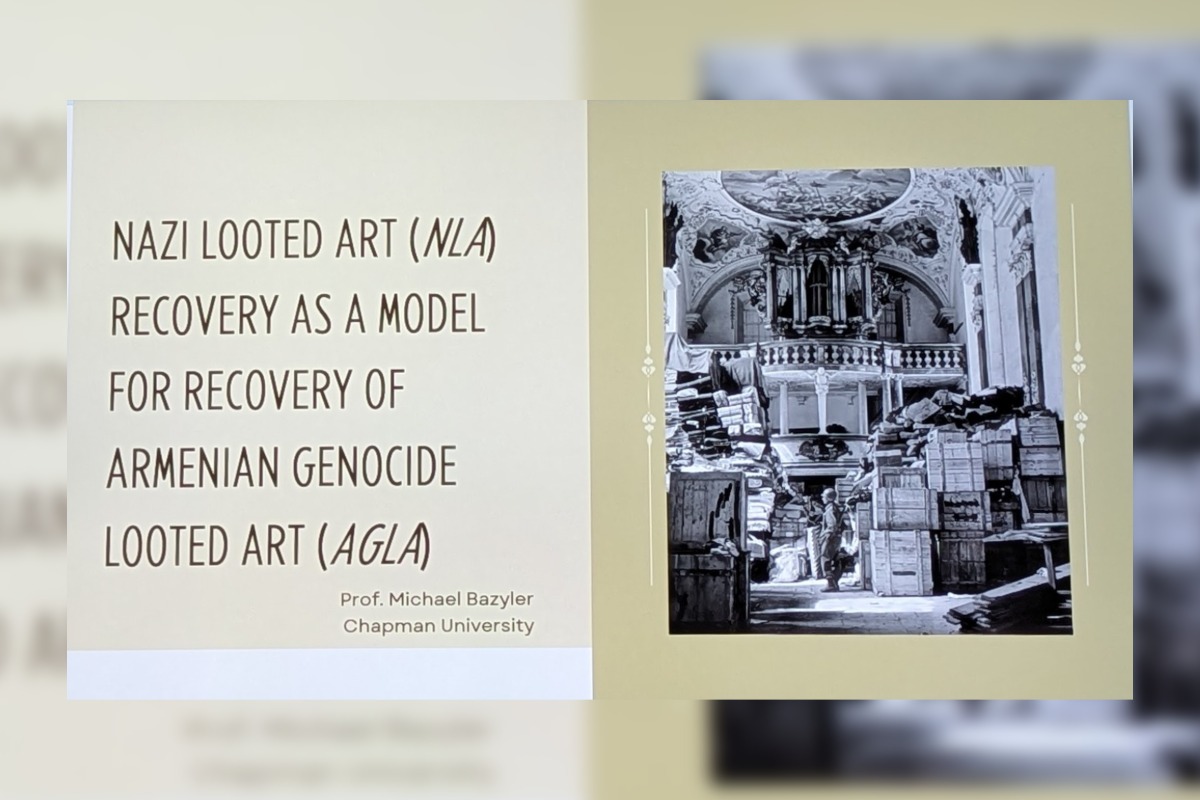
How might efforts to recover Nazi looted art from the Holocaust inform efforts to recover art looted during the Armenian Genocide? Law professor Michael Bazyler and historian Taner Akçam explored that question during a series of East Coast lectures in early May.

The presentation, titled “Nazi Looted Art Recovery as a Model for Recovery of AGLA: Armenian Genocide Looted Art,” was held in New York City, Fair Lawn, N.J., and Boston. It was hosted by the Armenian Genocide Research Program (AGRP) of the Promise Armenian Institute (PAI) at UCLA, where Akçam serves as the program’s inaugural director.

“What comes next after recognition?” asked Akçam, who was one of the first Turkish scholars to publicly acknowledge and write about the Armenian Genocide.

Cover slide of Michael Bazyler’s presentation on Nazi Looted Art recovery. (Photo by Rosie (Toumanian) Nisanyan.)

Akçam said the Armenian community remains focused on securing Armenian Genocide recognition from Turkey, even though many countries, including the U.S., have already done so. Regardless of recognition, he argued, the central issue of justice remains unresolved without reparations or restitution. 

Nazi Looted Art (NLA) Recovery

Michael Bazyler and Taner Akçam speak at CUNY Graduate Center in New York City. (Photo by Rosie (Toumanian) Nisanyan.)

Much of the lecture’s discussion of Holocaust-era restitution drew on Bazyler’s expertise in the field. A professor of law at Chapman University and the 1939 Law Scholar in Holocaust and Human Rights Studies, he has written extensively about Holocaust restitution, international human rights and international art law. His work has been instrumental in establishing legal processes for identifying and claiming stolen property after an atrocity.

Advertisement

In 1998, the Washington Conference on Holocaust Era Assets took place and resulted in the publication of the Washington Principles, a list of “non-binding principles to assist in resolving issues relating to Nazi-confiscated art.” 

In 2026, Congress enacted the Holocaust Expropriated Art Recovery Act of 2025, which permanently extends and expands the 2016 HEAR Act. The original law “establishe[d] procedures for civil claims and causes of action to recover artwork and other property lost between 1933 and 1945 because of Nazi persecution,” including extending the statute of limitations to within six years of “discovery” of the artwork and the claimant’s right to it.

Regardless of recognition, he argued, the central issue of justice remains unresolved without reparations or restitution.

These frameworks have since provided the basis for a number of cases to reclaim Nazi looted art, such as the landmark Altmann v. Republic of Austria (2001), as well as the unsuccessful Orkin v. Taylor (2007) and Zuckerman v. The Metropolitan Museum of Art (2019).

Public awareness of Nazi looted art is partly due to its depiction in major motion pictures, such as “The Monuments Men,” which stars George Clooney and Matt Damon as members of a U.S. military unit tasked with recovering stolen art from Nazis during World War II, and “Woman in Gold,” which was inspired by the Altmann case and stars Helen Mirren as Maria Altmann and Ryan Reynolds as her lawyer. 

For Armenian Genocide restitution, Akçam and Bazyler stressed the importance of developing a similar institutional framework for a claim conference and then pursuing binding legislation. That’s where the Armenian Genocide Looted Art Research Project (AGLARP) comes in. 

The Armenian Genocide Looted Art Research Project (AGLARP)

AGLARP was created following the first conference on the topic of Armenian Genocide looted art in 2023 at UCLA, featuring keynote speaker Ambassador Stuart Eizenstat, who has devoted much of his career to Holocaust restitution. The event was depicted in the Carla Garapedian-directed documentary film “What’s Next? Armenian Genocide Restitution in the Post-Recognition Era.”

The conference “concluded that President Biden’s recognition of the Armenian Genocide in 2021 created a legal framework to pursue Armenian Genocide Looted Art (AGLA) and religious objects.”

AGLARP, which is part of the Armenian Genocide Research Program of The Promise Armenian Institute, is on a mission to identify, locate and reclaim the art and religious objects stolen from Armenian families and institutions during the Armenian Genocide.

AGLARP has enlisted the help of law and art students to examine the collections of museums throughout the U.S. and catalogue objects that are identified as or could potentially be of Armenian origin, such as those perhaps labelled as Byzantine. Then, experts are brought in to help research and discuss the provenance of these objects to determine where they are actually from, how they arrived at the museum, and who their rightful owners are.

A presentation slide details the restitution case involving pages from the “Zeytun Gospels.” (Photo by Rosie (Toumanian) Nisanyan.)

The project builds on earlier restitution efforts. In 2010, the Western Prelacy of the Armenian Apostolic Church of America sued the Getty Museum over its possession of several pages of the “Zeytun Gospels.” The pages were separated from the rest of the book during the Armenian Genocide. The rest of the manuscript is housed in the Matenadaran in Armenia. 

In 2015, the lawsuit was settled and Getty recognized the Church’s ownership and corrected the document’s listed provenance. However, due to the fragile nature of the pages, transporting them to Armenia was deemed too risky, so the Church donated them back to the Getty. 

While the pages did not find their way back to their Armenian owners, the case result is notable because it established true ownership of the document and paved the way for future restitution cases related to objects lost during the Armenian Genocide. This story is also examined in Heghnar Zeitlian Watenpaugh’s book “The Missing Pages: The Modern Life of a Medieval Manuscript, from Genocide to Justice.”

Art vs. Land

When hearing the words “reparations” and “restitution” in regard to the Armenian Genocide, many first think of reclaiming the land of Western Armenia, not religious artifacts. However, these objects serve as a small, tangible first step on the path of reparations, and therefore remain AGLARP’s main focus.

For Armenian Genocide restitution, Akçam and Bazyler stressed the importance of developing a similar institutional framework for a claim conference and then pursuing binding legislation.

That does not mean the land is forgotten. AGRP recently published a digital archive of Armenian property (buildings, land, etc.) that was confiscated during and after the Armenian Genocide. Entitled “The Auctioning of Stolen Armenian Properties: Emval-i Metruke,” the archive uses historic Turkish newspaper clippings announcing auctions of Armenian properties to establish evidence of mass theft.

“This is not just an Armenian issue, it’s a human rights issue,” Akçam said. 

This recovery mission’s significance expands beyond Armenia and the Armenian Diaspora. Art and religious objects are not simply decorations, he said. They are part of collective memory and cultural symbols.

As Akçam and Bazyler argued, the Holocaust restitution movement can serve as a blueprint for Armenian Genocide restitution.

The lecture series was co-sponsored by the Armenian Bar Association, the Middle East and Middle Eastern American Center at the CUNY Graduate Center, the National Association for Armenian Studies and Research (NAASR) / Calouste Gulbenkian Foundation Lecture Series on Contemporary Armenian Issues, NYC Times Square Armenian Genocide Committee, and St. Leon Armenian Church.

“This is not just an Armenian issue, it’s a human rights issue.”

Rosie (Toumanian) Nisanyan

Rosie (Toumanian) Nisanyan (she/her) is the Arts and Culture Multimedia Correspondent for The Armenian Weekly. She reports on arts and cultural events, reviews performances, and interviews artists and cultural researchers of the diverse Armenian Diaspora. She grew up in the vibrant Armenian communities of Chicago, Ill. and Orange County, Calif. before moving to New York to work in Broadway advertising. From writing for her high school newspaper to crafting consumer trend reports, Rosie has been a writer all her life. Her writing portfolio also spans poetry, screenplays and humor pieces.

Leave a Reply

Your email address will not be published. Required fields are marked *


Back to top button