



The upcoming parliamentary elections in Armenia, scheduled for June 7, could mark a historic turning point in the South Caucasus nation’s history. If Prime Minister Nikol Pashinyan’s Civic Contract party wins the vote and manages to form a government, it will almost certainly lead to the final decoupling of Yerevan’s relations with Moscow. But what consequences could such a shift have for Armenia’s geopolitical position?
As the election campaign intensifies, regional and global powers are actively seeking to influence the outcome indirectly. On May 26, Russia warned Yerevan that it may suspend or terminate the agreement on supplying Armenia with natural gas, petroleum products and rough diamonds if the country continues the process of joining the European Union (EU), as reported by The Armenian Weekly. A day earlier, Deputy Chairman of the Russian Security Council Dmitry Medvedev told the state-owned news agency Ria Novosti that Armenia will lose the Russian market and the entire Eurasian Economic Union’s (EAEU) market “as a result of Pashinyan’s course.”
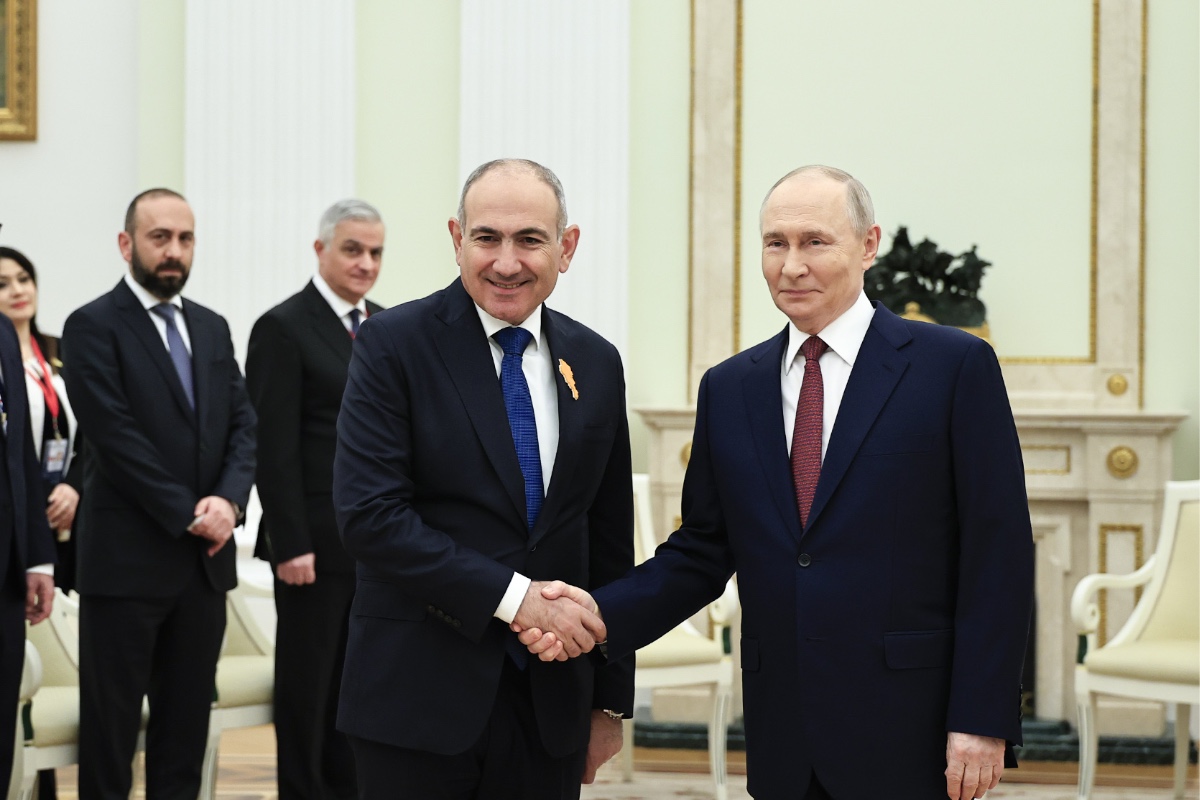
Previously, on April 1, Russian President Vladimir Putin used the same rhetoric during a meeting with Pashinyan, reminding him that Russia “sells gas to Armenia for $177.5 per thousand cubic meters, while gas prices in Europe are currently over $600 per thousand cubic meters,” reported Radio Free Europe/Radio Liberty’s (RFE/RL) Armenian Service. Although Russia has a history of using energy as a weapon, Putin’s exchange with Pashinyan seems to have served a different purpose.
Pashinyan came to Moscow amid the election campaign. In the heart of the Kremlin, he openly criticized the Russian-dominated Collective Security Treaty Organization (CSTO), justifying his decision to suspend Armenia’s participation in CSTO activities. In response to the Russian leader’s remark that Yerevan, being part of the EAEU, cannot simultaneously seek to join the EU, Pashinyan said Armenia plans to develop relations with both the EU and the EAEU “as long as it is possible.”
More importantly, knowing that energy plays a crucial role in Russia’s foreign policy, Pashinyan stressed that although Armenia is discussing the construction of a new nuclear power plant with Moscow, it is also exploring the matter with others. Given that Pashinyan and U.S. Vice President JD Vance signed a civil nuclear cooperation agreement on February 10, it is highly likely that Pashinyan sees Washington, rather than Moscow, as Yerevan’s major nuclear energy partner.


There is no doubt that Pashinyan’s appearance in the Kremlin was part of his election campaign. By defying Putin, he likely aimed to portray himself as a statesman protecting Armenia’s sovereignty in the eyes of his voters. However, it remains unclear why Putin agreed to participate in Pashinyan’s performance, in which the Russian leader effectively ended up being humiliated.
Pashinyan’s rhetoric suggests that he no longer sees Russia as Armenia’s ally. On the other hand, Russian policymakers, although aware of the ongoing decoupling between Moscow and Yerevan, do very little to keep Armenia within the Kremlin’s geopolitical orbit. Threats to cut off gas to the country of around three million people can only have the opposite effect — strengthen Pashinyan’s position and force him to develop closer ties with the West.
If history is any guide, the Soviet Union had a similar approach to Yugoslavia in 1948. The friction began in March 1948, when Moscow issued an ultimatum-like letter demanding that Yugoslav leader Josip Broz Tito comply with Soviet directives regarding foreign policy. Tito’s refusal to comply led to the split between him and Soviet leader Joseph Stalin. As a result, Yugoslavia began developing closer ties with the West and later became one of the leaders of the Non-Aligned Movement.
Threats to cut off gas to the country of around three million people can only have the opposite effect — strengthen Pashinyan’s position and force him to develop closer ties with the West.
At the time, Tito used the Cold War to carefully balance between the two major blocs. Pashinyan, however, does not seem to have such ambitions — nor does he have Tito’s charisma and influence in international politics — as all of his cards are aligned with the West. Even his policy of normalizing relations with Turkey and Azerbaijan seems to be closely coordinated with Western powers — particularly the United States, which is pushing for the construction of the Trump Route for International Peace and Prosperity.
Besides issuing threats, the Kremlin, for its part, does not seem to be taking concrete steps to preserve even the remnants of its influence in Armenia, nor to win the hearts and minds of the Armenian people. That is why, in the event of a Civil Contract party victory, a Pashinyan-Putin split seems inevitable.
The fact that Pashinyan skipped the EAEU summit in Astana, citing the upcoming elections, indicates that Armenia, if forced to choose between the EAEU and the EU, will choose the latter. That, however, will be rather challenging given Armenia’s close economic ties with Russia, which is why Pashinyan’s strategy of distancing Yerevan from Moscow needs strong Western financial backing. At this point, it remains uncertain whether Western powers intend to support Armenia in a similar way as they supported Yugoslavia following the Tito-Stalin split. Without such support, Armenia’s geopolitical shift could amount to economic suicide.
Still, for the time being, Yerevan is expected to continue strengthening ties with the United States. Secretary of State Marco Rubio’s visit to Armenia on May 26 and the signing of a strategic partnership agreement between the two countries are indicators of a strategic shift in Yerevan’s foreign policy. Rubio’s trip to Armenia was also a clear support for Pashinyan ahead of elections, as was the 8th European Political Community (EPC) Summit held in Yerevan on May 4.
Through the summit, the EU indirectly signaled that Pashinyan remains its preferred candidate in the elections. Pashinyan was even indirectly backed by Azerbaijani President Ilham Aliyev, who stressed that “the Armenian people could suffer if factions pushing anti-Azerbaijan rhetoric come to power in Yerevan,” according to the Azerbaijani Report news site.
At this point, it remains uncertain whether Western powers intend to support Armenia in a similar way as they supported Yugoslavia following the Tito-Stalin split. Without such support, Armenia’s geopolitical shift could amount to economic suicide.
Thus, with support from the West and Azerbaijan, Pashinyan’s victory seems very likely. However, to fully implement a policy of decoupling from Russia, he will need more than statements of political endorsement from international partners. Without financial backing, a break with Moscow could come at a heavy price for the Armenian people.


I wonder when Pashinyan and his puppets amd dupes will ever realise thst you can’t decouple from Geography.
Pashinyan and his foolish supporters live in a dream world, who pretend that Armenia is located in Central Europe, surrounded by peaceful and civilized neighbors. Turks and Azerbaijanis won’t change – for the better. Expecting them to change is like expecting a wolf to become a herbivore and tame.
This is suicidal, Armenia is surrounded by turkish enemies who reject the fact of the genocide and want to squeeze whats left of armenia out of the way. Russia was the only guarantor of Armenias safety and PRIOR to the second Artsakh war Pashoglu distanced and bit Russias hand. Now the outcome of Armenia’s final dissolution is inevitable. It will become a satellite of US, Israeli and Turkish interests with no sovereignty of its own.