


For nearly a decade, Armenians have been subjected to a political communication strategy that follows a recognizable and deeply damaging pattern: first, emphatic denial; second, ridicule of concern; third, gradual normalization of the previously denied possibility; and finally, acceptance of the very outcome once dismissed as impossible. This pattern has repeated itself across issue after issue: Artsakh, territorial concessions, constitutional changes, relations with Turkey and Azerbaijan, the so-called “corridor” and now discussions surrounding the settlement of Azerbaijanis in Armenia.
The danger of this strategy is not merely political. It is psychological. Understanding this distinction is critical because one of the most persistent false equivalencies in Armenian public discourse today is the claim that both the ruling regime and the opposition are simply engaged in competing forms of fearmongering or “gaslighting.” They are not.
The ruling authorities have repeatedly denied risks, mocked concerns, dismissed warnings as hysteria or foreign manipulation, only to later normalize, implement or openly defend the very outcomes they previously claimed would never happen. The opposition, meanwhile, has largely found itself in a reactive posture, constantly trying to document contradictions, preserve institutional memory and warn society about consequences before they materialize.
This distinction matters to those who value truth and defend the interests of the Armenian nation.
One side repeatedly shifts reality itself. The other is attempting, however imperfectly, to keep pace with a rapidly changing political landscape in which red lines continuously collapse.
The issue, therefore, is not simply “fear.” The issue is credibility.
Armenians are not imagining that major national reversals have occurred over the past six years. They are reacting to observable political outcomes: the loss of Artsakh, the ethnic cleansing of Artsakh Armenians, changing rhetoric regarding Armenian sovereignty, discussions surrounding constitutional revision, the assault on the Armenian Church, history and values, the increasing normalization of Turkish and Azerbaijani demands, and public discourse that would once have been politically impossible.
The objective is not simply to convince the Armenian public of a specific policy position. The objective is to exhaust the public’s confidence in its own memory, intuition and lived experience until the population becomes psychologically conditioned to accept outcomes that previously would have been considered unthinkable.
This is why so many Armenians increasingly use words such as “gaslighting,” “hypnosis,” “demoralization” and “psychological warfare” to describe the public discourse surrounding the current ruling regime.
The core grievance is not that the government simply made unpopular decisions. Governments do that routinely. The grievance is that the public increasingly feels it is being told not to trust its own memory.
There was no corridor issue.
Then there was.
There would be no abandonment of Artsakh.
There was war, and 44 days of deception.
Then Artsakh was declared part of Azerbaijan.
There would be no erosion of sovereignty.
Now discussions have emerged regarding externally managed transit arrangements and constitutional changes aligned with Azerbaijani demands.
Concerns about Azerbaijani return narratives were dismissed as paranoia. Now, Azerbaijani officials openly discuss “Western Azerbaijan,” the return of Azerbaijanis to Armenia and historical claims over Armenian territory. The Armenian authorities not only do not deny these narratives but now openly speak of them.
First comes the emotionally charged nationalist language: “Artsakh is Armenia, and that’s it.” Then comes the denial of danger. Then comes ridicule directed at anyone who expresses concern. Then comes gradual reframing: Perhaps compromise is necessary; perhaps historical assumptions were wrong; perhaps national expectations were unrealistic. Finally comes the reversal itself: Artsakh is Azerbaijan, the issue is closed, move on.
Many Armenians feel psychologically manipulated by the constant movement of political red lines. This is not fundamentally about one policy disagreement. It is about trust. The Armenian public remembers being told there would be no concessions. It remembers being told there was no corridor issue. It remembers being assured that sovereignty would remain untouched. It remembers being told that Artsakh Armenians would not be abandoned.
Now the public is increasingly hearing discussions that once would have been politically unimaginable: constitutional changes aligned with Azerbaijani demands, regional “communications” involving external oversight, normalization without reciprocity, and rhetoric that minimizes or reframes core Armenian national concerns.
The issue is not whether every fear circulating in Armenian society will materialize exactly as described. The issue is that the Armenian public no longer trusts the political communication process itself.
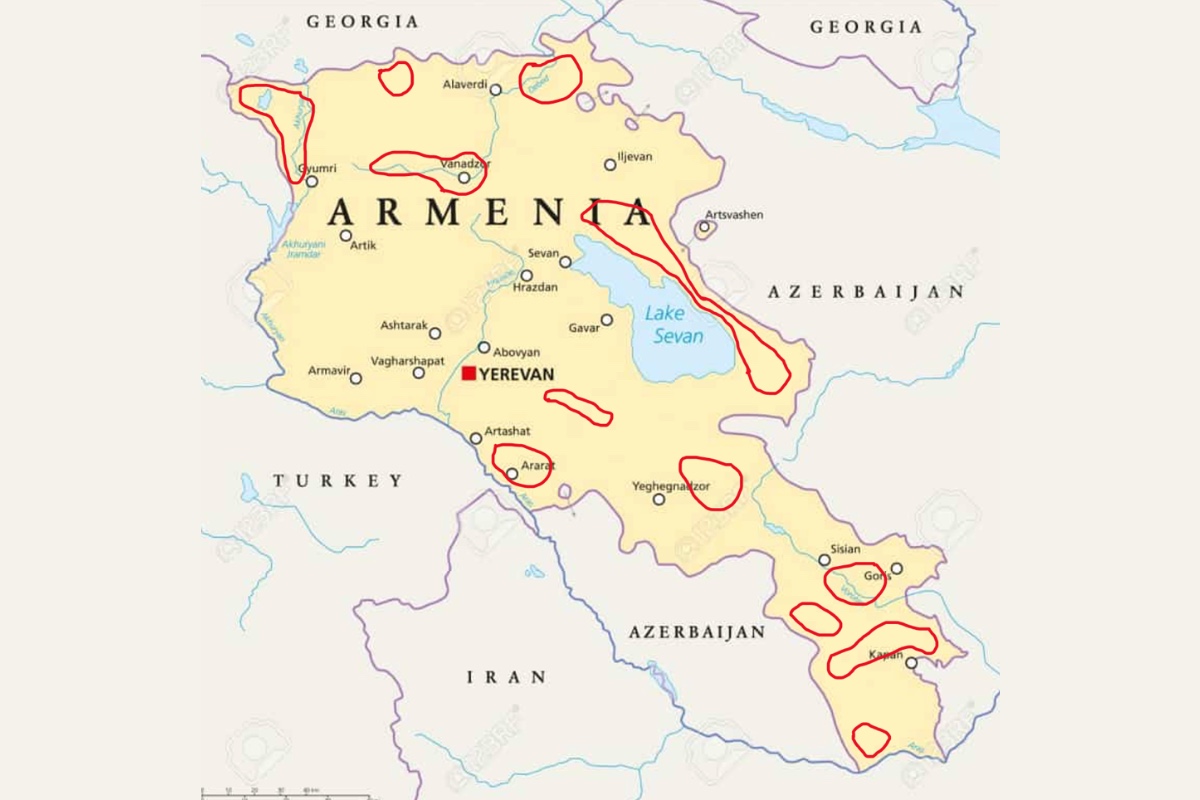
This dynamic is particularly visible in discussions surrounding the possible return of Azerbaijanis to Armenia. One of the most emotionally charged issues in Armenian political discourse today concerns the prospect of settling large Azerbaijani populations — approximately 300,000 people — within Armenia proper, including in Syunik, Gegharkunik, Tavush and other regions.
Critics of the government point not to abstract conspiracy theories but to explicit Azerbaijani rhetoric regarding “Western Azerbaijan,” organized conferences discussing Azerbaijani return narratives and increasingly normalized public discourse regarding the rights of Azerbaijanis to return to Armenia, confirmed by members of Armenia’s ruling elite.
One may debate the precise scale or immediacy of these risks. But dismissing such concerns as pure fantasy becomes increasingly difficult when Azerbaijani officials themselves repeatedly advance these narratives publicly and Armenian officials do nothing to counter them.
An annotated map circulating widely in Armenian political discussions and referenced repeatedly in recent commentary highlights areas where approximately 150 villages are distributed across strategically sensitive regions of Armenia. These settlement zones are not random demographic locations but align closely with the broader “Western Azerbaijan” narrative advanced by Azerbaijani state-linked actors.
The map is particularly alarming because of the strategic locations it highlights. Significant concentrations appear along the eastern Lake Sevan region and throughout Syunik, areas that collectively control some of Armenia’s most critical transportation arteries, elevated terrain, and water resources. In Syunik specifically, large-scale Azerbaijani settlement patterns could eventually create demographic and political pressure along Armenia’s only reliable land connection to Iran, the country’s most strategically important external access route outside Turkish and Azerbaijani influence.
Other highlighted settlement zones sit near key highways, mountain passes, and major water systems throughout Gegharkunik, Tavush, and northern Armenia, where such demographic positioning could gradually produce not merely coexistence challenges, but long-term strategic vulnerability, giving Azerbaijani populations proximity to Armenia’s infrastructure, transit corridors and vital water resources.
Again, the issue is not whether every maximalist prediction will occur exactly as described, thoughArmenians have repeatedly seen once-dismissed outcomes materialize. The issue is that Armenian society is being asked to dismiss concerns that intersect directly with publicly stated Azerbaijani geopolitical narratives, strategic geography, and recent historical experience.
This is precisely where the opposition believes the ruling regime has engaged in a dangerous communication strategy: ridicule first, normalize later.
Those warning about these developments are frequently accused of fearmongering. Yet the opposition’s central argument is not that people should panic but that Armenian society should prepare, analyze and negotiate from a position of awareness rather than denial.
For years, public concern over such issues was often dismissed as fearmongering. Yet Azerbaijani officials and affiliated organizations have repeatedly spoken publicly about “Western Azerbaijan,” the settlement of Azerbaijanis in Armenia and historical claims regarding Armenian territory. Whether these positions are immediately actionable or not is not the only issue. The issue is that Armenians increasingly feel that concerns once mocked as irrational are later quietly acknowledged as real.
This is precisely how psychological trust collapses.
At the same time, the Armenian public is being presented with a parallel English-language narrative aimed primarily at diaspora and Western audiences. This narrative often portrays Armenian concerns primarily as irrational fear, emotional overreaction or manipulative nationalism. A recent piece from EVN Report, “It Has to Be Said,” argues that Armenian society is being driven by fear-based rhetoric and states: “Fear is not a policy. Fear cannot be a strategy.” In principle, this statement is correct. A nation cannot survive purely through fear.
The problem arises when legitimate national security concerns are reframed primarily as emotional pathology rather than responses to actual geopolitical developments.
The same commentary warns against “weaponizing fear” while criticizing narratives regarding territorial loss, Azerbaijani return and national insecurity. Yet many of the underlying concerns referenced in Armenian political discourse are not inventions. They are connected to explicit statements made by Azerbaijani officials, actions taken by Armenia’s ruling party, ongoing regional pressures and the lived experience of Armenians after the loss and ethnic cleansing of Artsakh.
This creates a widening disconnect between Armenian-language political discourse within Armenia and English-language discourse aimed at the diaspora and Western audiences.
The same disconnect is increasingly visible in discussions surrounding Armenia’s economic future and the opening of borders with Turkey and Azerbaijan.
The ruling authorities present open borders primarily as unquestionable goods — symbols of peace, modernization and regional integration. Yet remarkably little public discussion has occurred regarding the economic consequences for Armenian producers, farmers and businesses. In reality, there are stark pricing asymmetries between Armenian and Turkish goods, particularly in agriculture and textiles. Turkish agricultural products are 10 to 50% cheaper than Armenian equivalents, while textile products are dramatically less expensive due to Turkey’s scale advantages and industrial development. The concern being raised is not opposition to trade itself. It is opposition to entering unrestricted competition with a vastly larger neighboring economy without serious transition planning, industrial protections or national economic strategy.
This concern is neither irrational nor anti-peace.
Modern Turkey itself built much of its industrial capacity during the 1980s and 1990s through protectionist economic policies, state support for domestic industry and carefully managed market development before liberalization. Armenia’s current leadership appears willing to expose fragile Armenian agricultural and manufacturing sectors to direct Turkish competition without comparable preparation, subsidies, industrial policy or long-term economic planning. The likely result is not healthy integration but asymmetric economic absorption. If Armenian consumers predictably purchase cheaper Turkish goods, many Armenian producers may simply collapse under the pressure of unequal competition. Small farmers, textile producers and local manufacturers, already operating under difficult conditions, will find themselves unable to survive. This is not abstract nationalism; it is a question of whether Armenia intends to maintain productive national economic capacity or gradually transition into dependency on neighboring economies. Yet these concerns are often dismissed in English-language discourse primarily as emotional resistance to peace or irrational nationalism, rather than legitimate questions of economic sovereignty, transition planning and state responsibility.
Inside Armenia, many citizens increasingly feel existential insecurity.
Outside Armenia, English-language “independent” commentary often frames those same anxieties primarily as manifestations of trauma, manipulation, or irrational nationalism. The issue here is not whether every Armenian fear is objectively correct. The issue is whether Armenian concerns are being fairly represented. When media organizations consistently minimize one side of national anxiety while amplifying the framing preferred by ruling authorities and their international partners, questions naturally emerge regarding independence, narrative alignment and agenda-setting. This is particularly important because modern political persuasion does not operate primarily through facts alone.
Decades of communication research show that people process political reality through identity, emotion, trust and social reinforcement. The most effective political messaging is rarely the most factually detailed. It is the messaging that shapes emotional interpretation.
That is why simply fact-checking narratives is often ineffective. The real battle is over framing.
Is concern over sovereignty irrational paranoia or legitimate national caution?
Is resistance to externally imposed concessions extremism or national self-preservation?
Is public skepticism toward geopolitical realignment backwardness or strategic realism for a small, vulnerable state?
These are not merely factual disputes. They are competing identity narratives. The Armenian public must therefore become more sophisticated in evaluating facts and recognizing communication techniques.
One of the strongest findings in modern behavioral science is known as inoculation theory: When people are taught in advance how manipulation works, they become substantially more resistant to it.
Armenians do not need to agree with every opposition argument. Nor must they accept every alarmist prediction. But they should learn to recognize recurring persuasion techniques:
- Denial followed by gradual normalization.
- Ridicule directed toward concerned citizens.
- Reframing national memory as emotional excess.
- Presenting surrender as pragmatism.
- Equating national caution with extremism.
- Using exhaustion and despair to reduce resistance.
None of this means Armenia should reject peace, diplomacy or regional engagement. But genuine peace cannot be built upon psychological exhaustion, manipulated expectations or the erosion of national interests, values, history, memory and confidence. A nation that loses confidence in its own memory eventually loses confidence in its right to exist politically at all. And that is the deeper fear now emerging across significant parts of Armenian society. Armenians do not need more managed narratives designed to condition them into accepting every new concession as inevitable.
They need honesty.
They need transparency.
They need leaders and institutions willing to speak clearly about risks, trade-offs and national consequences.
Most importantly, they need to recover confidence in their own ability to recognize reality without being psychologically managed into submission.
Because in the end, the survival of a nation depends not only on territory or military strength, but on whether its people still possess the clarity, confidence and consciousness necessary to defend their collective future.




This dystopian nightmare can become a reality if the archtraitor Pashinyan stays in power and continues to appease both the Azerbaijani and Turkish enemies. Armenia has not been under such peril since 1915-1921. I think most of us could not have predicted that Armenia, which has always been vulnerable even after winning the First Artsakh War, would fall into such a dire and dangerous situation. While Azerbaijan constantly makes these outrageous, provocative irredentist statements, the Armenian (Pashinyan) government conspicuously, embarrassingly and shamefully remains silent. How much longer will this go on?
Armenia lost and defeat has consequences it’s as simple as that.
It’s taken a long time for this publication and posters to acknowledge that Azerbaijan is plotting settlement of Azeris reportedly descendants of those who left 1988 -91 in Armenia and the continued agitation for return to Arktash was ignoring this prospect which Azerbaijan has been clear would be conditional to it plans for Azeris in Armenia and how the insularity and lack of context has led to this.
The article presents a sweeping narrative that Armenia’s government is deliberately “conditioning” the population into surrender through psychological manipulation. But this framing collapses under careful scrutiny because it relies on selective interpretation, assumed intent, and retrospective certainty, rather than a balanced assessment of Armenia’s current geopolitical constraints and the complexity of state decision‑making.
1. The article treats geopolitical constraints as psychological manipulation
The author claims that the government follows a four‑step pattern—“denial, ridicule, normalization, acceptance”—and uses this to argue that Armenia is being “conditioned” into concessions. Yet this pattern is not evidence of manipulation; it is a post‑hoc narrative imposed on events that were shaped by military defeat, regional power asymmetry, and the collapse of Armenia’s security architecture.
For example, the article states:
“There was no corridor issue. Then there was.” armenianweek…
This is presented as deception, but the reality is that the “corridor” issue emerged because Azerbaijan escalated demands after the 2020 war, not because the Armenian government secretly planned it.
A government responding to shifting external pressure is not “gaslighting”, it is navigating a deteriorating security environment.
2. The article assumes intent without evidence
The author repeatedly attributes intentional psychological strategy to the government:
“The objective is to exhaust the public’s confidence in its own memory.” armenianweek…
This is a serious accusation, but the article provides no evidence of deliberate intent,
no internal documents, no statements, no strategic directives.
It replaces evidence with interpretation.
A government making unpopular or reactive decisions under duress is not proof of a coordinated psychological operation.
Armenia’s leadership may be criticized for strategic errors, communication failures, or misjudgments, but equating these with a deliberate plan to “condition surrender” is analytical overreach.
3. The article collapses complex realities into a single villain narrative
The author frames every development, Artsakh’s fall, border demarcation, constitutional debates, economic concerns,
as part of one unified strategy of manipulation. But these issues have different origins, different timelines, and different drivers.
For example:
• Artsakh’s fall was the result of military defeat and Russian withdrawal, not domestic psychological conditioning.
• Constitutional reform debates predate the current crisis and involve legal alignment with international norms, not capitulation.
• Economic asymmetry with Turkey is a structural reality, not a government‑engineered trap.
By merging unrelated developments into a single narrative, the article oversimplifies and misattributes causality.
4. The article treats public fear as proof of government wrongdoing
The author writes:
“Many Armenians feel psychologically manipulated.” armenianweek…
Public fear is real and must be respected.
But fear is not evidence of manipulation.
Fear is the natural consequence of:
• a devastating military defeat
• the ethnic cleansing of Artsakh
• Azerbaijan’s maximalist rhetoric
• the collapse of Armenia’s traditional security guarantees
The article misinterprets trauma as proof of conspiracy.
5. The article selectively cites Azerbaijani rhetoric to imply inevitability
The article highlights Azerbaijani statements about “Western Azerbaijan” and settlement plans:
“Azerbaijani officials openly discuss ‘Western Azerbaijan’… approximately 300,000 people.” armenianweek…
These statements are dangerous and must be taken seriously.
But the article uses them to imply that Armenia’s government is preparing to accept these demands, without presenting any evidence that Yerevan has agreed to or is negotiating such settlement.
Azerbaijan’s rhetoric is a threat, but the
article treats it as a foregone conclusion, reinforcing fear rather than informing strategy.
6. The article mischaracterizes economic arguments
The author argues that opening borders will lead to “economic absorption” because Turkish goods are cheaper:
“Turkish agricultural products are 10 to 50% cheaper.” armenianweek…
This is true, but the conclusion that Armenia is being “conditioned” into economic dependency is speculative.
Every small economy bordering a larger one faces similar asymmetries.
The question is not whether asymmetry exists, but how Armenia can negotiate safeguards, transition periods, and industrial policy.
The article presents a structural economic challenge as evidence of a psychological operation, which weakens its credibility.
7. The article’s framing risks disempowering Armenians
Ironically, by insisting that Armenians are being “conditioned,” the article does exactly what it accuses the government of doing:
it undermines public agency.
If every development is part of a master plan, then:
• citizens are victims, not actors
• institutions are puppets, not decision‑makers
• outcomes are predetermined, not influenceable
This framing is emotionally powerful but strategically harmful.
A more grounded interpretation
Armenia is not experiencing a government‑engineered psychological operation.
It is experiencing:
• the consequences of military defeat
• the collapse of its security umbrella
• aggressive demands from a stronger adversary
• internal political fragmentation
• a painful national reckoning
These are structural realities, not manufactured illusions.
Criticism of the government is legitimate and necessary.
But attributing every development to a coordinated plan to “condition surrender” replaces analysis with narrative—and risks deepening societal despair rather than strengthening national resilience.
Excellent analysis and so true. Unfortunately, dollars buy many “governors” not true heads of states who do the bidding of their masters and Pash is one of those governors, the governor of Armenia.