



The socio-cultural dilemma of Armenia’s “Citizen’s Day”
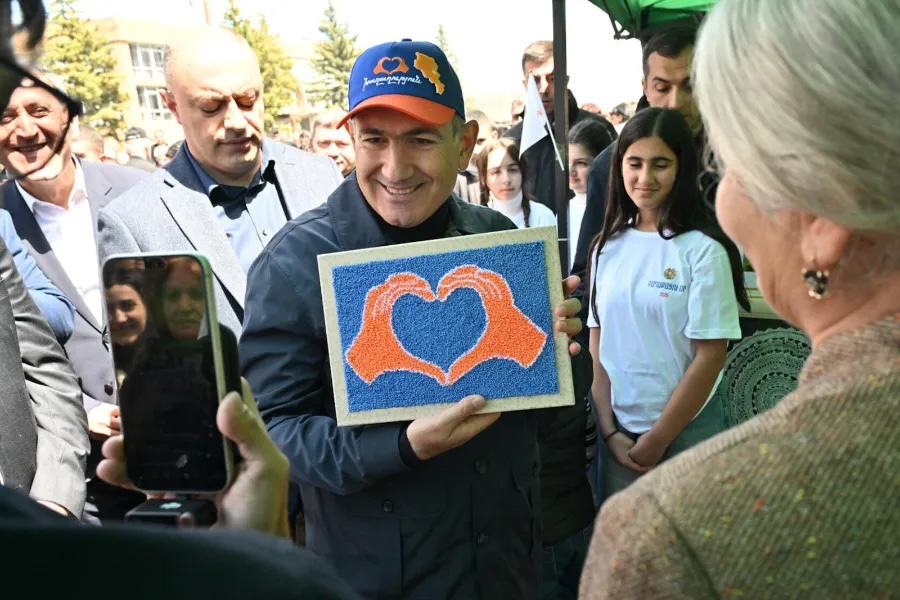
The formation and evolution of public holidays are shaped by the interplay of social, economic, historical, political, ethno-cultural and religious processes. In this sense, Armenia’s “Citizen’s Day” should not be understood merely as a newly introduced holiday but as part of a broader political and cultural project aimed at constructing and reaffirming civic identity.
In general terms, holidays can be divided into two broad categories: spontaneous and systemically constructed. The former emerge “from below,” rooted in everyday life, collective emotional release and informal cultural practices. The latter, by contrast, are “imposed from above,” functioning as institutionalized instruments of memory, ideology and identity. “Citizen’s Day” clearly belongs to the second category.
The tradition of creating state holidays, especially in post-revolutionary contexts, dates back to the French Revolution, when the calendar itself became a tool for constructing a new national order. In a similar logic, Armenia introduced “Citizen’s Day” after the 2018 Velvet Revolution, through amendments to the Law on Holidays and Memorial Days in 2019. It was designated as a day celebrated on the last Saturday of April, with the aim of symbolically consolidating the political transformations of 2018.
Although the name avoids explicit reference to the revolution, the holiday is structurally inseparable from it. In this regard, a comparison with Independence Day is revealing. Both holidays are built around the idea of an “origin,” both attempt to renegotiate the relationship between citizen and state, and both emerge in a post-crisis context. Paradoxically, however, they are often perceived not as complementary narratives, but as competing ones.
Unsurprisingly, the introduction of the holiday generated diverse public reactions. Some interpreted it as an affirmation of democratic values; others viewed it as a politicized initiative that failed to represent the entire society. Proposals emerged to rename it “Day of Solidarity” in an attempt to soften political polarization. Meanwhile, the first celebration in 2019 was marked by mass participation and a lingering sense of revolutionary euphoria. Streets turned into open stages of public life, where people danced, sang, organized fairs and even held informal outdoor gatherings—echoing the collective energy of the revolutionary period.

However, in the following years, the meaning of the holiday shifted significantly. After the 2020 war, widespread societal disappointment and polarization reshaped the symbolic field surrounding “Citizen’s Day.” What had initially been framed as the “victorious citizen’s day” gradually acquired opposing interpretations—becoming, for some, the day of the “defeated” or “fragmented” citizen. In this way, the holiday lost part of its original unifying potential, transforming into a site of political and emotional tension.
In 2026, when Prime Minister Nikol Pashinyan announced that “Citizen’s Day” would be marked on the last Saturday of April—immediately following April 24, and reimagined through a more informal, participatory format, including public gatherings organized around the logic of communal barbecue events. This shift further sharpened the importance of temporal arrangement in understanding the holiday.
From an anthropological perspective, this configuration reveals a transformation of collective emotional regimes. April 24 in Armenia functions as an institutionalized day of mourning and remembrance, constructing what can be described as “sacred time”—a temporality separated from everyday life and saturated with symbolic meaning. The immediate transition to celebratory, bodily and sensory practices—such as public barbecues—signals a move into “profane time,” characterized by sociability, consumption and visible expressions of joy. Crucially, this transition occurs without sufficient mediating phases, producing a sense of semantic and emotional dissonance.
This phenomenon can be interpreted through Victor Turner’s concept of liminality. April 24 constitutes a liminal moment in which collective identity is reworked through mourning and memory. Yet, the passage out of this liminal state requires a “reaggregation” ritual—an intermediate cultural mechanism that is largely absent in this case. As a result, the shift from mourning to celebration is experienced not as a culturally structured transition but as a rupture.
Similarly, from the perspective of Émile Durkheim’s distinction between the sacred and the profane, this temporal proximity generates normative tension. Sacred time demands silence, restraint and specific forms of respect, yet it appears to remain “unclosed” when immediately followed by noisy gatherings, food-centered sociability and bodily expressions of enjoyment. This creates a perceived violation of symbolic boundaries.
At the socio-psychological level, such juxtaposition produces divergent responses: defensive mechanisms that favor rapid disengagement from mourning; normative conflict and alienation among those who perceive the transition as inappropriate, and internal ambivalence among individuals simultaneously navigating both emotional regimes.
Ultimately, “Citizen’s Day” can also be seen as an attempt to construct a contemporary model of civic identity through a new symbolic calendar. However, when this calendar is superimposed onto deeply traumatic historical memory without sufficient cultural mediation, it produces what might be called a fragmented narrative—where commemoration and celebration coexist in tension rather than coherence.
The central issue, therefore, is not merely the content of the holiday, but its placement within public time and the cultural language that surrounds it. If “Citizen’s Day” is to become a stable and widely accepted public holiday, it will require more than institutional designation. It will require carefully designed transitional practices that allow society to process mourning before entering celebration.
Whether “Citizen’s Day” will eventually acquire a stable, unifying meaning or remain a contested political and cultural site will depend not only on policy but also on how Armenian society negotiates the delicate boundary between memory and joy, mourning and civic affirmation, silence and festivity.


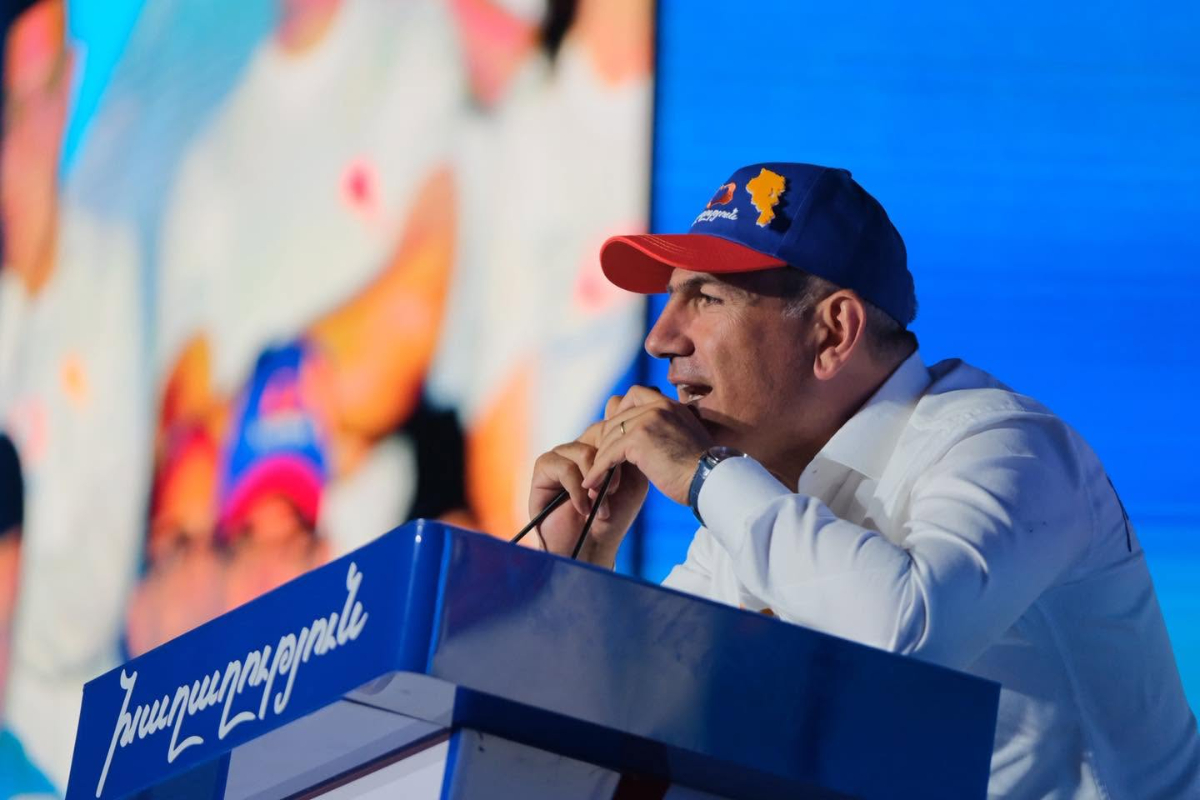
This “Citizen’s Day” introduced by Pashinyan in 2019 to celebrate his so-called “Velvet Revolution” on the last Saturday in April, is not only his narcissistic attempt to celebrate himself, but also an obvious attempt to usurp Armenian Genocide Remembrance Day.
If an average person did and behaved like this psychopath does and behaves he would be rushed to the sanitarium! That sign he is displaying is not the “love” sign but the enemy’s rear end he’s been kissing for years already because he is not man enough to admit to all his mistakes, ask for forgiveness and resign like a TRUE leader would. Insanity is defined as doing the same thing over and over again and expecting different result. The enemy’s behavior has not changed. The enemy is the same scum as it has always been. The enemy has found a sheep with no dignity and sense of patriotism in this fool and is milking him for all it can. There are 12 months in a year. Why pick the month of April and the day after the Genocide Commemoration Day and in this election year for his fake “Citizen’s Day” nonsense? Clearly to manipulate people of course! Because April is the month that marks the start of the 1915 Armenian Genocide and by doing so he is trying to shift people’s focus onto something totally irrelevant so as to overshadow and lessen, slowly but surely, the importance of April 24th in people’s minds with ultimate goal of leaving it in the past to please his genocide denier Turkish and pseudo-Turkish collaborators. He won’t succeed. This act and con game of his reminds me of Turkish-occupied Western Armenia be referenced by our enemies as “Eastern Anatolia” as a cover to remove from the map the existence of Western Armenia and to erase from memory any mention of its native and indigenous multi-millennia Armenian inhabitants. The term “Anatolia” has Greek roots and it means territory “east of Greece”, i.e. today’s Western Turkey, having absolutely nothing to do with the eastern part of the country, occupied Western Armenia!
It would not come as a surprise, if the traitor-in-chief Pashinyan even abolishes Armenian Genocide Remembrance Day and discontinues the official commemoration of the Armenian Genocide by the Armenian state and in schools, in order to please his two Turkic overlords as their ready-to-please compliant satrap. Anything can be expected from this cowardly, treacherous sellout.