



Between political uncertainty and military threats: Syria’s forgotten Armenian community
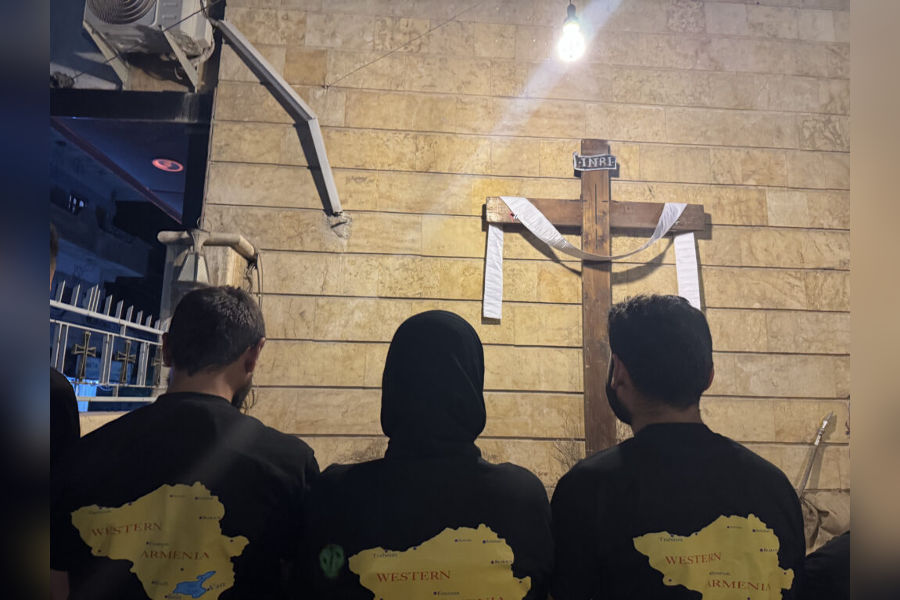
Syria today remains a politically and militarily fragmented country, defined not only by the legacy of a devastating civil war, but also by unresolved tensions between the country’s central authorities and the Kurdish forces operating in the northern and northeastern regions. Periodic clashes, shifting alliances and contested systems of governance continue to generate instability and uncertainty, particularly for minorities caught between competing centers of power. Under these vulnerable conditions, Christian minorities — including Armenians — are forced to ensure their survival and security without genuine guarantees of equal citizenship.
Historically, Armenians in Syria have formed an integral part of the country’s social and cultural fabric. For many decades, Aleppo was one of the most vibrant centers of Armenian diasporic life, with its schools, churches, press and cultural institutions. This strong communal presence, however, sharply declined after 2011 as a result of mass displacement, economic collapse and security instability.
Today, Syria’s Armenian community has diminished in number, its institutions have weakened and its future is uncertain. What for many years was a self-sufficient community has been reduced to a vulnerable remnant, surviving primarily thanks to Christian churches and support from the diaspora. This situation has created a profound and dangerous rupture in the historical trajectory of the Armenian presence in Syria.
Under these conditions, the three Armenian religious denominations — Apostolic, Catholic, Evangelical — continue to play a broader role than mere spiritual leadership. They function as pillars of community governance, organizers of humanitarian assistance and intermediaries with the state. During the years of war, churches also became places of refuge and protection, continuing a historical tradition deeply rooted in Eastern Christianity.
Relations between Armenians and other religious communities in Syria have generally been peaceful, but they have always been based on pragmatic coexistence rather than genuine equality. The war exposed the fragile nature of this coexistence and the vulnerability of minorities amid the disintegration of state authority.

Armenian cultural and religious heritage in Syria remains deeply rooted, yet seriously endangered. Places such as Deir ez-Zor serve as reminders that this presence is not merely cultural, but also part of historical memory and collective suffering.
Under the current circumstances, the issue is no longer solely one of reconstruction, but of securing the political and legal conditions for survival. Without equal citizenship, stable security and genuine rights, the future of Syria’s Armenian community remains bleak.
Unfortunately, amid rapid geopolitical developments and the serious, ongoing crises unfolding in the region, the condition of Syria’s Armenian community seems no longer to be a priority for much of the diaspora. In this environment of limited international attention and limited diasporan capacity, Armenians in Syria remain on the margins, facing existential challenges and an uncertain future.
* Dr. Hratch Tchilingirian is a sociologist, university lecturer and innovation executive. For a more extensive discussion of Armenians in the Middle East, see his chapter on the subject, published in a book in 2023.


There is no future for Armenians in the “new” Turkish-run Islamist Syria anymore, just as there is no future for Armenians in highly volatile Iraq, Lebanon, Iran and Turkey. The ideal solution would be to help all Armenians from these dangerous conflict-ridden and conflict-prone countries to settle in Armenia. But more realistically, they should leave these utterly hopeless powderkeg countries to the West and save their lives, because living there is the equivalent of playing Russian roulette.
Having just read an interview with Levon Sharoyan of Aleppo, I read this disturbing article.
The header reads: “Syria’s forgotten Armenian community”. It is understood than primarily, the Institutional Diaspora is expected to remember the Syrian Armenian community. Obviously, whatever constitutes institutional Diaspora has neglected Syrian Armenians.
In the body of the text, I read: “Without equal citizenship, stable security and genuine rights, the future of Syria’s Armenian community remains bleak>” Obviously the author claims that Syria’s Armenians are not regarded as an equal citizen and are discriminated. Dr. Nora Arissian is the Ambassador of the Syrian Arab Republic to Armenia. She was appointed to the position by President Bashar al-Assad and for all I know continues in that capacity. I imagine that the three Syrian Armenians in the Syrian Parliament continue in that capacity as well in this transition.
Levon Sharoyan is a distinguished Diasporan. He is born and raised in Aleppo and remains put there along with a few thousand Armenians whose Armenian cultural events, even at the present, eclipse that of Armenian Americans on the East Coast.
I suggest the Weekly editorial board post the translation of Levon’s interview to give the interested readers a broader view of the Syrian Armenian Community at the present.
Regarding “equal citizenship”, Christian religious leaders have, on a number of occasions, expressed concerns about equality of citizenship in the proposed new constitution of Syria. For example, about four months ago, Patriarch Aphrem of the Syriac Orthodox Church stated: “The current ‘constitutional declaration’ fails to reflect the aspirations of all Syrians, especially the clause stating that Islamic jurisprudence is the only source of legislation — this must change. We know Syria is a Muslim-majority country, but all citizens — Muslims, Christians, or non-Muslims — must have full rights.” (https://www.copticsolidarity.org/2025/10/15/syrian-christians-seek-stability-equal-citizenship/#:~:text=Asked%20about%20Syria's%20proposed%20new,must%20change%2C%E2%80%9D%20he%20said; and https://premierchristian.news/en/news/article/church-leaders-meet-regime-fate-christians-uncertain-syria#:~:text=The%20meeting%20on%20December%2031,made%2C%20their%20implementation%20remains%20uncertain).