Fragile Armenia-Azerbaijan deal tilted power to Baku and Ankara

For decades, the South Caucasus has been a crucible of ethnic tension, territorial disputes and geopolitical rivalry — a place where historical grievances, national ambitions and great-power competition violently intersect. The agreement signed in August in Washington by Armenia and Azerbaijan, under U.S. mediation, was heralded as a potential turning point. Yet, a closer look reveals a pact rich in symbolism but poor in substance — one that redraws the region’s strategic map while dangerously deferring its deepest conflicts. This new phase not only reshapes the balance between Yerevan and Baku but also directly tests Iran, a traditional regional power whose strategic depth and influence now face unprecedented strain.
A Trump-era blueprint: Grandeur over substance
The ceremonial signing, orchestrated under the watchful eye of Donald Trump, was officially presented as a historic opportunity to close decades of conflict over Nagorno-Karabakh and to normalize relations between two nations born of the Soviet collapse, still bearing open wounds. However, the signed text contains agreements, commitments and omissions that must be rigorously dissected to understand what is truly at stake.
The central element, around which a major geopolitical shift pivots, is the establishment of the corridor dubbed the “Trump Route for International Peace and Prosperity” (TRIPP). This strategic artery is slated to cross Armenian territory, connecting Azerbaijan to its exclave of Nakhichevan and, from there, extending its reach to Turkey and Europe. The exclusive management of its development and operation by a U.S. consortium for nearly a century marks a stark change of era: it displaces traditional Russian dominance and deliberately marginalizes Iranian influence in the South Caucasus.

Formally, the agreement commits both sides to respect territorial integrity, renounce future claims and ban the deployment of third-party forces along the border. Yet, the political reality is far more complex. Azerbaijan maintains its demand that Armenia remove any reference to Nagorno-Karabakh’s status from its constitution — a demand Yerevan is neither close to accepting, nor likely to, given the powerful national sentiments surrounding the issue. Simultaneously, the pact establishes no clear or immediate mechanisms for troop withdrawals or a solution for the political and legal status of the disputed regions, particularly those occupied during Azerbaijan’s 2023 offensive.
This normative and pragmatic vacuum legitimizes, de facto, Baku’s territorial gains from its military campaign, reinforcing a vision of peace not as a balanced compromise but as a ratification of a new reality dictated by force.
Deferred decisions and dangerous ambiguities
The agreement’s formal clauses are riddled with significant ambiguities that hinder effective implementation and generate uncertainty. For instance, there is no agreed-upon map that guarantees Azerbaijani President Ilham Aliyev’s recognition of Armenia’s territorial integrity, a concession Armenian Prime Minister Nikol Pashinyan had previously accepted. This absence creates fertile ground for new disputes, especially because the multiple Soviet-era maps expected to form the basis of resolution are subject to contradictory interpretations.
Furthermore, key articles curtail or condition fundamental rights for one party. Articles 1 and 6 establish formal mutual recognition but postpone precise border delimitation for future negotiations, leaving the very concept of “recognition” in suspense. Article 7 prohibits the deployment of third-party forces along the border, a restriction that unilaterally reduces the defensive capacity of strategically isolated Armenia, while Azerbaijan can openly rely on the military support of Turkey.
Moreover, Articles 8 and 9 employ vague definitions of “separatism” and “extremism” that legitimize ongoing judicial processes against Armenian leaders from Karabakh and leave the door open for new political and legal claims against Armenia. Finally, Article 15 obliges both parties to withdraw all pending cases in international courts and commit to not filing new ones in the future, effectively depriving Armenia of legal tools for its defense — a significant blow, given Yerevan’s active cases against Baku in international tribunals.
This imbalanced framework is exacerbated by statements from Aliyev’s special envoy, Elchin Amirbekov, who declared that if Armenians want to sign the final peace agreement, Baku expects Armenia to amend its Constitution. This constitutes clear interference in Armenia’s internal affairs, directly violating the agreement’s own clause on non-interference. It reveals a profound lack of trust and a power dynamic based on unilateral pressure, undermining the basis for equitable and genuine negotiation.
Iran’s strategic alarm and calculated response
From Tehran’s perspective, this shift is viewed with a mixture of strategic alarm and pragmatic realism. Iran, a traditional regional ally of Armenia and a key actor in Caucasian security and economy, interprets the TRIPP corridor not merely as a trade route but as a de facto beachhead for Western advance — driving another nail into the geopolitical fence constraining its interests.
The corridor displaces Iranian influence, which for years enjoyed privileged access northward to Eurasia via Armenia — access now compromised and potentially replaced by U.S.-managed infrastructure. More sensitively, the risk of Western military, intelligence or logistical presence just kilometers from its border is, for Tehran, an uncrossable red line. This has been bluntly expressed by Ali Akbar Velayati, an advisor to Iran’s Supreme Leader, who warned that the corridor, if materialized under U.S. control with military deployments, would become a “graveyard for Trump’s mercenaries.” His words contain both a threat and a stark statement of deterrence.
Iran’s diplomatic response has been one of calculated containment: it has rejected any unilateral alteration of borders or foreign presence, while showing a willingness to engage in multilateral dialogue formats like the “3+3” initiative (which includes Iran, Russia, Turkey, Armenia, Azerbaijan and Georgia). Tehran is thus balancing the need to preserve its regional influence and security with diplomatic prudence to avoid forced isolation, especially given Moscow’s reduced capacity to act as a regional guarantor.
This ambivalence is evident in significant military maneuvers along the Iranian-Azerbaijani border, designed to underscore Iran’s capacity for response without escalating to open confrontation.
Armenia’s precarious crossroads and the ghost of elections
For Armenia, the situation is one of extreme vulnerability. The apparent abandonment of nationalist rhetoric around Karabakh and the acceptance of painful concessions illustrate a political reality squeezed by military defeat, internal weariness and the absence of traditional Russian support. This places Yerevan at a crossroads: cede territorial sovereignty and decision-making power to an external actor, like the United States, to ensure economic survival and minimal security — at the cost of its inherited strategic autonomy.
Armenia’s volatile internal politics sharpen this dilemma. With roughly seven months until critical parliamentary elections, political conflicts have intensified. The outcome is profoundly important for Iran because a shift in Armenia’s orientation could finalize the geopolitical realignment now taking shape.
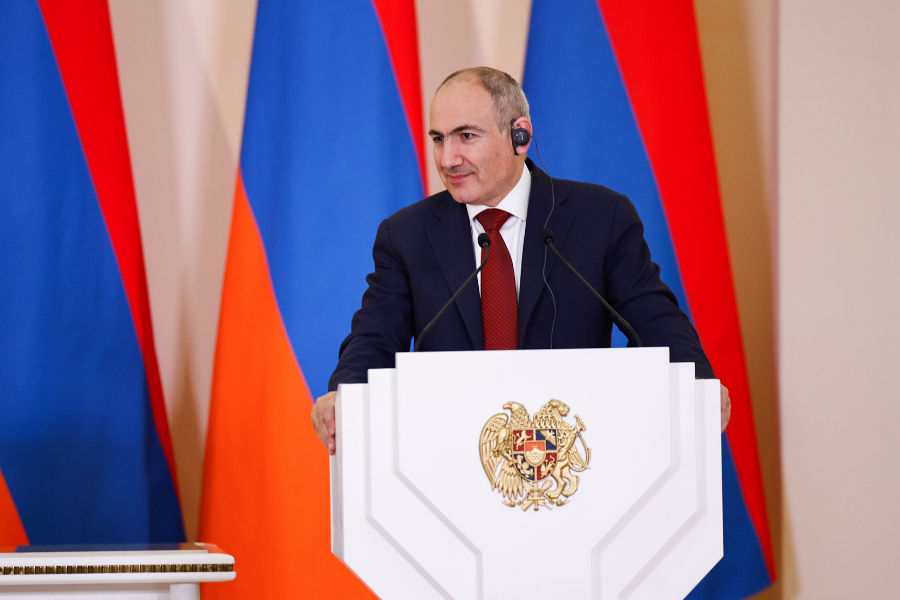
Prime Minister Nikol Pashinyan professes peace with Turkey and Azerbaijan and backs the creation of the TRIPP corridor. He tells an exhausted populace trapped between hostile neighbors that, if he is not re-elected, a new war with Baku is a real risk. He couples this with “promises” of economic stability, greater integration with European structures and increased prosperity.
His opponents, however, are not against peace per se, but against the government’s process for achieving it. They argue that excessive concessions to Baku and Ankara — the acceptance of their economic, cultural and security influence over Armenia and the manipulation of its national identity — constitute an existential threat. They point to Aliyev’s continued use of the term “corridor”; his recent reference to Lake Sevan by its Azerbaijani name “Goycha”; his declarations that Armenia is historical Azerbaijani territory; and his demands for the return of Azerbaijani citizens to Armenia, a tool of demographic manipulation.
The internal dispute is further aggravated by Pashinyan’s hardline attitude toward his political, religious and economic opponents. He has ordered the arrest of many influential opposition activists, with critics alleging he is using corruption charges and allegations of misconduct within the powerful Armenian Apostolic Church to eliminate rivals ahead of the vote. Pashinyan and his supporters counter that his opponents are pro-Russian, seek to overthrow him by harsh means, and are genuinely implicated in corruption.
The stakes of the ballot box
The question of who will win remains deeply uncertain, hinging on several factors. Pashinyan retains a core base of support, and governments in Armenia have relied on a fixed vote of 300,000 to 400,000 voters, often comprising public sector employees and their families. However, the prevailing mood in the country is one of apathy and political disillusionment.
The opposition’s chances depend on its ability to form a broad, united front, renew its leadership and present a credible candidate for prime minister.
The regional implications of this electoral battle are immediate. It is unlikely that before the Armenian elections, the governments of the U.S., Turkey or Azerbaijan will take serious measures to destabilize the country, as any new border conflict or aggressive move to establish the TRIPP route would upset the internal balance to Pashinyan’s detriment. However, should Pashinyan lose, many analysts fear that Turkey and Azerbaijan could rapidly move to attack Armenia to occupy the Syunik province and create the so-called “Zangezur Corridor” by force.
Conclusion: A corridor to an uncertain future
The Washington declaration, self-proclaimed as “historic,” lacks operational content and is shaped by Trump-style politics: striking gestures, grandiloquent branding and open promises that postpone all substantive decisions. Renaming Zangezur the “Trump Route” is, in practice, the only concrete achievement of a negotiation that neither resolves territorial disputes nor addresses fundamental humanitarian or political issues.
Everything important has been left for later, trusting that the rhetoric of progress can substitute for progress itself. No key problem between Armenia and Azerbaijan has been thoroughly discussed; wounds remain open, refugees are still in limbo and forces on the ground have not moved.
Armenia is being forced to accept a game that drastically reduces its autonomy, while Iran, excluded and vigilant, sees its security perimeter and strategic connectivity network threatened. If this experience teaches anything, it is that in the South Caucasus, peace cannot be built on documents unanchored from reality, nor on corridors controlled by actors foreign to the region. True stability will only be possible when structural problems are addressed head-on and inclusively, incorporating the voices and interests of all who share a border and a destiny in this contested space.
Until then, the “Trump Route” will be less a path to peace and more a reminder that, in the Caucasus, grand gestures rarely guarantee lasting solutions. The upcoming Armenian elections are not just a domestic affair; they are a pivotal vote that will determine whether this fragile arrangement holds or collapses — with consequences that will echo from Yerevan to Tehran and beyond.