



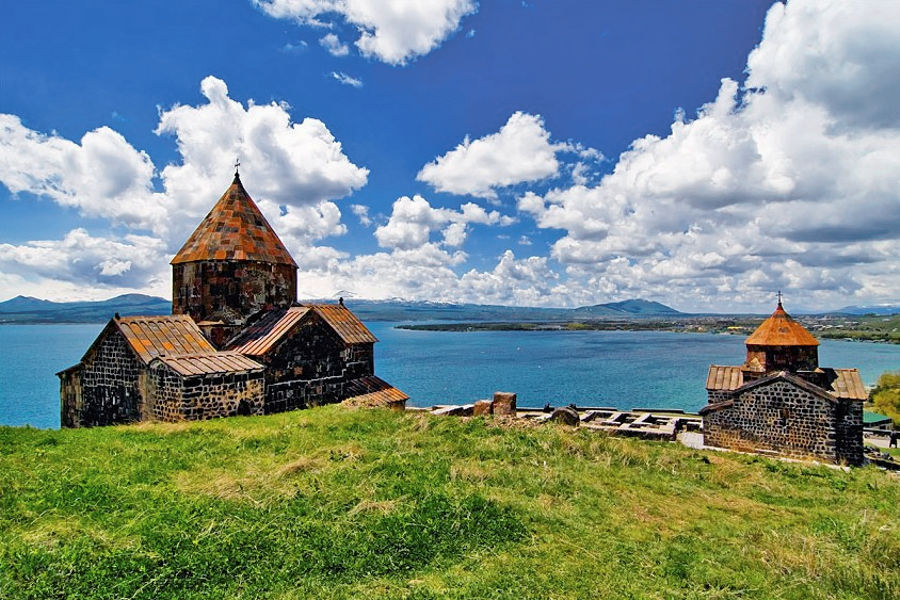
During the latest session organized by the Azerbaijan National Academy of Sciences (ANAS), President Ilham Aliyev stated that “It is enough to look at early-20th-century maps published by Tsarist Russia to see that the overwhelming majority of toponyms in what is now Armenia are of Azerbaijani origin.” He went on to claim that there was “no Lake Sevan” but “Lake Goycha… along with all other Azerbaijani historical toponyms we use.”
Subsequently, he added, “We did not compile those maps for someone to say that we are falsifying something here. Tsarist Russia did this. The same Tsarist Russia that once brought Armenians from Iran and Eastern Anatolia and settled them in our Karabakh land so that the ethnic and religious composition would change here.”
Unfortunately, such claims are hardly new. In recent years, the Azerbaijani leader has referred to Armenian territories as “historical Azerbaijani lands” several times, denying their ties to the Armenian people. This rhetoric aims to portray Armenians as “newcomers” who arrived in the South Caucasus only in the 19th century, following the Russian conquest of the region.
However, these assertions are entirely baseless — Armenians have not only inhabited the Caucasus since ancient times but also established their own political entities, such as the Kingdom of Greater Armenia. In the case of Lake Sevan, Aliyev’s chauvinistic claims are easily debunked. In fact, modern Western sources indicate that the toponym was used even before the annexation of the Southern Caucasus to Russia.
For example, the “Compendio storico di memorie cronologiche concernenti la religione e la morale della nazione armena suddita dell’Impero ottomano” (“Historical compendium of chronological memoirs concerning the religion and morals of the Armenian nation subject to the Ottoman Empire”) — a monumental work published by the Italian marquis Giovanni de Serpos in 1786 — refutes the claim. The report says, “There are three most notable lakes in Greater Armenia, namely Van, Gelan and Kabodan…The second lake, called Gelan, is in Siunia [Syunik], and bears the name of one of the ancient patriarchs, or heads of families; but more commonly, it is called Lake Sevan from the island of Sevan.”

Let’s consider another book: the sixth volume of “Geographia historica,” edited by the Spanish cartographer Pedro Murillo Velarde in 1752. On page 98 of the volume, it reads, “Three short days’ journey northeast of Erivan lies Lake Sevan.”
Even French sources — such as “Histoire moderne des Chinois, des Japonais, des Indiens, des Persans, des Turcs, des Russiens, &c.” (“Modern history of the Chinese, Japanese, Indians, Persians, Turks, Russians, etc.”) — utilize the Armenian toponym. Specifically, the seventh volume of this publication, carried out by François-Marie de Marsy around 1758, states: “The Persian possessions include Erivan, a province situated at the eastern extremity of Greater Armenia, to the west of Shirvan and to the south of Georgia. It is watered by the Kur, the Araxes, the Zangui, etc. and by a lake called Erivan, or Sevan, which has a circumference of twenty-five leagues.”
Lastly, it’s worth mentioning the case of Jonas Hanway, who published “An Historical Account of the British Trade Over the Caspian Sea” in 1753. In his account of Yerevan, the author writes: “At the foot of this rock runs the river Zengui, which emerges from the lake Sevan.” It is true that the Turkic place name Gokcha (or Gökche) — meaning “blue lake” — was used by some to refer to the location, since both Christian Armenians and Turkophone Muslims inhabited the area; nonetheless, it coexisted with the term Sevan.
It is evident, therefore, that Aliyev’s recent statement does not reflect historical reality: the toponym Sevan wasn’t coined after Russian expansion in Transcaucasia. On the contrary, the declaration released by the Azerbaijani president demonstrates the spread of pseudo-historical theories in Azerbaijan, a country where the past is exploited and falsified to legitimize irredentist dreams and anti-Armenian hatred.
Indeed, since the Soviet era, Azerbaijani scholars — such as Ziya Bunyadov, Igrar Aliyev and Farida Mammadova — have published books, articles and studies through which they have sought to erase Armenians from Caucasian history. These “scholarly works” portray Armenians as a foreign people brought into the region by the Russian Empire following the treaties of Gulistan (1813) and Turkmenchay (1828), which forced Iran to cede territories corresponding to modern-day Armenia and Azerbaijan to Saint Petersburg.
According to Baku, Russia settled Armenians on Azerbaijani soil, which allegedly included not only Karabakh but also the Republic of Armenia, in order to facilitate imperial control, since Christians were considered more loyal to the Romanov monarchy than Muslim subjects. The logical consequence of such a theory is that Armenia must be considered an artificial state created at the expense of Azeris, who were unjustly deprived of their lands.
Later, this academic pseudo-historical conceptualization became a useful instrument for legitimizing a political discourse characterized by Armenophobia, chauvinism and irredentism. For example, President Ilham Aliyev, during a speech delivered to Milli Majlis (National Assembly of Azerbaijan) in November 2015, publicly declared: “The present-day Armenia is an artificial state created on historically Azerbaijani lands. I want to say again that this truth should be known to the world, because historical fundamentals, of course, also play an important role in resolving the conflict.” This kind of rhetoric often refers to “Western Azerbaijan,” a supposed historical region centred on modern-day Republic of Armenia, which Azerbaijani nationalists claim as part of their nation.
Furthermore, this concept has received official endorsement from the current regime, especially by its leader, who regularly labels Irevan (Yerevan) and Göyçə (Lake Sevan) as “Azerbaijani lands.” In his inauguration address in December 2022, Ilham Aliyev proclaimed, “Present-day Armenia is our land. When I repeatedly said this before, they tried to object and allege that I have territorial claims. I am saying this as a historical fact.”
Such statements have become increasingly common since the end of the 2020 Nagorno-Karabakh war, which saw Baku defeat its long-standing rival. Currently, Azerbaijan is trying to use the “Western Azerbaijan” concept in order to strengthen its diplomatic position, by comparing the rights of the former Azerbaijani minority in Armenia — who were displaced during the 1990s — to those of Karabakh Armenians.
According to such logic, the fate of the exiled Armenians can be debated only if the fate of the expelled Azeris is discussed, too. In fact, through the so-called Western Azerbaijan Community (WAC), Baku explicitly promotes the return of Azeri families to Armenia. However, the notion also reflects expansionist ambitions nurtured by the post-Soviet republic, which appears interested in acquiring new territories, especially in Syunik Province, which separates Nakhichevan from Azerbaijan proper.
In the aforementioned context, history plays a significant role, being weaponized to validate geopolitical ambitions.
Academia is one of the primary targets of this project, to the point that Azerbaijan spends hundreds of thousands of dollars annually to influence it, attempting to shape a positive image of itself to sell to global public opinion. Thanks to such an operation, the autocracy has managed to create a network of loyal scholars who, maintaining close ties with the Azerbaijani dictatorship, act as lobbyists alongside their academic careers.
In conclusion, President Aliyev’s recent speech at ANAS does not constitute mere disinformation but rather proof of Baku’s hostile conduct towards Armenia. This attitude appears to persist, despite the agreement signed at the White House last August.
Formal commitment to peace and dialogue — shown by Azerbaijan in international forums — collides with the hateful and jingoistic speech endorsed domestically, becoming one of the biggest obstacles to genuine reconciliation.

First of all, Ilham Aliyev the chicken-hawk son of the late KGB agent Heydar Aliyev whose army we wiped out in utmost humiliating fashion and whom we brought to his knees in front of coward Ilham’s eyes is delusional and is suffering from inferiority complex. His bold-faced lies and history fabrications are a manifestation of his lack of ability to digest that humiliating defeat they suffered at the hands of victorious Armenians back in 1994. Imagine how delusional one belonging to a former tribe of sheep herders with an artificial state invented 107 years ago in 1918 on occupied historic Armenian territories, that is the dictatorship of Azerbaijani petrostate, has to be to make such empty claims against the ancient Armenian nation with well-known and world-renowned Armenian kingdoms dating back to 6th century BC! He is a sore loser and his artificial state totally irrelevant in world affairs in absence of the Caspian oil and gas resources. Given his tribe and artificial terrorist cesspool totally unknown to the world, he should thank the Armenians for putting his artificial state on the map as a result of their defeat and humiliation at the hands of the Armenians right after the collapse of the now-defunct Soviet empire! I laugh at this pseudo-Turkish fool!
P.S. The Sevan Lake has always been Sevan Lake except in his imagination and fabricated rewritten fake history which itself was proposed, initiated and ordered to his artificial state’s racist anti-Armenian thieves disguised as fraudulent historians. If one can misappropriate someone else’s property and claim it as his own by giving it a false name and using his own twisted logic, what then is the ancient Armenian province of Nakhichevan with purely and authentically original Armenian name still doing under Azerbaijani occupation? For those who don’t know, Nakhichevan (Նախիջեվան or Նախիջևան) in Armenian means: The Original Resting Place of Noah’s Ark. Nakh-iche-van in which Nakh (Նախ) = Primary/Original; iche (իջե from the verb իջել) = To descend/Come to rest; van (վան) = Place/Region.
Can the supporters of Pashinyan and of this so-called “peace agreement” explain what “benefits” and “safeguards” Armenia has “gained” and what “peace” has been “established”, when Aliyev constantly expresses provocative Azerbaijani irredentist rhetoric against Armenia, constantly threatens Armenia with war, occupies 200 square kilometers of Armenian territory, holds many Armenians as hostages in Baku prisons and engages in a cultural Armenian Genocide in Artsakh which he violently ethnically cleansed of all Armenians?