




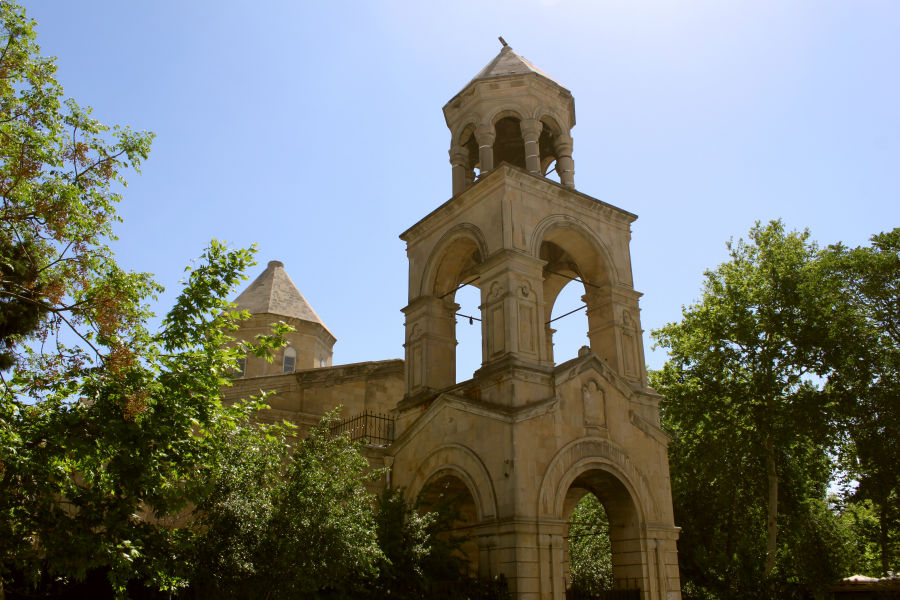
In the center of Baku, shadowed by 19th-century buildings and modern skyscrapers, stands a small church silently amid the urban frenzy. It is Saint Gregory the Illuminator Church — commonly called “the Armenian church” — a historic structure near Fountain Square.
Today, this edifice is no longer merely a historical or religious monument. Deprived of its original community, it has been reframed by Azerbaijani authorities as a symbol of their alleged commitment to tolerance and multiculturalism.
In a certain sense, this monument is a relic of a world and a time that no longer exists and cannot be brought back. The church was designed by Karl Hippius, a Baltic German architect, and subsequently built between 1863 and 1869. During that period, Baku was a part of Russian-ruled Transcaucasia and known for its flourishing multicultural environment. Azerbaijanis — at the time known as Caucasian Tatars — were one of many ethnic groups living in this Caspian city. Many Russians, Armenians, Jews, Tats, Iranians, Germans, Georgians and Poles lived there, drawn by the development of the oil industry. In 1913, Baku’s population included 76,288 Russians, 45,962 Azerbaijanis, 41,168 Armenians, 9,690 Jews, 4,073 Georgians, 3,274 Germans and 25,096 Persian citizens.
The city’s multicultural character distinguished it from the countryside: the former was modern, progressive, multiethnic and Russophone, while the latter was often depicted as conservative, homogeneous and Turkophone. This dynamic gave rise to a distinct Bakinets identity rooted in the cosmopolitan, multiethnic and Russophone environment of Baku.
Inevitably, different communities left their mark on the urban landscape: Russians built Alexander Nevsky Cathedral and Archangel Michael Church; Protestant Germans erected the Lutheran Church of the Savior; Catholic immigrants established the Church of the Immaculate Conception; Muslims constructed Ajdarbey and Taza Pir Mosques; and Ashkenazi Jews built their own synagogue. Armenians also left traces. During the early Soviet period, three Armenian churches operated: Saint Thaddeus and Bartholomew Cathedral, Holy Virgin Church and Saint Gregory the Illuminator Church.

However, during the second half of the 20th century — especially between the 1980s and 1990s — the metropolis lost its distinctive character and effectively became overwhelmingly Azerbaijani in its demographic composition. Several factors contributed to this shift, including immigration from rural areas, cultural assimilation, economically driven migration and, most notably, ethnic violence during the First Nagorno Karabakh War. The Armenian minority was the victim of ethnic violence between 1988 and 1990, leading to the departure of nearly all members of the community, most of whom fled to Armenia.
Nowadays, the bell tower of Saint Gregory the Illuminator Church remains silent, its nave untouched by worshippers, its walls devoid of the perfume of incense for decades. Despite these historical facts, the monument has become a recurrent leitmotif in Azerbaijani propaganda.
Officials portray the edifice as proof of the country’s tolerance and multiculturalism, juxtaposed to alleged Armenian “chauvinism” and “intolerance.”
In August 2021, Ilham Aliyev, in an interview with CNN Türk, declared: “Azerbaijan is a multi-ethnic and multi-confessional country, and many peoples live here like one family, including the Armenians. Armenians are living in Baku today.”
When the interviewer reminded that “there is an Armenian church [in the capital], and it has not been touched or damaged,” the dictator proudly asserted: “Yes, on the contrary, we have repaired it. It is in the center of the city, and if anyone goes there, they will see that there are about 5,000 Armenian books there. But look what they have done to our mosques? For comparison, more than 60 of our mosques have been demolished.”
Similar statements have been made by several Azerbaijani officials and media. In December 2021 Nasimi Aghayev, Azerbaijan’s ambassador to Germany, posted on X, formerly Twitter, writing: “Unlike #Armenia, where hundreds of ancient Azerbaijani mosques were destroyed, #Azerbaijan has been carefully preserving its Christian heritage. Here is Armenian Church in #Baku, Azerbaijan. Renovated & meticulously preserved with its 5,000 Armenian books by Gov. of Azerbaijan.” In recent years, the official account of the Azerbaijani embassy in Germany has posted several times about Saint Gregory the Illuminator Church, underlining the supposed governmental efforts to protect this monument.
In November 2024, Riad Gasimov, advisor to the chairman and head of the Baku General Directorate of the State Committee on Urban Planning and Architecture, wrote on X: “Armenian church stands safe and sound right in the center of Baku’s main pedestrian square. Is there any Azerbaijani mosque left in Irevan [Yerevan] or anywhere in Armenia? Or it was not Armenians who made pigsties of dozens mosques during the occupation of Karabakh?”
Furthermore, The Azeri Times — an Azerbaijani news outlet — has published multiple provocative statements on X in which the Armenian Church in Baku is juxtaposed with Muslim buildings in Karabakh and Armenia. The website Religious.az claims that the church “…is periodically restored and is under state protection. Currently, about 30,000 Armenians live in Azerbaijan. Despite the aggressive policy of Armenia towards the Azerbaijani people, the Armenians living in Azerbaijan have never been subjected to any type of discrimination and persecution […] Azerbaijan, being a prominent example of multiculturalism all over the world, restored the Church of St. Gregory the Illuminator, destroyed by Armenians.”
This narrative follows a consistent pattern in pro-government messaging. Armenian authorities are often accused of destroying Azerbaijani religious sites, associated with chauvinism and barbarism; Azerbaijan, on the contrary, presents itself as multicultural, tolerant and respectful of minority heritage, even with the enemy. Nevertheless, reality is quite the opposite. Saint Gregory the Illuminator Church does not fully reflect the condition of Armenian cultural heritage in Azerbaijan nor is it a vivid proof of Azerbaijani tolerance.
Saint Gregory the Illuminator Church is one of the few remaining Armenian religious structures in Azerbaijan that has not been demolished, neglected or altered. Since its independence, Azerbaijan has spent extensive effort in concealing its Armenian heritage. Nakhichevan is frequently cited by scholars and Armenian sources as a region where Armenian Christian cultural patrimony has disappeared over time. In other areas, Armenian monuments — including the Monastery of Saint Translators in Dashkasan — are left in decay, leaving them vulnerable to vandalism or natural deterioration. Other churches have been restored under the guise of “restoration works.” Azerbaijan has pursued a process of “de-Armenization” and “Albanization,” which led to the erasure of Armenian inscriptions and symbols from edifices classified as ‘Albanian temples.’
Saint Gregory Church in Baku remains one of the few Armenian religious structures in Azerbaijan that has been maintained in recognizable form. Azerbaijani authorities openly acknowledge its Armenian origin and have kept the building in good physical condition. Critics argue that the church serves as a sort of Potemkin village to create a positive image and conceal the ethnic violence and cultural genocide that Azerbaijan has perpetrated against its Armenian minority. Aliyev’s regime advertises its treatment of the Armenian church in Baku, while hiding the heinous destruction of Julfa’s khachkars or the execrable treatment of Shushi’s cathedral.
The Church’s recent history has little to do with tolerance. In 1989 Azeri nationalists carried out an arson attack against the building, destroying books, paintings and ecclesiastical clothing. According to the American journalist Bill Keller, “…firefighters and the police watched without intervening as vandals destroyed the building…” In 1992, the Church of the Holy Virgin was razed to the ground, leaving Saint Gregory the Illuminator Church empty (without the cross) as the last remaining Armenian place of worship in Baku. The building was later used as a tea house and billiard hall before being transferred in 2002 to the Presidential Library, where it now functions as an archive. No religious services are held there, as the Armenian community in Baku is virtually non-existent.
Today, the Church functions as a carefully maintained exhibit, a visible proof of “tolerance” aimed at external observers, while the wider Armenian heritage in Azerbaijan remains erased or neglected.



Azerbaijan’s so-called “preservation” of the last Armenian church and structure in Baku, is eerily reminiscent of the Nazis’ plan to turn the Old Synagogue in Prague into a “Museum of an Extinct Race”, if they had won World War II and annihilated all Jews in Europe. Azerbaijan has destroyed 99.9% of all Armenian heritage within its borders, and by keeping this church as the last Armenian object, is their sick way of “celebrating” their “accomplishment” of destroying everything Armenian.
These former homeless Caucasian Muslim Tatars, so-called despicable racist Azerbaijani thieves, are experts in spreading propaganda and committing bribery & blackmail. But the thing is they get away with so much of their deceptive actions and that is primarily because they never get any formal and effective response from our incompetent leaders at the state level who never support our historians and cartographers to counter our enemy propaganda machine to expose their lies to the world and to put them to shame. We have quite a few experts in these fields who literally know every inch of our homeland but they are ignored and their expertise never put to use. In addition, in all of interviews the leaders of our enemy terrorist cesspool give to hand-picked western reporters, the English ones in particular and by Ilham the chicken-hawk Aliyev, they are never challenged and countered by these paid and inexperienced & historically illiterate reporters. If there were any Armenians living in Baku, as they claim, I guarantee the first thing they do would be to interview them for the whole world to see but that never happens. They would show Armenians attending the only remaining Armenian Church in that terrorist state but we never see that because they are all lies. How can such racist anti-Armenian artificial state claim all these fallacies as facts when at the same time consider all Armenians, regardless of where they are born and raised & where they come from, as enemies of their tribe and artificial state? Only racist fascists would talk like that. They don’t even let anyone with “yan” or “ian” at the end of their last names to enter their terrorist state.
Using this church to show their fake “benevolence” towards Armenians whose killings are considered heroic and patriotic by their criminals, and despite the fact that they set on fire and desecrated this church under watchful eyes of their complicit police force, and all Armenians who used to attend the church were forced out and ethnically-cleansed and their properties confiscated, reminds me of their genocide denier Turkish step-cousins-in-crime who claim there was no Armenian Genocide and that if that were the case there would not be any Armenian living in Istanbul, occupied Constantinople, when there are a hundred thousand Armenians living there today according to their figures. But what they won’t tell you is the fact that at the time when the Armenian Genocide was being committed in remote eastern provinces, occupied Western Armenia, Constantinople was the political capital of the Ottoman Empire full of foreign embassies and ambassadors. Imagine dragging Armenians living in Constantinople (Bolis or Պոլիս in Armenian) out of their homes under watchful eyes of foreign ambassadors and under armed Turkish gendarmes like they did in remote eastern provinces! They would have been found out and their premeditated mass extermination of the Armenians exposed. It would have been like committing suicide for them. That is the reason why the Armenians there still exist despite the fact that, figuring it will be much easier to get rid of Armenians without their leaders across the land, over two-hundred fifty Constantinople Armenian intellectuals, teachers, clergy, and community leaders were kidnapped in the dark of the night on April 24, 1915 and murdered in cold-blood and in secret. When you hear Turkish and pseudo-Turkish Azerbaijani leaders talk about the welfare of the Armenian people and anything and everything Armenian, rest-assured they are lying! Never ever trust anyone of them. They are all wolves in sheep’s clothing!