The Region in Brief
Artsakh
Following the sentencing of Ruben Vardanyan, his family issued a statement outlining his position regarding further legal action.
According to the statement, Vardanyan has decided not to appeal the court’s verdict.
The family emphasized that the decision does not signify agreement with the ruling or a refusal to defend himself. Rather, they described it as a conscious choice not to legitimize a process that, in their view, “had nothing to do with justice from the outset.”
They characterized the court proceedings as a “staged performance” rather than a genuine trial, noting that hearings were held behind closed doors, independent observers were not permitted to attend and defense motions were disregarded.

The statement further claimed that the full text of the verdict was not publicly announced in the courtroom. At the time of publication, the family said it had not received an official written version of the ruling with proper translation. They argued this constitutes an additional procedural violation and prevents even a formal understanding of the grounds for the 20-year prison sentence.
According to the family, an appeal is meaningful only in a system where higher courts have the capacity to correct errors made by lower courts. In cases where violations are systemic and concern fundamental principles of justice, they argued, an appeal becomes “another instrument for legitimizing unlawful prosecution.”
Under such circumstances, filing an appeal would amount to recognizing the judicial process as meeting minimal legal standards — something Vardanyan does not accept, the statement said.
The family stressed that his refusal to appeal should not be interpreted as the end of efforts to challenge the ruling, but rather as a refusal to participate in what they described as a “judicial imitation.” Vardanyan does not recognize the verdict as lawful and considers it politically motivated and part of what they termed an illegal prosecution.
They added that efforts to seek justice will continue through international legal mechanisms and other international platforms.
“It is impossible to defend one’s rights within a system that from the outset denies the right to a fair trial,” the statement concluded.
Azerbaijan
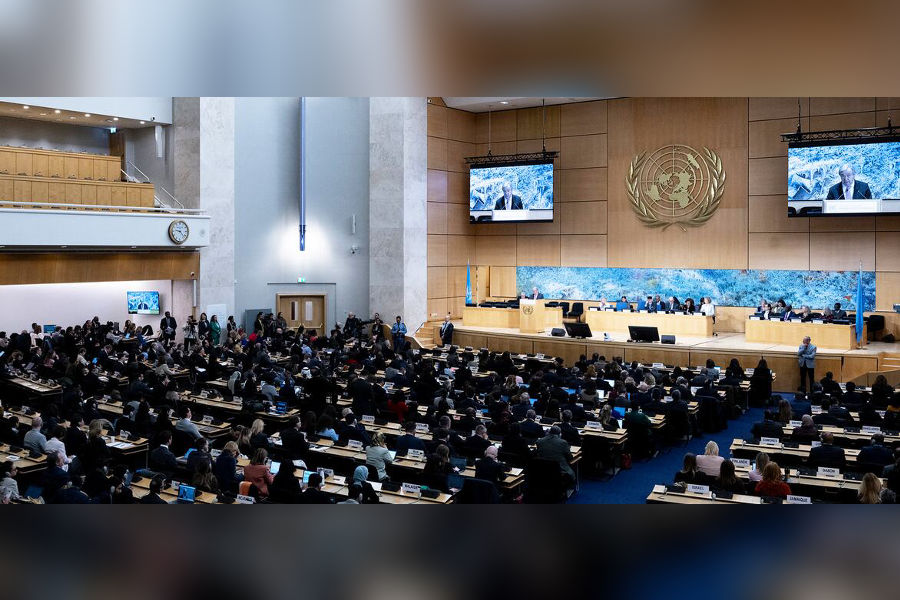
Azerbaijan’s deputy foreign minister, Elnur Mammadov, participated in the high-level segment of the 61st session of the United Nations Human Rights Council.
During his address, Mammadov spoke about the current state of the post-conflict normalization process between Azerbaijan and Armenia. He also tackled issues concerning the Washington Agreement and the so-called “Trump Route” (TRIPP) in fostering regional development.
Notably, the term “Zangezur Corridor” was once again used in the official statement issued by the Azerbaijani Foreign Ministry.
In addition, the deputy foreign minister referred to the trials of former officials of Artsakh, describing them as having been conducted “in accordance with international law and national legislation.”
Iran
Joint military exercises between Armenia and Iran may continue and could become more large-scale, Iran’s newly appointed ambassador to Armenia, Khalil Shirgholami, said in response to a question from Sputnik Armenia.
Shirgholami made the remarks while attending a ceremony at Yerevan State University honoring Professor Vardan Voskanyan, head of the Department of Iranian Studies at the Faculty of Oriental Studies, who was awarded honorary membership in Iran’s Academy of Persian Language and Literature.
In April 2025, special forces units of the Armenian and Iranian armed forces conducted joint military exercises.
“Considering the existing ties between the two countries in various domains, including the defense sector, such events may also take place in the future and be more large-scale,” the ambassador said.
Responding to a question about whether Armenian Defense Minister Suren Papikyan’s visit to Iran had been planned in advance or should be viewed in the context of heightened tensions surrounding Iran, Shirgholami said the visit had been pre-scheduled.
“And this once again proves the development of cooperation between our countries in various domains. Within the framework of this visit, the parties will be able to exchange views on various topics and deepen cooperation,” he noted.
The ambassador emphasized that the Armenian-Iranian border has consistently been a “border of peace” and holds significant importance for both countries.
“…the border between Armenia and Iran has always been a border of peace, and it is of great importance for both countries and cooperation in the military sphere is based on these historical ties, the inviolability of the borders and the preservation of the territorial integrity of both countries,” Shirgholami said.
He added that cooperation between Armenia and Iran is progressing across academic, economic, political and cultural spheres, expressing confidence that further achievements will follow.
Turkey
The normalization of relations between Turkey and Armenia is directly tied to the normalization process between Azerbaijan and Armenia, Fuat Oktay, chairman of the Foreign Relations Committee of the Grand National Assembly of Turkey, said, according to Anadolu Press Agency.
Oktay stated that the two tracks are advancing in parallel.
Oktay also welcomed what he described as the reactivation of the so-called “Zangezur Corridor” project following recent agreements.
“This is, in fact, a strong project that will contribute both to peace in the region and to the region’s development. At the same time, it is an important initiative that can unite the Turkic world,” he said.
According to the Turkish lawmaker, the project would strengthen connections not only between Nakhichevan and mainland Azerbaijan, but also between Turkey and Azerbaijan, as well as across the wider Turkic world.
From a regional perspective, he added, the initiative would serve the development of all countries involved, including Georgia. Oktay further noted that, should lasting peace be fully established in the region, the project could also contribute to a more stable and secure future for Russia and Iran.
“We hope that this project will be implemented as soon as possible,” he said.