Neither Empowered nor Erased: Armenian Cypriots and the Politics of Recognition
Editor’s note: In this essay, Ellie Krikorian explores the history and identity of the Armenian community in Cyprus, from its centuries-long presence on the island to its role in modern Cypriot society. She examines questions of recognition, political representation and cultural continuity.
Origins of the Armenian Community in Cyprus
Armenians have had a millennia-long history in Cyprus, beginning in the fourth century when Cyprus became a province of the Byzantine Empire1 Alexander-Michael Hadjilyra, The Armenians of Cyprus (Larnaka: Kalaydjian Foundation, 2009), 4.. In 578, Emperor Tiberius resettled 10,000 Armenians on the island, with his predecessor, Maurice, attempting to coordinate with the Persians to forcibly move Armenians. They were seen as a wild nation and “source of trouble” that was located between the two empires2 Peter Charanis, “The Transfer of Population as a Policy in the Byzantine Empire,” Comparative Studies in Society and History 3, no. 2 (1961): 141-142.. The annexation of Armenia by the eleventh century led to further transfers to other parts of the Empire. 3 Ibid, 146.
In 1191, Cyprus was seized by Richard the Lionheart and sold to the King of Jerusalem, Guy de Lusignan, ushering in an era in which many ethnicities from the Levant and Cilicia were encouraged to reside in Cyprus. Connections were formed between the House of Lusignan and the Armenian Kingdom of Cilicia, with the former ruling over the latter for the last thirty years of their existence in the fourteenth century. The fall of Sis in 1375 to incoming Mamluk forces officially ended the Kingdom, and King Leo VI’s death resulted in the transfer of the crown to his cousin, James I of Lusignan, uniting the titles of the King of Cyprus, Jerusalem, and Armenia.4 Gohar Grigoryan Savary, “Armenian Colophons on the Takeover of Sis (1375),” Revue des études arméniennes 40 (2021): 85. 5 Sossie Kasbarian, “The ‘Others’ Within: The Armenian Community in Cyprus,” in Diasporas of the Modern Middle East: Contextualising Community, ed. Anthony Gorman and Sossie Kasbarian (Edinburgh: Edinburgh University Press, 2015), 241. The end of the Cilician state saw 30,000 wealthy Armenians escaping into Cyprus, which was held by the House of Lusignan for another century. 6 Mihran Kurdoghlian, Պատմութիւն Հայոց [History of Armenia], vol. 2 (Athens: Հրատարակութիւն ազգային ուսումնական խորհուրդի, 1996), 53-56.
Cyprus then came under Venetian rule, followed by three centuries of Ottoman rule beginning with the fall of Famagusta in 1571. Armenians were a non-Muslim religious and commercial minority, subordinated under the imperial hierarchy and millet system. The early years of Ottoman rule was marked by a common practice of Islamization (creating Linobambaki, or crypto-Christians) in order to avoid the jizya poll tax levied against non-Muslim dhimmi.7 Floya Anthias and Ron Ayres, “Ethnicity and Class in Cyprus,” Race & Class 25, no. 1 (1983): 60. In 1878, the island was annexed by Britain in a secret agreement with the Ottomans. The Sublime Porte ceded the land and gave support to the British during the upcoming Congress of Berlin in exchange for the creation of a British base in Cyprus to protect the Ottomans from Russian advances.8 Salâhi R. Sonyel, “In the Light of British Foreign Office Documents: How Abdulhamit, the Ottoman Sultan, Leased Cyprus to Britain within Forty-Eight Hours,” Belleten 42, no. 168 (1978): 745–760. Armenians in Cyprus were important actors under British rule, as they were multilingual and could aid in translating Ottoman texts for Europeans, while also working in commerce and education.9 Hadjilyra, Armenians of Cyprus, 4. Their dominance in trade is demonstrated by the Armenian word for shop, khanoot, entering the Cypriot dialect in this era. 10 Ibid, 14.
In the last decades of the Ottoman Empire, the Hamidian Massacres in the 1890s and Armenian Genocide resulted in at least 9,000 Armenians fleeing to Cyprus, with about 1,300 deciding to permanently stay on the island.11 Ibid, 12. Later waves of Armenian migrants came from other Middle Eastern countries, including Palestine after the creation of Israel in 1948, Egypt after the Suez Crisis and Nasser’s rise in the 1950s, and war-torn Lebanon, Iran and Iraq in the 1970s and 1980s. It is important to note that many of these populations were not escaping from villages, but were part of an “urban petite bourgeoisie” that allowed them to use their acquired skills and crafts to gain wealth in Cyprus.12 Caesar Mavratsas, “Armenian Identity and Greek Nationalism in Cyprus,” MOM Éditions 31, no. 1 (2000): 105. After the fall of the Soviet Union in 1991, Armenians from Armenia and other post-Soviet states also became part of the Cypriot diaspora, often facing distrust from earlier waves of Western Armenian migrants (similar to reactions from pre-genocide, affluent migrants towards incoming refugees post-1915).13 Sossie Kasbarian, “Between Nationalist Absorption and Subsumption: Reflecting on the Armenian Cypriot Experience,” in Cypriot Nationalisms in Context: History, Identity and Politics, ed. Thekla Kyritsi and Nikos Christofis (Cham: Palgrave Macmillan, 2018), 182.


The Making of Modern Cypriot Politics
Cyprus remained under British control until 1960, first as a protectorate, then as an occupied territory and colony. Many Armenians valued the stability of British rule and benefitted from their multilingual, European education by working as dragomen for the colonial regime. However, this period marked a significant rise in nationalism, with religious-based Ottoman millet identity evolving into volatile ethnic consciousness. The British encouraged the latter by formalizing ethnic divisions with the 1882 constitution and creating two sets of schooling for Greek and Turkish Cypriot populations, respectively.14 Anthias and Ayres, “Ethnicity and Class in Cyprus,” 63. Education became an important means of connecting Greek Cypriots to mainland Greece and Turkish Cypriots to mainland Turkey, as they relied on these nations for teachers and materials.15 Ibid.
The creation of an independent Greek state in 1830, after rebelling against the Ottomans, also spread the concept of the Megali Idea, imagining a recreated, united Byzantine Empire, with Cypriot enosis (union with Greece) being rooted in the desire to restore Hellenic glory.16 Ibid, 62. Under the British, this nationalist sentiment continued to ferment, causing anti-colonial uprisings like the 1931 Oktovriana (October Events). As Greek Cypriot calls for enosis increased, Turkish Cypriot nationalism and growing ties to the Republic of Turkey were, in turn, reinforced. Continued unrest in the 1950s, led by the EOKA (Union of Cypriot Fighters), culminated in Cyprus’ independence in 1960. The period was marked by increasing polarization with the use of Turkish auxiliaries against the Greek-Cypriot guerrilla movement.17 Ibid, 68.
Recognition and Marginalization After 1960
The polarization of the Greek-Turkish binary on the island has greatly overshadowed minority presence and power, which has been significantly affected and diminished by the intercommunal strife of the twentieth century. The most poignant example is in the constitution of 1960, the foundational document for the newly-created Republic of Cyprus, where proportionate parliamentary and military representation was given only to Greek and Turkish Cypriots, with “the president always to be a ‘Greek’ and the vice-president a ‘Turk.’”18 Ibid, 71.
Armenians, along with Maronites and Latins, were identified as distinct religious communities, a reminder of the Ottoman millet legacy. Nonetheless, Article 2 only recognizes a Greek or Turkish national community, inextricably linked to religious and linguistic identities, and anyone that does not identify with either group must “within three months… opt to belong to either the Greek or the Turkish Community as individuals… .”19 Constitution of the Republic of Cyprus, 1960, rev. 2013, art. 2, Constitute Project, accessed May 11, 2026, https://www.constituteproject.org/constitution/Cyprus_2013. All religious communities opted into the Greek Cypriot community, unsurprisingly, as it represented over three-fourths of the island’s population (among other reasons, particularly Armenian-Turkish history). Article 109 also grants each recognized minority one parliamentary representative, who has no vote or right to submit a bill.20 Kasbarian, “Between Nationalist Absorption and Subsumption,” 185. The role is more symbolic, with their only outlets for political advocacy being informal lobbying and contributing to Parliament when invited to speak.
The later twentieth century saw other important events that polarized the Greek-Turkish binary and further marginalized Armenians within the Cypriot political system and consciousness. The 1963-64 intercommunal strife, known as Bloody Christmas, broke out after mounting tensions from the 1960 constitution.21 James Ker-Lindsay, Britain and the Cyprus Crisis, 1963–1964, Peleus: Studies on the Archaeology and History of Greece and Cyprus 27 (Mannheim: Bibliopolis, 2004), 21. Negotiations and deadlocks plagued relations between the two parties following the Republic’s founding, resented by Greek Cypriots for being too lenient and conciliatory while giving Turkish Cypriots more safeguards and rights. The new President and Archbishop Makarios III attempted to solve certain issues with constitutional amendments, despite serious warnings from the Turkish Government to keep the constitution intact.22 Ibid, 23. This rise in tensions peaked on December 21, when an altercation between Greek Cypriot police and Turkish Cypriots returning from the walled Venetian streets of Nicosia ended with gunshots being fired. Two Turkish Cypriots were killed, with several others injured, and their funerals were followed by increased provocations and violence against villages, mosques and churches. Hundreds of people were killed or injured within both communities.
Armenians were caught in the crossfire during this conflict, especially because many had been living in or near Turkish neighborhoods due to linguistic and social ties. Olga Demetriou describes how Armenians displaced in this period from Turkish-administered areas were known as Tourkoplikti (“struck by the Turks”), and not recognized as refugees.23 Olga Demetriou, “‘Struck by the Turks’: Reflections on Armenian Refugeehood in Cyprus,” Patterns of Prejudice 48, no. 2 (2014): 173. Demetriou attributes this difference to political motivations, as Greek Cypriots attempted to emphasize their victimization in the later 1974 invasion, excluding the 1963 victims from the benefits and collective memory of refugeedom.24 Ibid. Moreover, the victims of Bloody Christmas were mostly Turkish-Cypriots who were displaced into Turkish-administered areas, and these events were likely a major factor for the 1974 invasion. This created an environment where Greek Cypriots felt that Armenian voices of displacement in 1963 were opposing their simplified, nationalist narrative of the period, which largely excludes non-Greek Cypriot victimization.
The 1974 invasion resulted in Turkish troops landing and occupying the north, declaring autonomous Turkish-Cypriot administration. Most refugees were Greek Cypriot, and many “prosfiyes” (refugees) received aid from the Republic to rebuild their lives.25 Ibid, 168. By this time, many displaced Armenians had already gone through a decade of pain and grief, finding new jobs and homes. Thus, they were excluded from state-organized housing and benefits, and were not labelled as prosfiyes. Many Greek Cypriots also attempted to minimize Armenians’ experiences from 1963, with some declaring that they deserved to be driven out as they chose to live with the Turks.26 Ibid, 178. Therefore, the early decades of the Republic were plagued by further hardening of the Greek-Turkish binary, while also silencing and deepening Armenian memories of displacement. Many Armenians saw 1963 as a reminder of the Armenian Genocide, as it ushered in another era of property loss and insecurity.
Modern Armenian Cypriot Identity
Caesar Mavratsas calls Armenians an “apoliticized ethnicity” with an almost “non-presence” because of their existence outside of the island’s “political culture.”27 Mavratsas, “Armenian Identity and Greek Nationalism,” 105. This is seen through the performative actions of the government towards Armenians. In the 2001 elections, leading up to Cyprus’ 2004 admission as a full member in the European Union, personal appeals and election letters written in Armenian were sent to the community to gain support and demonstrate its respect of minority rights (a prerequisite for joining the EU). Similarly, Cyprus supported the community’s protests of the closing of the Melkonian Educational Institute in 2005, earning praise from the Council of Europe. However, in the place of real political power or presence in Cypriot political consciousness, Armenians have utilized culture, education and ties beyond the nation to sustain their community. These conditions of political isolation have allowed for more ethnic distinctiveness and autonomy, especially in comparison to Armenian diasporas in the West, but has had major repercussions on Armenian Cypriot identity.
The early decades of the Republic were plagued by further hardening of the Greek-Turkish binary, while also silencing and deepening Armenian memories of displacement.
Since 2006, the parliamentary representative for the Armenians has been filled by Vartkes Mahdessian, who has prioritized cultural production and education to increase awareness about his community and forge diasporan connections.28 Kasbarian, “Between Nationalist Absorption and Subsumption,” 185. Similarly, Armenian Cypriots have emphasized education, often private and non-Greek, to preserve Armenian culture, avoid nationalist curriculums of Greek Cypriot schools, and learn Western languages. Many Armenian schools are adjacent to churches, like Nareg Armenian School and the Holy Mother of God Cathedral in Nicosia. The Melkonian Educational Institute, a former orphanage for genocide survivors, was an important Armenian secondary school for the diaspora, until the Armenian General Benevolent Union closed its doors in 2005.
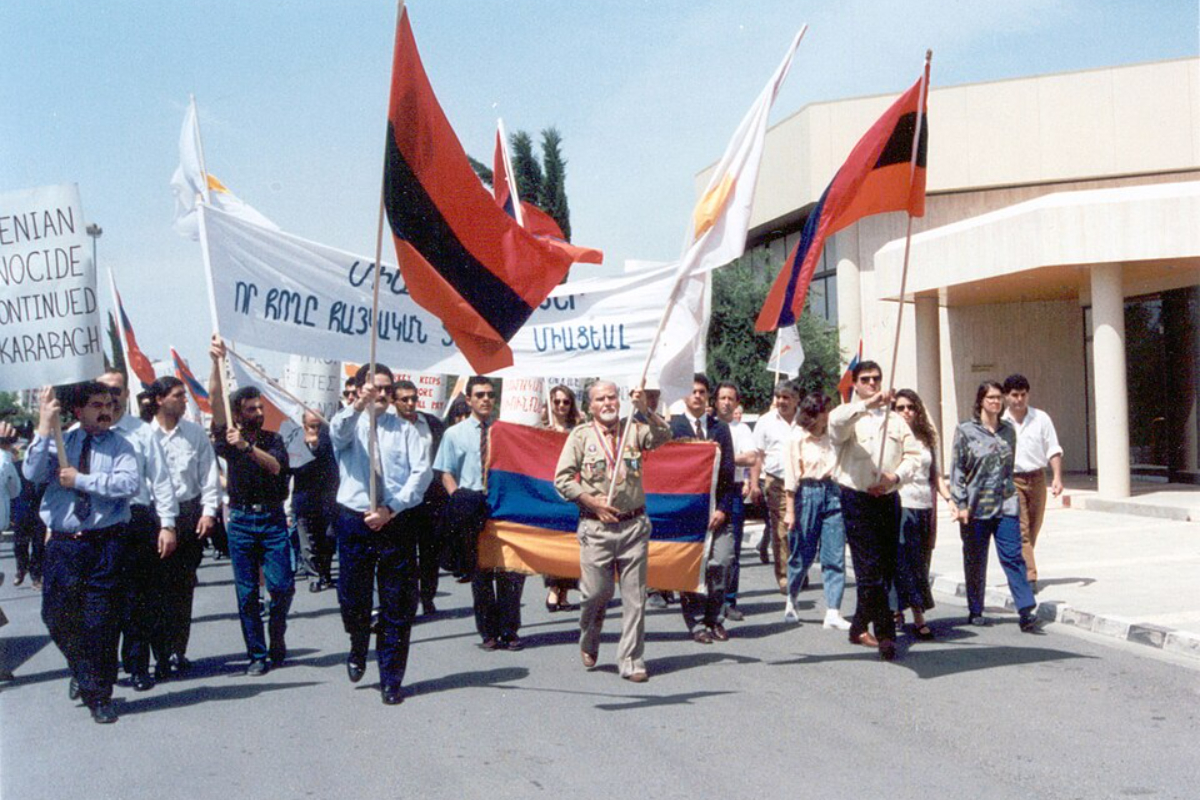
In the age of globalization and Cyprus’ accession to the EU, supranational entities and diasporic connections have also reinforced the community’s identity in place of local participation in politics. European membership has allowed minorities like Armenian Cypriots to have a new source of rights and an international arena for transnational dialogue with the wider Armenian diaspora.29 Kasbarian, “The ‘Others’ Within,” 243. Diasporic identity, including through the Armenian Youth Federation (AYF), the youth organization of the Armenian Revolutionary Federation (ARF), and its engagement with the Council of Europe and other pan-European organizations, allows Armenians in Cyprus to see themselves as Europeans. These organizations facilitate connections to the international Armenian diaspora that reinforce their ethnic and national identity and unite Armenian Cypriots with other Armenian youth. Thus, the marginalization of Armenians in Cypriot politics has allowed the community to form other bonds beyond Cyprus, while strengthening their roots to their own layers of identity on the island.
Conclusion
In sum, the Armenian community of Cyprus reveals how recognition by the state does not always translate into meaningful political power. Their long history on the island, notably migrations of refugees after late Ottoman massacres and genocide, demonstrates the rootedness of Armenian Cypriots over centuries. Yet, Armenians have been sidelined in the looming Greek-Turkish Cypriot conflict in modern times, both institutionally through the 1960 constitution and through nationalist disinterest in minorities. The crises of 1963-64 and 1974 further hardened the Greek-Turkish binary, further minimizing Armenian loss as it fell outside the dominant narratives of each side. This marginalization did not erase Armenian Cypriot identity, but instead pushed the community to ensure self-preservation and advocacy through churches, schools, communal institutions, and transnational networks of diaspora and belonging. Compared with Lebanon, Syria and Turkey, Cyprus therefore represents a distinct model of Armenian diaspora life in the Middle East: a community that is seen but not fully empowered, recognized but not politically central, and marginalized within the state while remaining resilient through culture, memory and international connection.
In the place of real political power or presence in Cypriot political consciousness, Armenians have utilized culture, education and ties beyond the nation to sustain their community.