



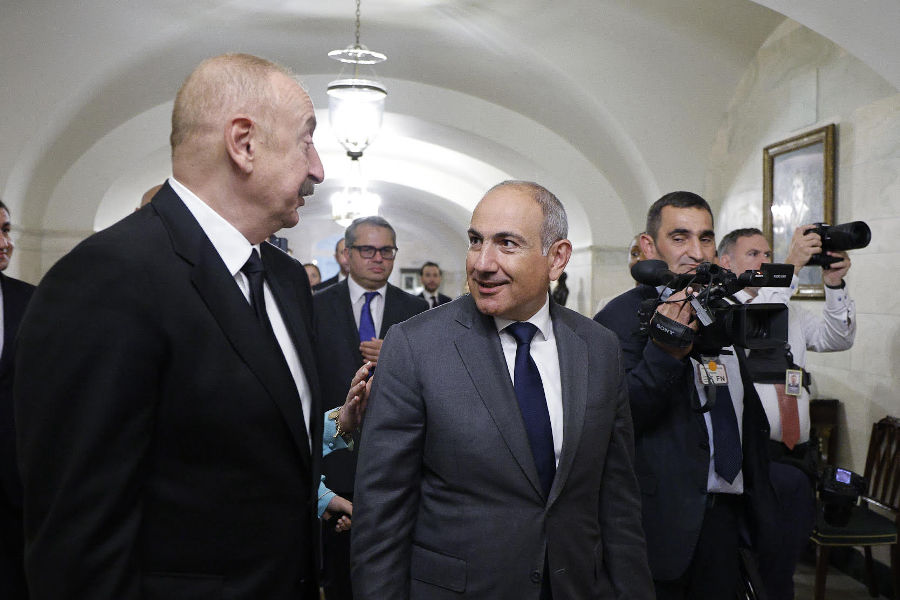
If President Aliyev, the dictator of Azerbaijan, moved any slower in concluding a peace treaty with Armenia, he would be in reverse. It seems reasonable to assume that he has commitment issues when it comes to formalizing real peace with Armenia. Behind the obligatory rhetoric, particularly on a global stage with third parties such as the United States, the Azerbaijani-Turkish strategy on peace and normalization has been to demand continuous preconditions to extract maximum concessions.
There is substantial evidence to doubt Azerbaijan’s good-faith commitment despite obligatory gestures, such as cross-border trading and civil society visits. The victims of Azerbaijani atrocities and violations of Armenia’s sovereignty understand that peace is more substantive than the short-term absence of overt military action.
Aliyev, with his unbridled attacks on Armenia’s sovereignty and its very existence, demonstrates that he treats the peace process more as an unconditional surrender. For many years, through successive iterations of dialogue, the Turkish alliance of Turkey and Azerbaijan has used unilateral preconditions as a process to extract concessions and introduce infinite delay.
Normalization with Turkey essentially would establish diplomatic relations and open the border to commerce and travel. The border was closed unilaterally by Turkey during the first Artsakh war with Azerbaijan. Recently, Turkish Foreign Minister Hakan Fidan stated that Turkey was ready to normalize relations “under the right conditions.” This is where the Turks introduce demands that are nonnegotiable and, at a minimum, create extensive delays.
Establishing relations and peace is always about trust. The Turkish-Armenian experience has layers of mistrust that can only be overcome with good-faith dialogue and mutual benefits. Turkey’s strategy is to hide behind Azerbaijani demands as a prerequisite for normalization. In this way, it can publicly advocate for relations but keep the ball in Armenia’s court.

While taking advantage of its obvious leverage, Turkey has hardly distinguished itself as a committed party. This essentially limits progress to small token gestures, the value of which is inflated to fit the narrative of progress. While Turkey slow-rolls normalization because of what it refers to as regional issues involving Armenia and Azerbaijan, Aliyev is free to keep the complex preconditions flowing. Aliyev has stated on several occasions that the peace treaty could be signed almost immediately once the current demands are met. This statement has little credibility.
Azerbaijan has a history of always having another issue that prevents signing a treaty. If it were truly committed to a peace deal, it would be more active in facilitating the closure of open items. Instead, there is a clear pattern of making difficult demands and keeping additional items on the table. The current precondition is Azerbaijan’s demand that any reference to the 1990 Declaration of Independence be removed from Armenia’s Constitution, since it interprets the reference as a territorial demand on Azerbaijan.
Many Armenians view this as meddling in the internal affairs of a sovereign country. Armenia’s Constitutional Court reviewed the case and found no such territorial-demand risk. The Armenian government is pursuing constitutional changes as an internal matter. Azerbaijan is well aware of the complex process of amending the Constitution in a democracy such as Armenia. There is the legislative hurdle requiring two-thirds approval and then a popular referendum. By characterizing it as a nonnegotiable precondition, Azerbaijan ensures that it will take time and internal debate, which favors the Azerbaijanis.
Creating political tension in Armenia has always been a goal of Azerbaijan. Aliyev is simply trying to buy time while waiting for a shift in the geopolitical environment. With the introduction of the TRIPP project, Aliyev has been blocked temporarily from attacking Armenia. Prior to this agreement last year, Aliyev threatened Armenia to force the opening of an extraterritorial corridor through Syunik connecting Nakhichevan with Azerbaijan.
Ironically, in his rogue dictatorship of Azerbaijan, the Constitution serves his purpose, and change is far less complicated. While Aliyev argues to protect territorial integrity, he ignores international court rulings and regularly violates the foundation of human rights.
It is also important to watch the rhetoric of the “right to return” of 300,000 Azerbaijanis to Armenia. While we may emotionally react to the absurdity of his claim, the rhetoric has progressed into state-sponsored programs to document a narrative that is attempting to legitimize his claims. This may become the next precondition in the seemingly never-ending journey of this peace treaty. Aliyev has the audacity to insist on moving 300,000 Azerbaijanis into Armenia while 120,000 Armenians were forced to leave Artsakh. Aliyev’s human rights record is genocidal, and his statements are insulting.
The relocation of any number of Azerbaijanis is a dangerous precedent, with or without a reciprocal move. The “Western Azerbaijan” campaign is more than rhetoric. The “right to return” is a first step toward territorial claims. With a population base, one can influence elections and interfere with claims of ethnic protection. Russia used that logic at the start of the Ukraine war. Stalin redrew maps to quell nationalism with strong Russian minorities in the Baltic states. Aliyev usually telegraphs his preconditions, since the public nature is meant to inspire his oppressed citizens. When one preaches systemic hatred, as the Azerbaijani administration has maintained for decades, promising common citizens the opportunity to return “home” buys domestic credibility. That is how dictators survive. Just give the huddled masses enough rhetorical hope at the expense of others.
We should also internalize Turkish Foreign Minister Hakan Fidan’s comments about “under the right conditions.” He clearly stated that the peace treaty with Azerbaijan must be agreed to and signed, which is a direct reference to Armenia’s Constitution. He also stated that resolving border and transport corridor issues with Armenia is important.
Armenia and Azerbaijan agreed to a parallel process of border demarcation and delimitation that started in Tavush province and has moved very slowly. Fidan’s statement seems to couple the border issues with any normalization, although they do not directly affect the common border with Turkey. There is also a reference to regional transit and corridor progress. The Turks have disrespected Armenians by continuing to refer to the agreed-upon TRIPP as a “corridor” or “Zangezur.” It seems like the Turks and Azerbaijanis have a pipeline of preconditions to serve their delay tactics. Given the current dynamics of U.S. involvement, the Turkish alliance could find itself pressured to remove obstacles as the window of opportunity narrows. This would be in Armenia’s interest, and promoting these reminders as diplomatic initiatives should be encouraged.
The Turks are so outrageous in their human rights and sovereignty violations that they afford Armenians a plethora of opportunities to promote a course correction.
If the delay tactics of the Turkish alliance continue, then the issue may be resolved when the lack of a peace treaty interferes with TRIPP and other geopolitical interests of the United States. Azerbaijan and Turkey’s playbook should be diplomatically exposed to the United States as contrary to U.S. interests, given the chronic precondition delay game.
A nonnegotiable constitutional change under the duress of external pressure and time constraints adds risk to the process and subjects Armenia to unnecessary political conflict. If the Azerbaijani government is truly committed to its rhetoric of peace when engaged with U.S. officials, then it should offer a good-faith diplomatic gesture to offset the harmful rhetoric of “Western Azerbaijan” and the insulting “300,000 right to return.”
In the absence of trust and commitment, any peace treaty is simply a piece of paper that can be discarded with political convenience. Aliyev has a long history of ignoring or violating confidence-building measures during the OSCE Minsk process that required any compromise from Azerbaijan. He has willingly ignored violations of international law. With no record of diplomatic integrity, he agreed to a trilateral rapprochement last August in Washington. He needs to be held accountable as a party to the agreement.
Of course, this is international politics and not a morality game. Unless the other parties pursue a path of accountability, Aliyev’s reckless behavior will continue. Thankfully, there is a powerful third party in the United States, which obviously has an interest in the success of this process. Armenia must demonstrate to the United States that U.S. interests are at risk with the Azerbaijani strategy.
Azerbaijan has succeeded in decoupling or separating several issues of importance to Armenians from the peace treaty process. The continued incarceration of Armenian hostages in Baku prisons is a disgrace. How can we call it peace when Armenian rights are blatantly violated by the same government that says it wants peace with Armenia? How can there be true peace if the border process, including the illegal occupation of sovereign Armenian territory, moves at a snail’s pace disconnected from the peace process?
Kicking the can down the road by leaving these issues to an uncertain future process is not in the interests of peace. Aliyev must be reminded in this process that setting preconditions can be viewed negatively and may have consequences. The United States, for a variety of reasons, wants this peace process to support the TRIPP project and be concluded in a timely manner. It is in Armenia’s interest to demonstrate to the U.S. government that border incursions, hostages, internal meddling and “Western Azerbaijan” lies introduce unacceptable risk to the peace objective and its economic benefits.


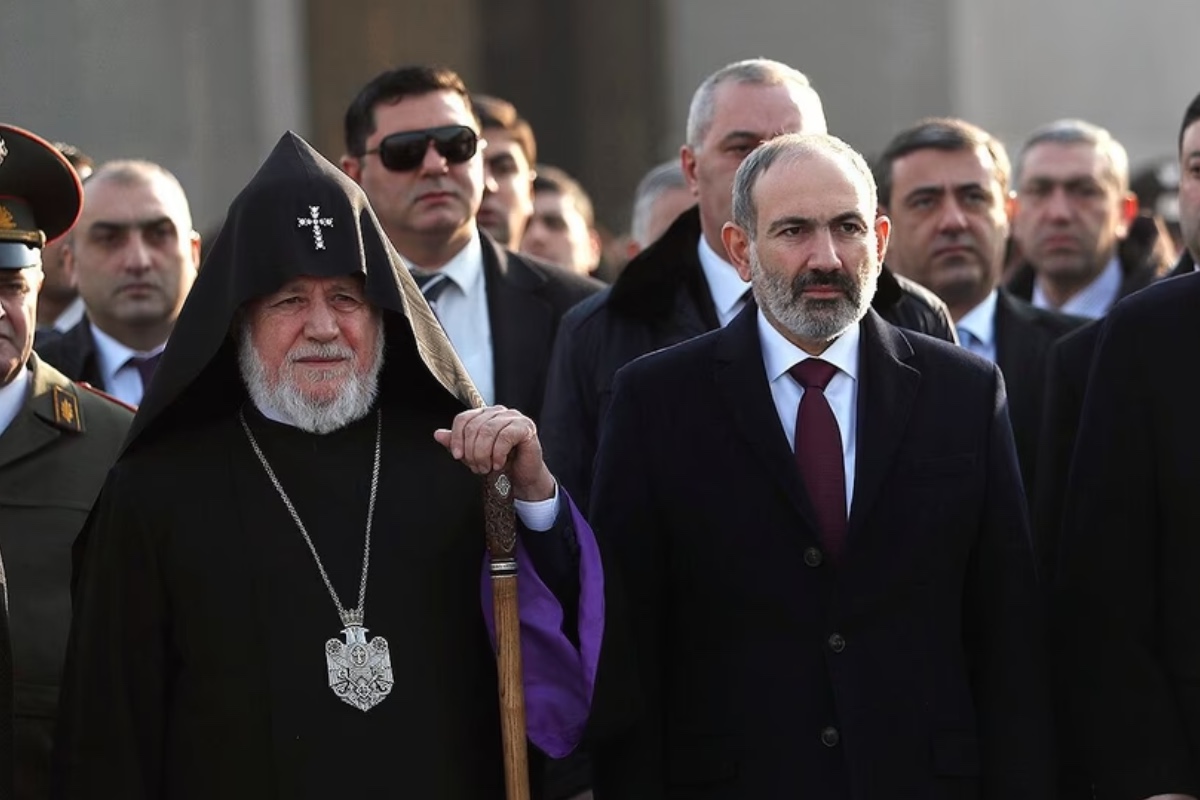
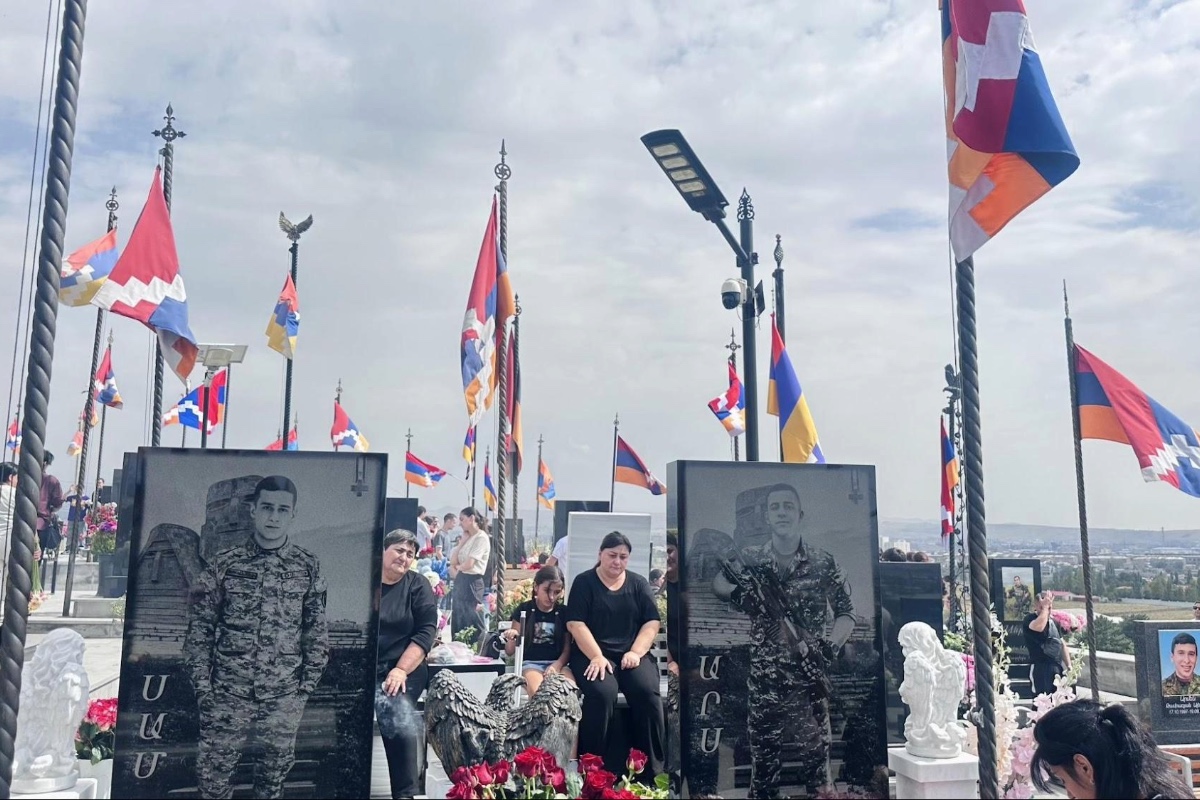
Turkey is guilty of eradicating hundreds of Armenian cities across 300,000 square miles or 800,000 square kilometers. Greeks, Assyrians, Armenians and other Christians were subjected to genocidal expulsion from their ancestral homes and homelands. For Turkey, the unresolved Western Armenia issue is a powerful spear Armenia holds. As a shield against this spear, AZERBAIJAN AND TURKEY USE ARTSAKH AND THE “RIGHT OF RETURN” OF DAJIG AZK TO YEREVAN ….AS A shield…. out time TOOTHPICK IN THE EYE OF ARMENIANS. The best defense, for the Genocidal Turks and the Aliyev dictatorship, is a good offensive and ridiculous OFFENSE.
The picture of Pashinyan looking at Aliyev and smiling makes me want to throw up!
Armenians, as I have seen over the course of history, have 2 major national diseases:
1. Gutless, scared and always whining for external help in the face of Azerbaijani or Turkish threats. Armenians, as a nation, must rigidly teach their families and children to be self-reliant, brave and regard the national interest of the Armenian nation far above their own family’s interests. Armenians get a ZERO score when it comes to collective mentality snd efforts to safeguard their motherland.
2. Worshipping money and prioritizing self-enrichment to wealth as not only their #1 interest, but the only interest they care for. This mentality and collective attitude is catastrophic and self-destructive. Add to that the total lack of true patriotism, and the absence of love and iron-clad commitment to the fatherland – and you get traitors and cowards as political leaders in Armenia. And the current situation reflects this truth.
Armenia desperately needs a brave, patriotic and highly astute diplomatic leader who can bring about a stalwart, highly competent government into power to CORRECT once and for all the Armenian self-interest based psyche, and establish a new generation of proud and patriotic Armenians with a Socialist persuasion to enable this small country to rise up and overcome this ever-present Turkish /Azerbaijani aggression, enmity, menace
and threat once and for all.
If we are to survive as an independent country and a Christian nation, fundamental change in society, education, ethics and morals and mental attitude is imperative. Otherwise, we will not survive with the continuum of the present dispensation and the Armenian people’s overall attitude. Period.
I would not call a nation gutless whose population rose up and demanded of the mighty Soviet empire the reunification of Artsakh with Armenia in the dwindling years of the USSR and then after the fall of this empire, being economically the poorest among the fifteen former Soviet republics with no army and with a massive earthquake with 25,000 dead on its hands, to shatter all Turkish myths by defeating and bringing to its knees a terrorist Muslim pseudo-Turkish petrostate (artificial Azerbaijan) with practically unlimited resources and with hired paid-mercenaries from all over the region, from the Northern Caucasus (Chechnya) to various parts of Muslim Middle East (Turkey, Afghanistan, Pakistan and even Iran) and handsomely paid unemployed former Soviet army officers, many of whom were killed or captured. The Armenian nation having been constantly invaded by various blood-thirsty armies and empires over the centuries, subjected to state-sponsored premeditated genocide and engaged in modern warfare by traditional enemies and still have a homeland, what is left of it, the size of Belgium in area is anything but gutless. It is truly a miracle! The globalist, pacifist, unpatriotic and defeatist Pashinyan, a former corrupt journalist, the losers around him and politically-ignorant and gullible population following and worshiping such a loser don’t count!
The demand to remove the “declaration of independence” from our Constitution is an absurd request and Azerbaijan knows that. It just illuminates further their phony face. In the United States we would say they are as genuine as a three dollar bill. Pashinyan needs to take his hands out of his pockets and start acting like he has Armenian blood.
The demand to remove the “declaration of independence” from our Constitution is an absurd request and Azerbaijan knows that. It just illuminates further their phony face. In the United States we would say they are as genuine as a three dollar bill. Pashinyan needs to take his hands out of his pockets and start acting like he has Armenian blood.
1. If there are to be routes across Armenia, they must be NORMAL routes, not ones with any SPECIAL Azeri rights such as TRIPP.
This should be obvious but seems to have escaped the attention of Armenia and most Armenians.
Moreover:
2. Azerbaijan has always had two fine road routes to Nakhichevan and Turkey:
A. Iran
B. Georgia
And now it can FLY across Armenia too.
Strange how these are rarely mentioned.
What, may one ask, is going on?
Totally agree, sir.
I am very skeptical and concerned about TRIPP.
Time to call their bluff and stop peace negotiations. it is never going to happen anyway. Stop giving the two tyrants international credibility.
The problem is not only that an incompetent, appeasing traitor and dictator like Pashinyan rules over Armenia; the other problem is that a segment of Armenian voters continue to vote for him even though they know exactly what he is by now (since he has also resorted to vote rigging and has become a dictator, even their votes don’t matter anymore to him). They too are to blame for bringing this traitor to power, and are doubly to blame for repeatedly voting for him, despite the disastrous consequences this brought to Armenia.
Some people just don’t want to accept with a strong dense cognitive dissonance that Armenia had since 1994 lost the advantages it had held in the years since and this would reveal itself in 2020 . Defeat and losing has its consequences!
What you say does not agree with the realities on the ground. That is just a fairy tale you are pushing. Do you truly believe it should take a petrostate over two decades, 22 years to be exact, since the Azerbaijani devastating and humiliating defeat in 1994, for Azerbaijan to try its first large-scale attack on Armenia in 2016 and last only 4 days after two decades of militarization with annual military budget well over the entire Armenia’s annual state budget? And then only a few years later in 2020 win a war against Armenia in 44 days? That’s a joke!
Armenia did not lose to Azerbaijan in 2020. Armenia never lost a war to Azerbaijan when Azerbaijan fought its own fight. The 2020 war was terrorist Turkey’s proxy war on Armenia on behalf of Azerbaijan. Why do you think genocidal Turkey and the Azerbaijani terrorist cesspool would form a mutual defense and cooperation pact in 2010, after Armenia-Turkey reconciliation fell through with Azerbaijani intervention and bribery & blackmail of Turkey, to provide mutual assistance in the event of an armed attack or aggression by a third state? Did terrorist Turkey with its 2nd largest army in NATO really need any military assistance from Azerbaijan? Was Turkey worried about an Armenian aggression that would require military assistance from Azerbaijan? This pact was a ploy for Turkish direct military assistance to Azerbaijan after Azerbaijan coming to the realization that it can’t do much against Armenia on its own ever if it was unable to do anything substantial in three decades despite its massive petrodollars. The pact was a ruse to get Turkey directly involved in the 2020 war and that is what exactly happened. Why were Turkey and Azerbaijan conducting joint military exercises under the command of the Turkish defense ministry only 45 kilometers away from the Armenian capital in Azerbaijani occupied Armenian province of Nakhichevan? Why had Azerbaijani defense minister taken the back seat in all activities leading up to the joint Turkish-Azerbaijani invasion of Armenian liberated territories and the Turkish defense minister acting as a mouthpiece for Azerbaijan was the one making direct threats against Armenia? What were Turkish F16 fighter jets doing hidden in city of “Genje” (Armenian Gandzak) in Azerbaijan and flying over the Armenian airspace during the invasion? Had Azerbaijan joined the NATO alliance to possess those F16 fighter jets that no one knew about, including NATO itself?
Foreign states assisting Azerbaijan by selling them weapons is one thing but actually fighting for Azerbaijan is another thing altogether. Azerbaijan could not do on its own what Azerbaijan did in 2020 by buying and paying for with its petrodollars which was paying for direct Turkish military assistance, not to mention flying over from Northern Syria thousands of fatherless ISIS terrorist paid-mercenaries and planting them in the conflict zone. If the Russian army generals planned and led a war against Azerbaijan and Russian soldiers shoulder-to-shoulder and in full view with their Armenian counterparts together fought against the Azerbaijan army in the battlefield, like the Turks who planned and participated in 2020 war, would you call that an Azerbaijani defeat at the hands of victorious Armenian army? I don’t think so! Yet for some reason you keep dismissing the direct Turkish military involvement and critical role in this war. Did you miss the Turkish defense minister showing up to congratulate the Azerbaijani chicken-hawk Aliyev, who was MIA in the 1990s war waiting out the war in Russian and Turkish casinos, almost immediately after the hostilities were halted? Did you miss all that I saw and researched to come to my conclusions? What I described here is all based on facts on the ground and not based on “strong dense cognitive dissonance” as you put it!
The way Pashinyan looks at Ailyev is the way a dhimmi looks at his Pasha.
Pashinyan is a dhimmi.
@Ararat one is perfectly entitled to hold and express an opinion, but ones tendancy to hyperbole about Armenian ability and adding of pronouns blinds one to reason. The ceasefire of 1994 was favourable to Armenia given it’s advantage at the time, it was not a devastating defeat for Azerbaijan , in the way Germany had in 1945 for example or even in 1918 or even Iraq in 1991 although undoubtedly was ignominious. Yet one continues with expressive rhetoric speaks as though it was. Turkey military pact was clearly aimed at supporting Azerbaijan clearly the junior partner, its a bit like what if world say if Ukraine was left to own devices despite marked improvements since 2014 it would have lost or without extensive US support Israel wouldn’t have the sweeping advantage, indeed the Arabs were and still are too inclined to be we’re the warriors of Mohammad inshallah but forgetting that was 1500 years ago and to assume current success upon something so long ago is insane! Wars aren’t “fair” in case you didn’t realise @Ararat . Likewise assuming future military success based on 1994 was conceited and complacent. The 2016 clashes ended with Azerbaijan making gains so were a victor actually and Russia broadly friendly with Armenia and having influence on Azerbaijan was able to pressure to halt the conflict but the minor loss could be dismissed as a bad (four) days although it did lead to disquiet about the fact that much of Azerbaijan military was recently supplied Russian equipment despite Armenia being an ally of Russia and Azerbaijan legally wasn’t. 2018 Pashinyan takes office and Russia sanctimoniously and hypocritically sides with Azerbaijan preaching about internationally recognised despite it’s own annexation of Crimea and occupation of parts of mutual neighbor Georgia and is understood to have been glad to see Armenia lose to teach them a lesson about straying from ‘mother’ Russia. However many Armenians faith in Russia takes a blow. As is well known in 2022 Russia two days after a friendship agreement with Azerbaijan who must have had a strong hunch that Russia was poised to invade Ukraine, where they agree to support eachother internationally recognised boundaries and oppose separatism, as Arktash is considered part of Azerbaijan internationally then attempts to secede were technically separatism which Russia had affirmed it as being part of Azerbaijan despite hinting to Armenia that it considered it disputed. Also the same type of TB2 drones of which Armenia seemed so helpless against in 2020 Russia too showed its own helplessness, this helped to debunk the Kremlin lie that had Armenia been closer to Russia it’s apparently all capable military weapons and practice would have brushed Azeri attacks aside. This along with Russia own hypocrisy given it’s annexations in Ukraine and failures to protect what remained of Arktash was another blow and further diminshed Armenians faith in Russia something which when Putin took office was strong but a quarter of a century of his government has gravely diminshed… Yes Turkey has assisted Azerbaijan significantly but that’s curiously irrelevant a bit like Russians saying we would be walking through Keev if not for NATO is just ignoring reality. Perhaps if Azerbaijan didn’t have the backing of hired guns from Syria they would have taken longer, after all it was only after 3 years Azerbaijan caved in 1994 . Similarly when Iraq overan Kuwait in 1990 it would lose to the US coalition the next year. Kuwait itself had failed spectacularly. The simple reality is that Armenia lost to Azerbaijan in 2020 due to being eclipsed militarily and the greater support it received from other countries than Armenia did, Armenia had rested on its laurels had the wrong friend and paid the price. At least Russia own woes have silenced the pro Russian Armenians “if not for Pashinyan we had been closer to Russia then this wouldn’t have happened” brigade which were very pronounced until shortly after Russia invaded Ukraine. And yes something else has happened since 2020 for Europe is a realisation that it can no longer count on the USA nor assume peace as a birthright from the defeat of Nazi Germany in 1945, in the way it could in 2020. Move with reality yes Azerbaijan lost in 1994 but it’s defeat wasn’t total it had from being the loser been more open to new ideas than Armenia which had ossified, thus the force faced in 2020 was a very different beast from 1994 . Sadly Azerbaijan has the economic and military advantage and due to international protocols had the legal advantage over Arktash but that’s life. Maybe in the future Azerbaijan advantage will slip as Armenia had done, maybe it’s relationship with Turkey won’t be so close, maybe international protocols will collapse and so forth but for now..