Haute Couture, baked: Artur Poghosyan’s radical dessert architecture
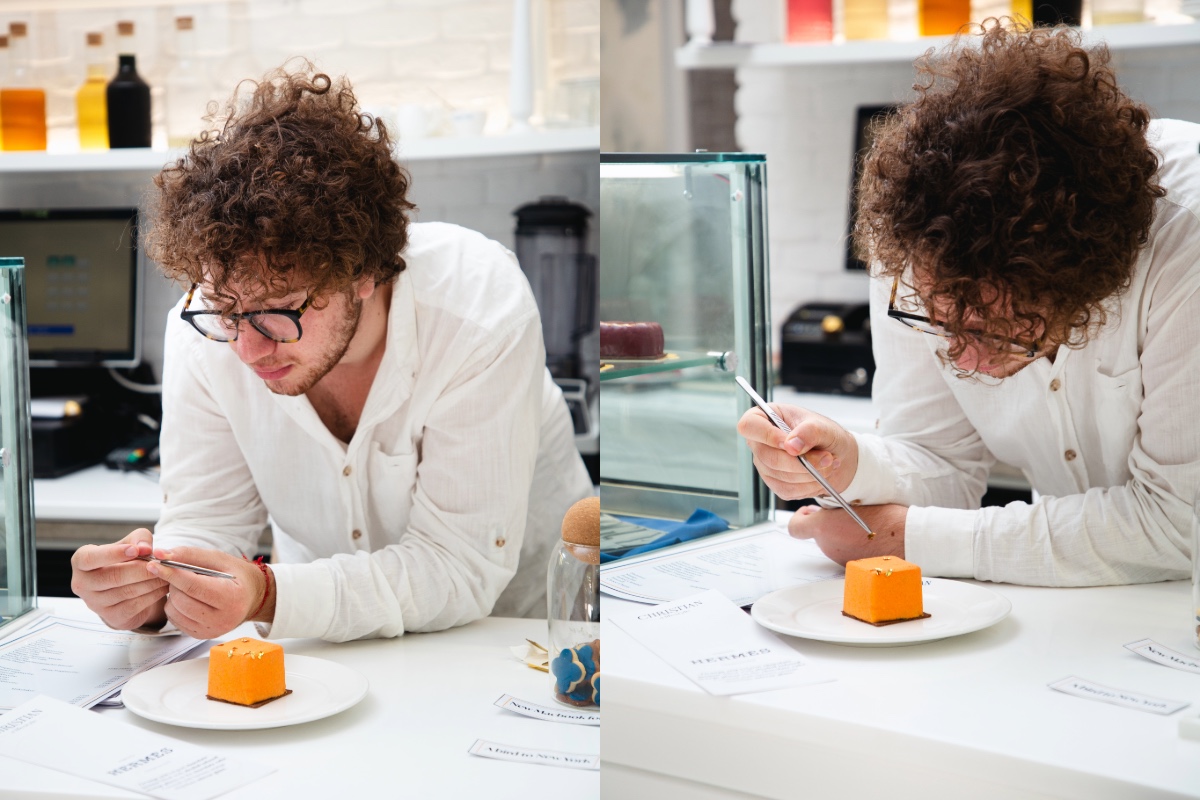
From 2023 to 2025, Armenian entrepreneur Artur Poghosyan transformed Yerevan’s culinary scene with the Christian Fashion Café — named in honor of Christian Dior. The venue was the Caucasus’ first space dedicated to translating fashion milestones, from Dior’s iconic 1949 Junon gown to Balenciaga’s avant-garde silhouettes, into edible creations.
By treating ingredients as structural materials rather than mere decoration, Poghosyan captured attention in November 2024 at the Golden Autumn Gala Dinner held at Yerevan’s Tufenkian Heritage Hotel. The event marked the conclusion of the “Golden Autumn” edition of The Armenian Quest, an international media-visit program organized jointly by The Armenia Project (TAP) and the DAR Foundation. The initiative brings food, wine, travel and lifestyle journalists to Armenia to experience and report on the country’s cultural heritage.

For Poghosyan, this manifested as a curated showcase where he was invited to design and present the menu’s dessert course. His work was served to a delegation of journalists from outlets such as Vogue, Forbes, National Geographic Traveller and the South China Morning Post, as well as Michelin-starred chefs.
Now based in Los Angeles, where he is pursuing an MBA, Poghosyan spoke with The Armenian Weekly about the mechanics of edible design, his upcoming book, and what it means to bring a modern, design-forward Armenian voice to the global culinary stage.
Milena Baghdasaryan: You’ve grown up with a mother who is a pastry chef. What role did your mom play in your career and development?
Artur Poghosyan: My mom is a pastry chef who began decorating cakes at 17. Growing up, we constantly saw her baking, decorating, and creating pastries for others, both professionally and as a home baker. After a break, she returned to pastry with a focus on viennoiserie. Her work has always been more than a profession; it is her form of therapy, something that brings her peace while remaining central to her career.

My upbringing was different from most people my age, even from my siblings. From the age of 8, I was making my own decisions; my mom wanted me to grow up independent and free.
My view of labor came entirely from my mom: whatever you do, you should do it with love, so I never worked anywhere I hated. When some energy shift happened at my workplace, I left early so I wouldn’t have to work somewhere I am not passionate about anymore.
Baghdasaryan: You noted that you became interested in form and structure before flavor. Looking back at traditional Armenian pastry-making, which often relies on meticulous repetition and structure, like the layers of gata or baklava, do you see any subconscious connection between those traditional forms and your architectural view of desserts?
Poghosyan: Flavor is the core of pastry; it is, fundamentally, food, and it exists in direct dialogue with taste and scent. Every dessert, regardless of how simple or traditional, is a structure. It has layers, composition, geometry and method, whether in something as refined as a plated entremet or as traditional as gata or baklava. The logic of layering — how ingredients are built, balanced and revealed — is the underlying system behind all designed desserts.
What has been missing is not structure, but evolution. Pastry has not fully transitioned into a discipline where flavor and form are developed in parallel, and where inspiration, design language and presentation are treated as equally critical components of the final piece.
My approach focuses on how we visually anticipate flavor. Before we taste a dessert, our brain projects an expectation of flavor based on its color, shape and texture. If the actual taste matches that visual projection, the sensory experience feels successful. I position my work right at this intersection of design, structure and sensory expectation.

Baghdasaryan: What specific limitations of Yerevan’s culinary scene compelled you to launch the Christian Fashion Café?
Poghosyan: Nothing like it existed in the region. I wanted a defined niche where fashion and pastry coexisted. At Christian Fashion Café, we paired high gastronomy with a retail experience, curating vintage designer pieces and emerging Armenian brands. The walls showcased archival images of designers such as Dior, Valentino and Loro Piana. I relied on intuition to design desserts that visually translated these haute couture inspirations. This was only possible because I trusted my mom’s technical precision to ground my radical concepts in reality.
Baghdasaryan: What was your steepest technical learning curve when shifting from recipes to design prototypes?
Poghosyan: Shifting from rigid culinary recipes to viewing ingredients as structural materials. I had to study the physical behavior of ingredients: how chocolate crystallizes, how sugar reacts to humidity, and how cream acts as controlled volume rather than structural support. Through iterative prototyping and hand-carving, we adjusted structural compositions based on physical material responses rather than culinary tradition.
Baghdasaryan: You have formalized your design philosophies by releasing two papers on research repositories like Zenodo, SSRN and ResearchGate. Could you clarify what these methodologies — EDPA and SAM — stand for, and how they connect to your work?

Poghosyan: These research frameworks were born directly out of our practical experiments at the Christian Fashion Café: EDPA (Emotion-Driven Pastry Architecture) is a methodology focused on translating abstract emotions and visual fashion forms into structural pastry designs.
SAM (Sensory Anticipation Model) is a framework mapping how visual aesthetics (colors, geometry, scale) shape a diner’s taste expectations before the first bite.
They are separate from my current MBA studies, representing my effort to build a rigorous, academic foundation for “dessert architecture” as a serious discipline.
Baghdasaryan: How did the local community in Yerevan initially react to a concept prioritizing “presentation before consumption”?
Poghosyan: The awareness spread overnight. Influencers posted organically, and within weeks, demand outpaced our limited supply. Guests reserved our signature dress-shaped desserts early each morning. The concept sparked immediate media coverage, interview invitations and connections within my field in the first three months.
Baghdasaryan: What did it mean to present your work at the Golden Autumn 2024 to international media representatives?
Poghosyan: As a 22-year-old entrepreneur, it was an incredible milestone. Armenia was being showcased as a must-visit cultural and culinary destination, and I was invited to present the closing dessert course to visiting international editors and culinary leaders.
Seeing Chef Hans Neuner — the Austrian-born executive chef of the two-Michelin-starred restaurant Ocean in Porches, Algarve, Portugal, which has held two stars since 2011 — photographing my creations and expressing amazement at their shapes and storytelling validated everything I had built.

Baghdasaryan: You personally trained Armenian chefs, including professionals in the field, to apply your methodologies. What was it like teaching an experienced chef to completely unlearn traditional pastry metrics and adopt a design-studio mindset?
Poghosyan: My methodology doesn’t dismiss classical execution skills; it removes creative barriers. The hardest part was executing high-risk conceptual pieces. For instance, we created a Balenciaga-inspired black trash-bag dessert featuring intentionally clashing notes of sour lemon and black sesame. It required extensive communication to get traditionally trained chefs to embrace something unusual, but eventually they began generating their own design-driven concepts.
Baghdasaryan: You’ve recently relocated from Yerevan to Los Angeles, home to one of the largest and most vibrant Armenian diaspora communities in the world. How do you anticipate the energy and creative culture of LA will influence the evolution of your “edible design” concept?
Poghosyan: LA moves quickly through ephemeral trends, which has actually made me more protective and conservative regarding my creative pieces. However, the market is vast. While LA excels at convenience and has many bakeries and cafés, there is a gap in the market for luxury, experiential spaces dedicated to coffee and high-concept pastry.
Baghdasaryan: Your upcoming book focuses on dessert architecture. Can you give The Armenian Weekly readers a sneak peek into its core thesis? Will it serve as a manifesto, a textbook or a visual monograph?
Poghosyan: The book is titled “The Architecture of Dessert: A Methodology for Designer Pâtisserie,” published under my own imprint, Poghosyan Editions.
The manuscript is complete, and we anticipate publication in November or December 2026 in both paperback and hardcover. It functions as a blend of personal storytelling, business advice for creative founders and academic research. It documents my complete methodology, including the Edible Color Translation Method, illustrated through five design case studies from the Christian Fashion Café archives.
Baghdasaryan: How do you hope this new culinary category impacts the broader Armenian identity on the global stage over the next 20 years?
Poghosyan: I don’t see this as reinventing pastry; pastry already possesses structure, technique and emotion. Instead, I see it as a new category where pastry intersects with design, fashion and psychology while keeping flavor as the foundation.
In 10 to 20 years, I want it to shift perceptions of Armenian gastronomy from static heritage to design-forward innovation. By drawing on traditional desserts such as gata and baklava, we can create a distinct visual language.
Baghdasaryan: You mention that “Christian” in your café’s name refers to Dior as a starting point for form and elegance. If you were to design a piece that specifically captures the spirit, architecture or history of Armenia, what would that silhouette look like?
Poghosyan: I previously prototyped a non-commercial collection called “Spirit of Armenia,” translating historic regional landmarks into clean, geometric forms. The initial three conceptual desserts centered on the Mother Armenia monument, the Yerevan Opera Theater and traditional Armenian church architecture. The flavor profiles focused entirely on authentic regional ingredients: pomegranate, apricot and red basil.
Baghdasaryan: What advice do you have for young artists in Armenia who want to reach a global audience?
Poghosyan: I started my creative journey at a young age through painting, acting, singing and fashion design. If you have a clear vision, it will pursue you until you make it a reality. I left a secure marketing career to step into the unknown, working day and night on branding, structural sketches and kitchen trials. You must be prepared to build your own path from scratch when an opportunity appears. Most importantly, whatever happens to you becomes part of your preparation.