


The HomelandCulture

A Yerevan landmark finds new life through Musæum 
Hidden in plain sight for decades, one of Yerevan’s historic buildings has found new purpose through Musæum this summer. Organized by Rambalkoshe Cultural Foundation, the annual initiative reimagines historically and culturally significant buildings as temporary museums, challenging conventional ideas of what a museum can be while breathing new life into spaces that have long remained hidden from the public. This year, the project transformed the forgotten space into a vibrant cultural landmark, where exhibitions, conversations, and creative encounters brought its walls back to life.

Exterior of the Hanrapetutyan 32 building. (Photo by Hena Aposhian.)

Presented in collaboration with the Museum of Literature and Art After Yeghishe Charents, this year’s edition of Musæum hosted the opening evening of the 23rd Golden Apricot Yerevan International Film Festival (July 12–19). Through this, the festival expanded beyond the cinema, creating a monthlong program of exhibitions, workshops, listening sessions, screenings and public events. Rather than serving as a companion venue, it became a cultural destination of its own, where the building itself formed part of the exhibition and every visit offered a new experience. The initiative was also realized with the support of the Yerevan Municipality and Armenia’s Ministry of Education, Science, Culture and Sports.

Dedicated to the reactivation of the historic building at 32 Hanrapetutyan Street, Musaeum temporarily transformed the space into an active museum, marking the first step in the building’s next chapter, as it is set to become the permanent museum of Marcos Grigorian as a branch of the Museum of Literature and Art After Yeghishe Charents.

Filled with exhibitions, events and creative encounters, the goal was to turn the venue into a meeting point for audiences during the film festival and beyond. To understand the significance of the space, one must first look beyond its walls and into the layers of history embedded within them.

The building is composed of two distinct architectural volumes, each carrying its own story. The first structure, built from black tuff, was originally an earthen residential house dating back to the 1850s. After the house collapsed in 1876, a new single-story wing was constructed in its place, featuring the room’s distinctive colored murals and an entrance through the balcony section. Designed by architect Mikhail von der Nonne, the building served as the office of the Persian consul until 1920.

Advertisement

Later, a two-story provincial administration building made of orange tuff was added to the complex, designed by architect Vasily Mirzoyan. Over the decades, the space continued to play an important role in Armenia’s cultural and social history. In the early 20th century, it became the headquarters of the Armenian Division, followed by the Armenia Aid Committee, led by renowned Armenian writer Hovhannes Tumanyan. Its longest-standing occupant was the Armenian Society for the Preservation of Historical Monuments, whose first chairman was celebrated artist Martiros Saryan.

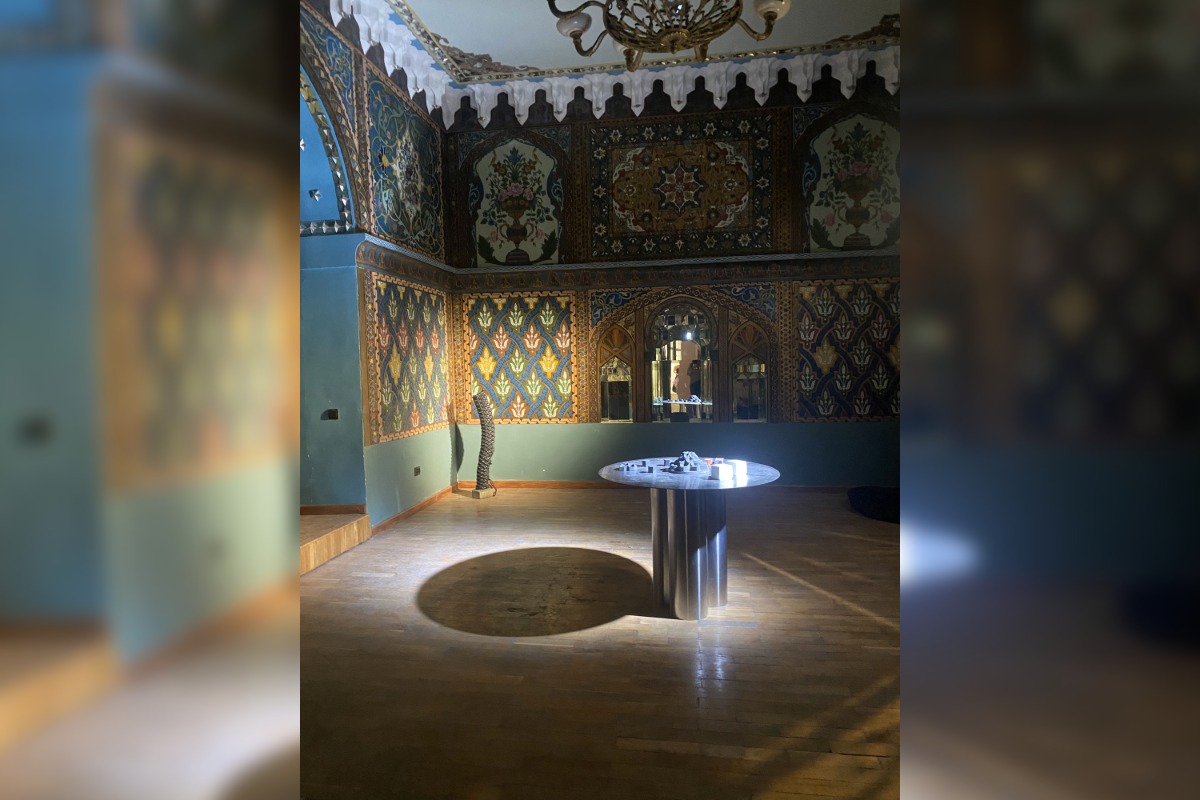
Beyond its historical significance, the building is also distinguished by its remarkable artistic details. The chandeliers in the main hall of the black-tuff structure were designed by architect Alexander Tamanyan and commissioned in Italy, while the stained-glass windows and murals were created by Armenian craftsmen, blending Armenian and Persian ornamental traditions. This cultural fusion is also reflected in the single-story wing’s arched carved windows and decorative rosette, further highlighting the building’s unique architectural identity.

Interior of the building. (Photos by Hena Aposhian.)

The space seems to have been quietly waiting for the right moment to come back to life.

Every few days, the space reveals a new experience, with each program thoughtfully connected to the building’s history, atmosphere, and the themes explored throughout the project. Through a constantly evolving lineup of events and artistic presentations, Musæum highlights different bodies of work while allowing visitors to experience the location in new ways each time they return. More than an exhibition, Musæum challenges conventional ideas of what a museum can be.

At the heart of Musæum is a simple yet thought-provoking question: Why has the museum experience remained largely unchanged? While cafés, restaurants, theaters and other public spaces have continuously evolved to reflect the changing ways people interact, museums have largely preserved the same model for generations. Visitors enter, observe the exhibits and leave. Since its establishment back in 2016, Rambalkoshe set out to challenge that convention. Rather than treating the museum as a static institution centered solely on its collection, the project reimagines it as a living organism—one in which people, their interactions, and the experience of occupying the space become just as significant as the objects on display. In this vision, the museum is no longer defined only by its artifacts, but by the relationships, conversations and moments that unfold within it.

Even the name Musæum reflects this philosophy. As Rambalkoshe founder Vahan Stepanyan explains, the Armenian word for museum, tangaran, often evokes the image of a place that is formal, untouchable and reserved for valuable objects. Musæum, by contrast, draws inspiration from the word’s ancient roots — a temple of the Muses, where people gather not simply to observe, but to seek inspiration, create, and share meaningful experiences.

This philosophy has become the foundation of the project. Each edition of Musæum temporarily transforms a historically, architecturally or culturally significant building into the kind of museum Rambalkoshe has envisioned.

Event posters inside the building.
“Artifacts” exhibition by Nensi Avetisian.
(Photos by Hena Aposhian.)

One of the defining ideas behind Musæum is the selection of spaces that are familiar yet inaccessible — places people may have passed by countless times without ever stepping inside. Whether an old office, a former restaurant or an abandoned building with a rich architectural identity, each location carries a hidden story waiting to be rediscovered.

In some cases, the number of visitors during the project’s few days exceeds the attention the location has received over many years. Through collaborations with artists and creative communities, these forgotten sites are brought back into public consciousness, filled with new energy, conversations, and experiences.

This year, in collaboration with the Museum of Literature and Art After Yeghishe Charents and the Golden Apricot Film Festival, Musæum has created an almost month-long program of exhibitions, discussions, performances, and creative events, with some days featuring multiple programs happening simultaneously.

What makes the program particularly unique is that its events have developed organically around different communities and audiences. Some visitors are drawn through Rambalkoshe’s creative network, others through the Golden Apricot Film Festival, and together these audiences create a diverse and dynamic environment where different perspectives and interests intersect.

The project raises an interesting question: how much creativity, inspiration, and cultural exchange can one person embrace?

“Once we entered the space and experienced the building firsthand, the vision began to take shape. The architecture, history and atmosphere of the location informed the selection of artists, exhibitions and programs that would best respond to the site,” Stepanyan said. 

One example of this dialogue between space and programming is the presence of Mahmoud Kalari, the renowned Iranian cinematographer and filmmaker, whose retrospective photography exhibition was presented at the location on July 19. The connection carries a symbolic significance, not only because of Kalari’s artistic background, but also because of the building’s own historical ties. It represents the way Musæum extends beyond simply organizing exhibitions, instead creating meaningful connections between the location, the artists, and the broader cultural moment surrounding the Golden Apricot Film Festival. 

Exhibition by Mahmoud Kalari. (Left, photo courtesy of Rambalkoshe; right, photo by Hena Aposhian.)

“The goal is not only to create an event, but to create an experience that feels connected to the city and its current cultural landscape. Each project is carefully considered in relation to its surroundings, allowing the building, the artwork, and the audience to become part of one larger narrative,” Stepanyan said

Another exhibition presented as part of the program is “Artifacts,” a collaboration between Armenian fashion designer Nensi Avetisian, Cascade Bureau and Rambalkoshe. The series explores form as a carrier of memory, examining how materials preserve cultural meaning, history and craftsmanship across generations. Created from Armenian tuff — the volcanic stone that has shaped Armenia’s architectural identity for centuries — the collection continues Avetisian’s exploration of sacred geometry, structural form and architectural language.

Each exhibition and program is carefully connected to the location and the themes explored within it. The selection of artists, cultural organizations, and creative projects is shaped by the building’s identity, allowing the works presented to enter into a dialogue with the space and its history.

In doing so, Musæum adds another dimension to the Golden Apricot Film Festival. It expands the festival beyond the traditional cinema experience, allowing audiences to encounter storytelling through different forms, spaces and senses. More than an accompanying program, it quickly became another way to discover Yerevan’s cultural potential and the many stories hidden within the city.

Hena Aposhian

Hena Aposhian is a freelance journalist who primarily focuses on Armenian arts & culture. She is a graduate of the American University of Armenia and holds a bachelor's degree in English & Communications.

Leave a Reply

Your email address will not be published. Required fields are marked *


Back to top button