


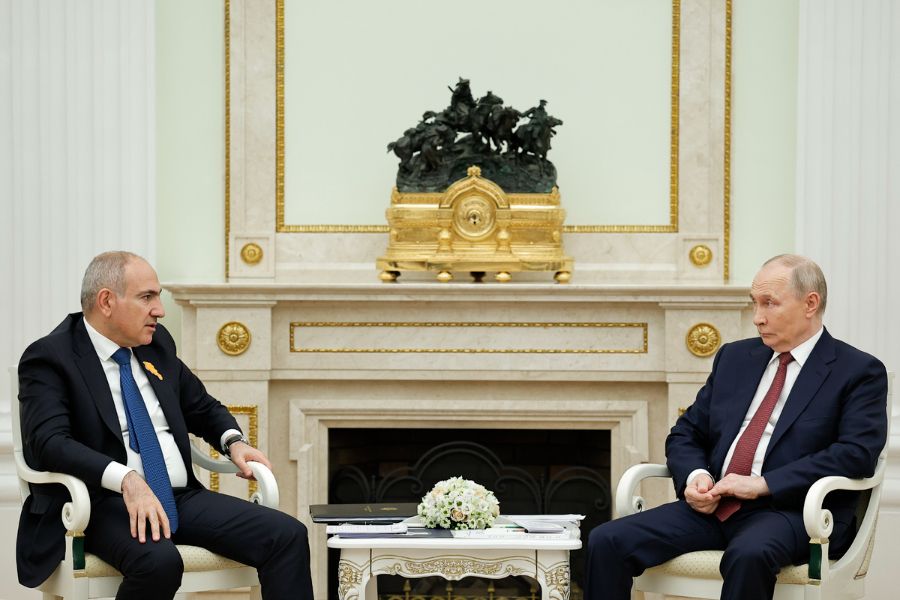
YEREVAN — On Monday, Armenian Prime Minister Nikol Pashinyan asked Russian President Vladimir Putin to intervene in a widening dispute over Armenian goods entering the Russian market. Fruits, vegetables, flowers, mineral water, alcoholic drinks and fish products were already affected; restrictions on Armenian dairy products came into force the same day. Pashinyan argued that the measures contradicted both bilateral agreements and the rules of the Eurasian Economic Union (EAEU). The appeal carried an uncomfortable truth. For all the government’s rhetoric about a European future, Armenia still needs the Russian market, Russian energy and the economic framework established by the EAEU.
Russia accounted for approximately 35% of Armenia’s foreign trade last year and remains a critical energy supplier. Armenia has also been a full member of the EAEU since January 2015, benefiting from the union’s arrangements for the movement of goods, services, capital and labor. Moscow’s position is that such benefits cannot be separated indefinitely from the responsibilities of membership.
Russian regulators have officially attributed the restrictions to repeated sanitary and product safety violations. Armenian authorities dispute that assessment, saying a joint inspection found no evidence of hazardous materials.
Moscow questions Armenia’s conduct as an ally
From Russia’s perspective, Pashinyan’s government is asking Moscow to preserve the advantages of Eurasian integration while progressively abandoning the political relationship that made those advantages possible. Armenia has frozen its participation in the Russian-led Collective Security Treaty Organization, expanded political and security cooperation with Western states and adopted a domestic law declaring the launch of a process aimed at eventual European Union accession. Russia and the other EAEU governments have warned that Armenia cannot ultimately belong to two rival regulatory and customs systems.
That argument is not simply an expression of Russian resentment. EU membership would require Armenia to align extensive areas of its trade, customs and product regulation with European rules. The EAEU, meanwhile, operates its own common regulatory structure and provides for the free movement of goods within its market. Full membership in both systems would be institutionally incompatible.
Putin has publicly called for openness about the consequences, arguing that Armenia should calculate the economic costs before making a choice. Russian officials have also said that integration may have to be reduced if Armenia adopts competing EU standards.
The Kremlin’s underlying complaint is therefore that Armenia no longer behaves like a dependable strategic ally, even as it expects Russia to continue providing preferential economic treatment.
Pashinyan nevertheless intensified the confrontation Wednesday. Speaking after a meeting of the Civil Contract party’s board, he said that failure to resolve the restrictions quickly could mark “the beginning of the end” of the EAEU, describing the union as paralyzed and unable to enforce its own rules. Economy Minister Gevorg Papoyan adopted a similar line, arguing that the failure to follow EAEU principles was not merely an Armenian problem but a threat to the integrity of the entire organization.
The European promise meets institutional reality
The dispute has also reopened a central question in Armenian politics: What exactly has Pashinyan promised the country concerning Europe?
Armenia’s parliament adopted legislation in March 2025 declaring the launch of the country’s EU accession process. Pashinyan has repeatedly presented that law as the opening of a historic European chapter and as a central component of Armenia’s postwar transformation.
Yet Armenia has not submitted a formal application for EU membership and is not included on the European Commission’s official list of candidate and potential candidate countries. Pashinyan acknowledged part of that gap during Monday’s conversation with Putin. He said a referendum on EU membership would become practically possible only after Armenia formally submitted an application and turned the issue into a concrete proposition. That statement is important because it distinguishes among three things that are frequently blurred in domestic political messaging: closer relations with Brussels, a declaration of European aspiration and an internationally recognized accession process. Armenia currently has the first two. It does not have the third.
Pashinyan’s critics argue that the distinction has been intentionally obscured because the European narrative serves a powerful domestic purpose.
The observable facts provide grounds for accusations that the government is overselling the prospect.
The ambiguity has helped Pashinyan politically. His Civil Contract party secured another parliamentary majority in June after an election dominated by Armenia’s geopolitical direction, relations with Russia and the government’s so-called “peace policy.”
Russian intelligence service says Europe cannot cover the losses
Russia’s Foreign Intelligence Service (SVR) entered the dispute Tuesday with an unusually direct warning about the economic consequences of Armenia leaving the EAEU. In a statement titled “The EU beckons Armenia but cannot help,” the SVR claimed that officials in Brussels understood that Armenia’s departure from the Eurasian bloc would produce a deep economic crisis.
The intelligence service also claimed that several European countries had signaled to EU leaders that they were unwilling to open their domestic markets to Armenian products at the expense of their own producers.
Russia is asserting that Brussels is encouraging Armenia’s geopolitical reorientation without being prepared to absorb the resulting economic costs.
Economic cost to Armenian households
The political confrontation is unfolding during a harvest season in which access to Russia matters immediately. The World Bank warned this week that the gradual expansion of Russian restrictions could move beyond a bilateral trade dispute and begin affecting Armenia’s overall economic growth, inflation and social conditions.
Presenting its annual “Armenia’s Economic Pulse” report in Yerevan, bank representatives said restrictions on Armenian agricultural and dairy products were already weighing heavily on exports. Shipments to Russia fell by 15% in May.
The risks are particularly acute for the dairy sector. Since the Russian agricultural watchdog Rosselkhoznadzor introduced new restrictions on Armenian dairy imports on July 27, Armenia has faced the possible loss of most of its dairy export earnings. About 78.3% of the country’s exported dairy products had been destined for the Russian market.
World Bank representatives said the resulting oversupply could also produce price fluctuations in Armenia’s domestic market.
The warning is especially significant because, although poverty has declined, many Armenian households remain close to the poverty line and vulnerable to even a modest economic shock.
Against this background, the World Bank reduced its forecast for Armenia’s economic growth in 2026 from 5.9% to 5.3%, citing the effects of conflict in the Middle East. A prolonged disruption of trade with Russia would add further pressure to that already weaker outlook.
The choice can no longer be postponed
The developments of this week have exposed the fragility of Pashinyan’s attempt to follow two strategic directions simultaneously.
At the same time, when access to Armenia’s most important export market is restricted, Yerevan turns to Moscow and invokes the protections of the Eurasian Economic Union.
That contradiction can now be measured in falling exports, threatened dairy revenues, accumulating agricultural products and the incomes of thousands of farmers whose businesses were built around access to the Russian market.
Russia’s restrictions should still be assessed according to EAEU law and supported by transparent regulatory evidence. Membership obligations apply to Moscow as well as to Yerevan.
But Armenia’s government must also confront the political and economic consequences of its own position. It cannot indefinitely describe the Eurasian system as a constraint nor should cooperation with Brussels be presented to the Armenian public as though it were equivalent to an established route towards EU membership.
Armenia has every sovereign right to reconsider its alliances and choose a different long-term direction. But sovereignty does not mean avoiding the costs of that decision, and no foreign partner is obliged to finance a geopolitical transition directed against its own interests. For Armenian farmers, exporters and households, the question is no longer whether Europe or Eurasia offers the more attractive political slogan. It is which market will buy their products, which economic system will protect their livelihoods and whether the government has honestly prepared the country for the choice it increasingly claims to have made.