




YEREVAN — As Armenia’s Constitutional Court continues hearings on challenges to the June 7 parliamentary election results, the case has become the main political development in Yerevan this week.
The court is reviewing appeals filed by seven political forces seeking to annul or revise the results of the June 7 elections. The Constitutional Court has consolidated the appeals into one case and must issue a decision by July 4.
The case is being heard with the CEC as respondent. The Prosecutor General’s Office, the Ministry of Internal Affairs and the Anti-Corruption Committee have been included as co-respondents. Civil Contract has also been involved in the proceedings as a third party.
Strong Armenia, led by businessman Samvel Karapetyan, has asked the court to invalidate the official results or order a second round between Civil Contract and Strong Armenia. Other opposition forces have also asked for annulment or revision of the final results.
A major point of dispute concerns Prosperous Armenia, which fell just below the 4% threshold required to enter parliament after the CEC invalidated results in several polling stations. During the court hearing, Prosperous Armenia representative Aram Orbelyan said there were polling stations where the number of ballots in the box exceeded the number of recorded participants. He also argued that commission protocols differed from Central Electoral Commission figures to the detriment of certain political forces.

According to the CEC, votes from invalidated precincts cannot be included in final calculations. CEC Chairman Vahagn Hovakimyan told the court that the law does not allow hypothetical calculations about whether Prosperous Armenia would have crossed the threshold if the invalidated results had been counted.
The Constitutional Court also questioned the applicants about claims involving military personnel voting after polling stations officially closed at 8 p.m. Representatives of Strong Armenia said voting continued at several polling stations, including precincts 35/65 and 10/51, where large numbers of soldiers remained after the official closing time. They argued that the incidents pointed to systemic violations.
The CEC has asked the court to dismiss all seven applications. Hovakimyan said the contested CEC decision was legal and adopted in compliance with Armenia’s Electoral Code. He also said the lack of video feeds from polling stations with fewer than 300 voters was due to technical difficulties, including the location of some polling stations in mountainous areas.
Pashinyan and his allies have rejected the fraud allegations. They have argued that opposition forces themselves were involved in vote-buying schemes.
In his closing remarks before the Constitutional Court, Artsvik Minasyan, secretary of the Armenia Alliance stated that the concerns raised in the alliance’s complaint had been substantiated throughout the hearings. Minasyan argued that the violations presented by representatives of various political forces demonstrated that the process could not be characterized as a legitimate election, but rather as a coordinated struggle by the ruling political force against the opposition. According to Minasyan, the alleged electoral violations were systematic and directed by the authorities. He said the individual and collective political rights of citizens had been violated “in the crudest manner.” “We did not hear any substantive rebuttal based on reasonable counterarguments to any of our arguments, evidence or claims,” Minasyan said. He concluded that, given the scope and nature of the alleged violations, the elections cannot be considered legitimate.
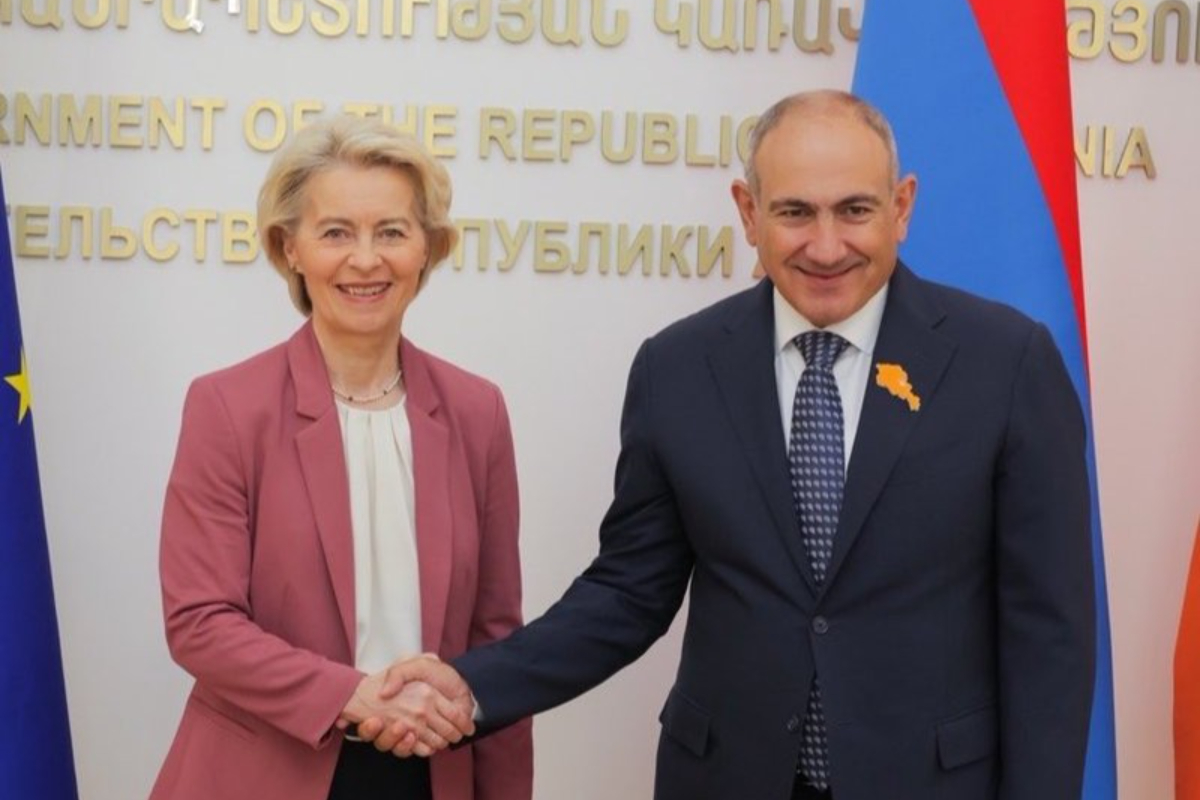
The election dispute coincides with European Commission President Ursula von der Leyen’s scheduled July 2 visit to Armenia and renewed warnings from Moscow over Armenia’s EU course. Ursula von der Leyen is expected to meet Pashinyan, after which the two will make statements and answer questions from the press.
Von der Leyen’s visit to Armenia and Azerbaijan is intended to highlight EU support for Armenia as Yerevan faces political pressure from Russia.
The timing has drawn criticism from opposition representatives. Robert Amsterdam, legal counsel to Samvel Karapetyan, sent a letter to von der Leyen urging the European Commission not to treat the Armenian election results as final or legitimate while they remain under review by the Constitutional Court.
Moscow, however, has expanded its criticism beyond Armenia’s EU course and linked the issue to the future of Armenia’s role in the Eurasian Economic Union, regional transport routes and the continued Russian military presence in Armenia.
On June 29, Russian Deputy Foreign Minister Mikhail Galuzin said experts are expected to assess the possible economic and legal consequences of suspending Armenia’s participation in the Eurasian Economic Union by December. Galuzin said the EAEU Treaty does not contain a clear mechanism for expelling or forcibly suspending a member state unless that country voluntarily withdraws, but said the leaders of Russia, Belarus, Kazakhstan and Kyrgyzstan had instructed officials to prepare a report on the matter.
The statement followed a May 29 joint declaration by the four EAEU leaders, who warned that Armenia’s EU accession process could create risks for the bloc’s economic security. The same statement called on Armenia to hold a nationwide referendum on whether it intends to pursue EU membership or remain in the EAEU.
Prime Minister Nikol Pashinyan has rejected the call for a referendum at this stage. He has said there are currently no grounds for asking citizens to choose between the EU and the EAEU because Armenia’s European integration process has not reached the point where such a decision is required. Pashinyan has also said Armenia will continue working within the EAEU framework until the moment when a choice between the two blocs becomes unavoidable.
Galuzin also linked the EAEU dispute to the Trump Route for International Peace and Prosperity, or TRIPP, the U.S.-backed project intended to unblock regional transport connections through Armenia. He said the project faces political and geopolitical difficulties and argued that Russian participation would make it more viable. According to Galuzin, earlier discussions on restoring railway links had taken place in 2022 and 2023 through a trilateral working group of Russia, Armenia and Azerbaijan, but were later interrupted.
Galuzin said the previous format became harder to continue after Armenia allegedly committed part of the future railway’s capital to the American side. He also said Iran and China may view a U.S.-linked route with reservations, citing the possible American presence near Iran’s northern border and broader concerns over transport corridors between Central Asia and Europe.
The Russian official further argued that Russia has technical and institutional reasons to be involved. He said the railway would likely need to be built according to the Russian rail gauge to ensure an uninterrupted connection with Azerbaijan, noted that Armenian railways are managed by South Caucasus Railway, a subsidiary of Russian Railways, and said transit through Armenia should be carried out in accordance with EAEU regulations.
Armenia’s Foreign Ministry responded by saying that the TRIPP project is currently being implemented in the Armenia-U.S. format and that an agreement has already been signed. Deputy Foreign Minister Mnatsakan Safaryan said he did not want to speculate about possible future formats involving Russia, but confirmed that, as long as Armenia remains an EAEU member, the project will operate under EAEU transit rules.
Galuzin also referred to the Russian border guards stationed in Armenia. He said the planned route would pass through areas where Russian border guards have served for decades alongside Armenian personnel on the borders with Turkey and Iran. He argued that Russia’s position, as well as the EAEU’s position, would have to be taken into account.
The Russian deputy foreign minister said Moscow has received no signal from Yerevan that Armenia intends to revise the 1992 agreement governing the presence of Russian border guards on the Armenian-Turkish and Armenian-Iranian borders. He also said Russia has received no indication that Armenia plans to review the agreement on the Russian 102nd military base in Gyumri, which remains in force until 2044.


Von der Leyen Visit Signals EU Support as Armenia Faces Russian Retaliation
The article correctly notes that Armenia is facing renewed pressure from Moscow, but the larger story should not be missed: the EU is not simply visiting Armenia symbolically. It is actively signaling political and economic support at a time when Russia is trying to punish Armenia for pursuing greater sovereignty.
President von der Leyen’s remarks in Yerevan were important because she made the point directly: as Russia closes doors to Armenian exports, the EU is opening doors. The EU is moving to remove tariffs on nearly 80% of Armenian exports heading to Europe, giving Armenia easier access to a market of roughly 450 million consumers. It has also announced additional support as part of a broader €52 million package to help Armenia offset Russian economic pressure.
That is not a small gesture. It means Armenia is gaining alternatives, market access, and support at a moment when Moscow is trying to use trade as leverage.
Russian pressure is real and should be reported. But Moscow’s displeasure should not be treated as the center of the story. Armenia has the sovereign right to diversify its partnerships, strengthen its economy, and reduce dangerous overdependence on any single power.
The real question is not whether Russia is upset. The real question is whether Armenia is gaining more options, more support, and more room to protect its statehood. On that point, the EU visit is a positive development.
Berge Jololian
Yerevan, Armenia
(Watertown, Massachusetts)
I also remember the European Commission President Ursula von der Leyen’s announcement a few years ago on increasing by 30% the oil & gas imports into the European Union from Azerbaijani terrorist cesspool to compensate for the sanctions placed on Russian oil & gas imports. She rewarded our filthy fascist anti Armenian enemy by this announcement instead of punishing them for the seizure and ethnic cleansing of Artsakh from its native Armenian population. Needless to say, the very same EU-sanctioned Russian oil & gas is flowing into Europe through Azerbaijani pipelines at much higher marker prices!
It is especially offensive when the EU, the US, and the West in general, shamelessly lecture other countries on human rights, democracy, election fraud, etc., while they close their eyes when their preferred dictators, like Aliyev and Pashinyan, violate them, which they brush aside as “minor irregularities”, and in addition, congratulate the latter, which makes their hypocrisy even more disgusting. During the Cold War, the West did this more covertly; today, they practically advertise their preferred candidates – dictators included. It is “my dictator” versus “your dictator”.
Historical memory matters, and Armenians should never be naïve about any outside power – European, Russian, American, or otherwise.
But history has to be analyzed carefully, not used as a reason to reject every present opportunity.
Armenia was also tied to Russia for decades as a client state, and that dependency failed. Russia failed to protect Artsakh, failed to prevent attacks on Armenia’s sovereign territory, and repeatedly placed its own interests above Armenia’s security.
So the lesson is not “trust Europe blindly.”
The lesson is: do not depend blindly on anyone.
France, the EU, the United States, India, Iran, and others all have their own interests. Armenia’s task is to understand those interests and use them to strengthen its own statehood, economy, security, and diplomatic room.
Today, the EU is opening markets to Armenian exports and helping Armenia offset Russian pressure. That is not something Armenia should dismiss simply because of European failures a century ago.
Armenia cannot survive by nostalgia, resentment, or dependence on one power. It needs options.
Diversification is not gullibility.
It is what small states do when old dependencies have failed.