


More than POWs
“Calling for the release of the former [Nagorno-]Karabakh leaders is the same thing, even worse. Their crimes are worse than what the Nazis did during World War II.” — Azerbaijani President Ilham Aliyev, France24 Interview, Feb. 14, 2026.
Lyudvig Mkrtchyan was captured by Azerbaijani soldiers while passing through Malikjanli village in the Fuzuli district at the end of October 2020. His wife, Hranush Shahbazyan, needed injections to remain calm and could not sleep in her own bed after his disappearance. “Lyudvig might be sleeping on the floor,” she said.
“How could I sleep in a bed?” She had begged him not to go to the front lines, but Lyudvig felt called to serve his country. When his letters finally arrived from prison, she could not recognize his handwriting, as his hand had been beaten so badly it had changed. More than 2,000 days later, his family says his body is failing him: severe heart damage, chest pain, blood pressure that climbs without warning and no real treatment for any of it. He has never lived in the home they bought together in Armenia’s Ararat Province. He missed their daughter’s wedding. He has never met his grandchildren.
Just a few days after Lyudvig, Azerbaijani soldiers seized Alyosha Khosrovyan. Neither man has ever gone home.
In December 2022, Azerbaijan sealed the only road connecting Artsakh to Armenia, besieged the region for nine months and then forced its entire Armenian population out. Madat Babayan, a shepherd from Getavan in the Martakert region, was captured. So were Erik Ghazaryan, Gurgen Stepanyan and Garik Martirosyan. Melikset Pashayan stayed behind in his village, Sznek, when most residents fled. He also could have left but chose to stay and see the last of his neighbors safely out, among them his own disabled brother. He was captured while trying to find them help. Vasili Beglaryan, who had stood armed guard near Charekdar village, and Levon Balayan and Davit Allahverdyan were captured and detained alongside them.

He has never lived in the home they bought together in Armenia’s Ararat Province. He missed their daughter’s wedding. He has never met his grandchildren.
And while that sweep of villages and families was underway, a far more targeted operation was already in motion. At the Lachin Corridor, Azerbaijani authorities were waiting for Artsakh’s leadership itself.
On Sept. 27, 2023, the Azerbaijani State Border Service arrested Ruben Vardanyan, a businessman and philanthropist who served as Artsakh’s state minister, in the Lachin Corridor as he attempted to enter Armenia. He was traveling in the same vehicle as Davit Manukyan, a major general and first deputy commander of the Artsakh Defense Army. Both men were detained at the border that day. Vardanyan would later tell Manukyan’s wife, Alvard, that his presence in the car had cost her husband his freedom. Ruben called it, in an apology from prison, the heaviest punishment he carries.
The following day, Artsakh’s Foreign Minister Davit Babayan surrendered himself to Azerbaijani-controlled Shushi, saying his “failure to appear, or worse, [his] escape, will cause serious harm to our long-suffering nation, to many people,” and that as “an honest person, hard worker, patriot and Christian,” he could not allow that. On Sept. 29, Azerbaijani forces arrested Levon Mnatsakanyan, who had served as Artsakh’s defense minister and commanded Armenian troops near Shosh during the 2020 war.
By Oct. 3, Arayik Harutyunyan, Artsakh’s fourth president, and Davit Ishkhanyan, speaker of the National Assembly, who had remained in Artsakh to help evacuate the last of its people, were both arrested.
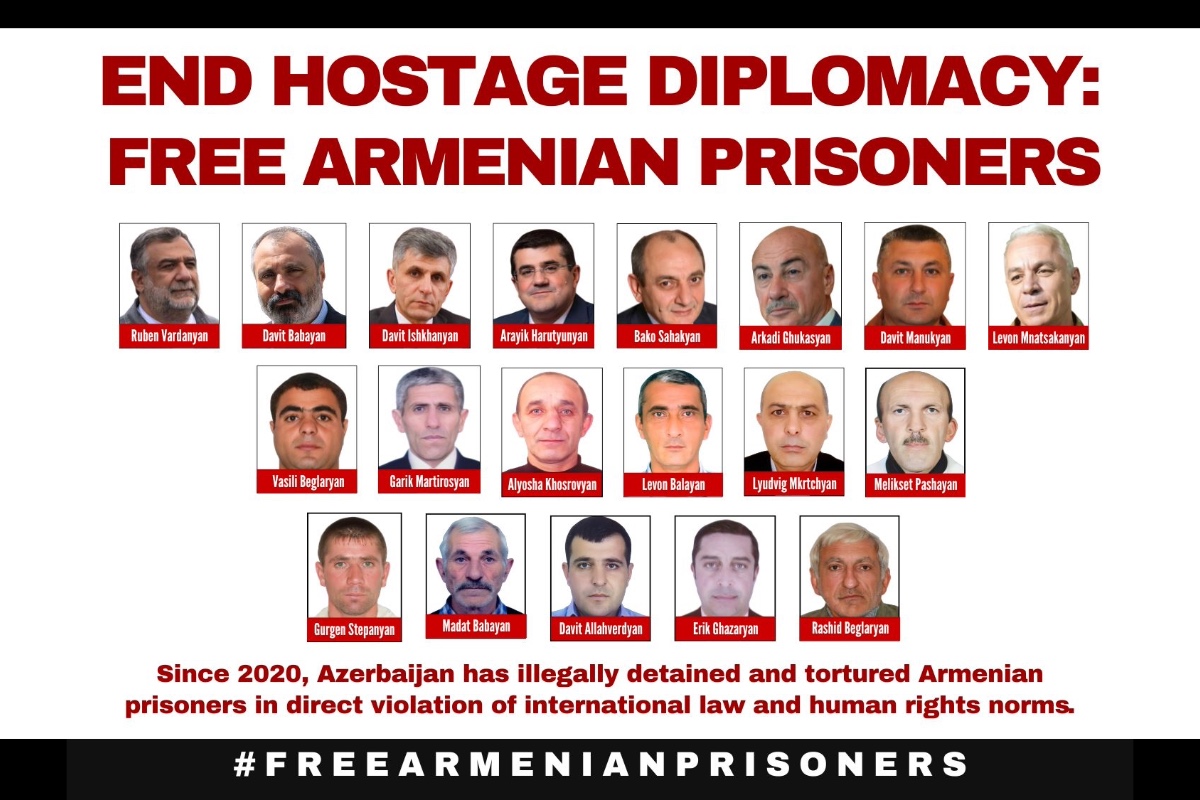
Nineteen known prisoners, tortured. Nineteen families, shattered. A nation held for ransom.
Only after eliminating the republic’s leadership — and ethnically cleansing nearly the entire indigenous Armenian population, more than 120,000 people, from their ancestral homes — did Azerbaijan begin speaking publicly of peace.
Nearly three years later, these arrests have hardened into prison sentences handed down at the Umbaki Penitentiary Establishment outside Baku, following sham trials closed to independent scrutiny. On Feb. 5, 2026, a Baku court sentenced five of them — Arayik Harutyunyan, Davit Ishkhanyan, Davit Babayan, Levon Mnatsakanyan and Davit Manukyan — to life imprisonment; Arkadi Ghukasyan and Bako Sahakyan received 20 years each, and Madat Babayan 19, all three spared life terms only because of their age. Twelve days later, Ruben Vardanyan was sentenced separately to 20 years after prosecutors sought life. Amnesty International called the proceedings a “travesty,” and Baku still refuses to provide the written verdicts to 15 of the 19 prisoners, effectively blocking their appeals. In one case, prosecutors charged a man born in 1993 with fighting in battles fought in 1991 and 1992, and the court accepted it as fact.
It is difficult to conceive of the human cost of captivity. Each hostage is a real person: a husband, a son, a father, a friend, an uncle, a story, a life. They are shepherds, soldiers, scholars, public servants and elected leaders. They have families and a nation crying for their return.
On July 14, at a European Parliament conference calling for the release of Armenian hostages, Davit Ishkhanyan’s son, Armen, discussed the human toll on the families of the hostages. He recalled asking his own daughter what she wanted for her birthday. She only wished for her grandfather to come home.
On April 24, 1915, Ottoman Turkish authorities arrested more than 200 leading members of the Armenian community, among them doctors, poets, religious leaders and political figures. Many were tortured and publicly executed in the months that followed. Today, we see former presidents, former ministers, former commanders and former soldiers of Artsakh arrested by Azerbaijan, alongside a longer list of civilians and soldiers. The plan is premeditated and studied.
Aliyev calls the crimes of Artsakh’s leadership worse than the Nazis’. This is a subterfuge for what his own regime has committed: not a new crime echoing an old one, but the same genocide, continued. With no state ever held accountable and no reparations ever made, the crime never ended. It simply waited a century, then found its opening: the genocidal ethnic cleansing of Artsakh in 2023.
The same blood that dyed the sands of the Syrian Desert now stains the floors of Azerbaijani prison cells. The same blood that crimsoned the ground of Erzurum and Kayseri in Western Armenia has, a century later, reddened the soils of Hadrut, Stepanakert and Shushi in Eastern Armenia. If you wince at photographs of genocide victims, you should ache no less at images of Armenian soldiers returned with their ears severed, their mouths mutilated, their chests desecrated. The violence has changed neither its language nor its purpose.
These hostages represent far more than individual lives. Together, they carry the full weight of what the Armenian nation stands to lose.
- Our symbols of Armenian excellence and success are imprisoned in Azerbaijan.
- Our symbols of Armenian intellect are imprisoned in Azerbaijan.
- Our symbols of Artsakh’s power are imprisoned in Azerbaijan.
- Our symbols of freedom and independence are imprisoned in Azerbaijan.
- Our symbols of security and sovereignty are imprisoned in Azerbaijan.
And alongside all of this, above all, they are people, missed by their families, like Ishkhanyan’s granddaughter, waiting for a birthday present no one can give her.
Until every hostage is returned, our story remains unfinished. Justice cannot coexist with political hostages, and peace cannot be built upon prison walls.
Congress has two chances, right now, to make that cost real for Baku. The ARMENIA Security Partnership Act (H.R. 6840) would bar the president from waiving Section 907 restrictions on U.S. aid to Azerbaijan unless Aliyev’s government takes concrete steps toward peace, including the release of Armenian hostages and a recognized right of return for the Armenians it drove from their homes. The Azerbaijan Sanctions Review Act of 2025 (H.R. 5369) would direct the administration to review Global Magnitsky sanctions against the Azerbaijani officials responsible for their detention and torture. Both bills already have bipartisan sponsors. What they need now is the pressure of an American public that refuses to look away. Call your representative. Ask them to cosponsor both bills. Nineteen hostages, and a nation, are waiting.