



UCLA East Coast lecture series examines Armenian Genocide looted art, restitution

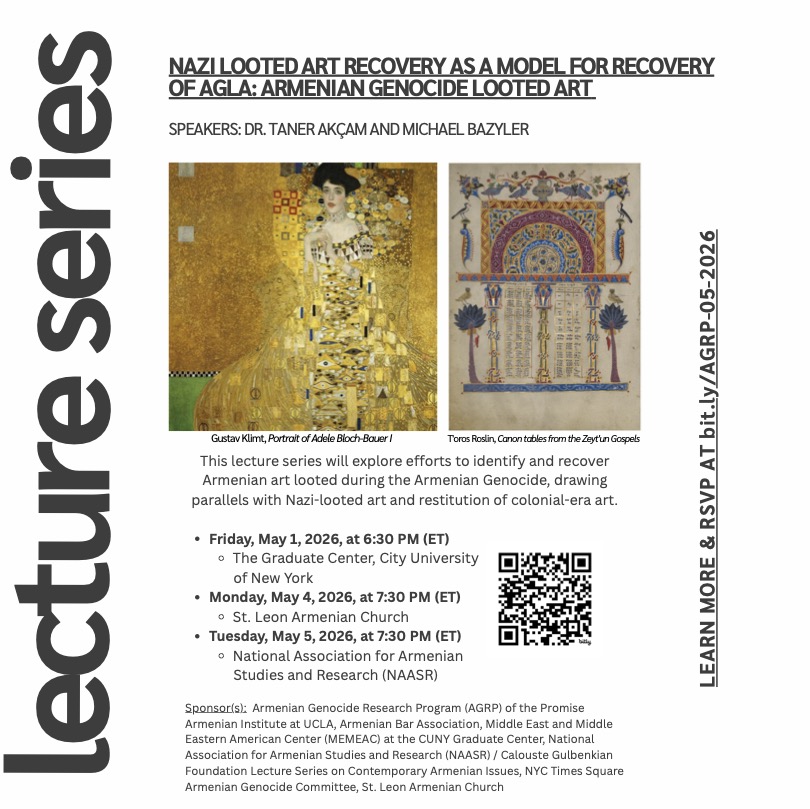
The Armenian Genocide Research Program (AGRP) of the Promise Armenian Institute (PAI) at UCLA is pleased to announce an East Coast lecture series titled “Nazi Looted Art Recovery as a Model for Recovery of AGLA: Armenian Genocide Looted Art,” to take place in early May.
This lecture series, featuring Dr. Taner Akçam and Professor Michael Bazyler, will explore efforts to identify and recover Armenian art looted during the Armenian Genocide — and to establish “Armenian Genocide Looted Art” (AGLA) as both a term and a framework for justice.
The AGLA movement is part of a broader, decades-long international effort to secure the restitution of culturally significant objects stolen during historical atrocities. That movement found its footing with Nazi-looted art recovery, and leading Holocaust restitution advocate Ambassador Stuart Eizenstat has described the extension of these principles to other communities as “the ripple effect” — one driven by the pursuit of “a measure of justice.” AGLA seeks to bring Armenian victims of genocide into that same arc of accountability. Ambassador Eizenstat was the principal negotiator of the 1998 Washington Principles on Nazi-Confiscated Art with 44 countries, which continue to be a basis for recovery and compensation for Nazi looted art and are the model for restitution of AGLA.
The program will touch on UCLA’s Armenian Genocide Looted Art Research Project (AGLARP), which brings together law students and art students — many of them Armenian Americans — to search museum and institutional collections for Armenian art objects, aiming to create a comprehensive list of all Armenian art in the United States and their provenances. The AGLARP specifically seeks to identify objects looted during or after the Armenian Genocide.
Law professor Michael Bazyler of Chapman University will discuss how models of Nazi-looted art recovery can inform this work, highlighting the legal and historical dimensions of restitution efforts. AGRP Director Dr. Taner Akçam will provide additional context on the Armenian Genocide and the scholarly significance of this groundbreaking initiative.

The lecture series will take place across three cities in early May. The first event is in New York City on Friday, May 1 at 6:30 p.m. ET, held in the Skylight Room at the CUNY Graduate Center (365 5th Ave.). Attendees can park in nearby paid garages or take the subway to 34th Street-Herald Square (N/Q/R/W or B/D/F/M lines) and walk a few minutes to the venue. The second lecture takes place in Fair Lawn, New Jersey on Monday, May 4 at 7:30 p.m. ET at St. Leon Armenian Apostolic Church (12-61 Saddle River Rd.), which has a parking lot on site. The series concludes on Tuesday, May 5 at 7:30 p.m. ET at the National Association for Armenian Studies and Research (NAASR), located at 395 Concord Ave., Belmont, Massachusetts 02478, also with on-site parking available.
This lecture series is co-sponsored by: The Armenian Bar Association, The Middle East and Middle Eastern American Center (MEMEAC) at the CUNY Graduate Center, the National Association for Armenian Studies and Research (NAASR) / Calouste Gulbenkian Foundation Lecture Series on Contemporary Armenian Issues, NYC Times Square Armenian Genocide Committee, and St. Leon Armenian Church.
Visit the event page for registration and more information.


AGLARP is doing the Turks work for them: threatening by intimidation the emptying of museums and collections in America and Europe of Armenian objects and thus removing worldwide awareness of the existence of Armenia and its cultural and historical importance. In Turkey, except for a few misrepresented propaganda examples, there is nothing identified as Armenian in museums located either within the territory of historical Armenia, or within areas historically inhabited by Armenians. AGLARP needs to examine why Turkey has done this, and have some basic self-awareness that its agenda walks hand-in-hand with Turkey’s genocide-denial and cultural genocide agendas. Armenian culture is not some insular “mud-hut” affair – it is inextricably linked in important and revealing ways to wider cultures dating from the classical-era down to the present day and this requires artefacts from Armenia to be held and properly presented in the collections of the world’s museums and galleries.