


Art as resistance: How GOY keeps Artsakh’s heritage alive
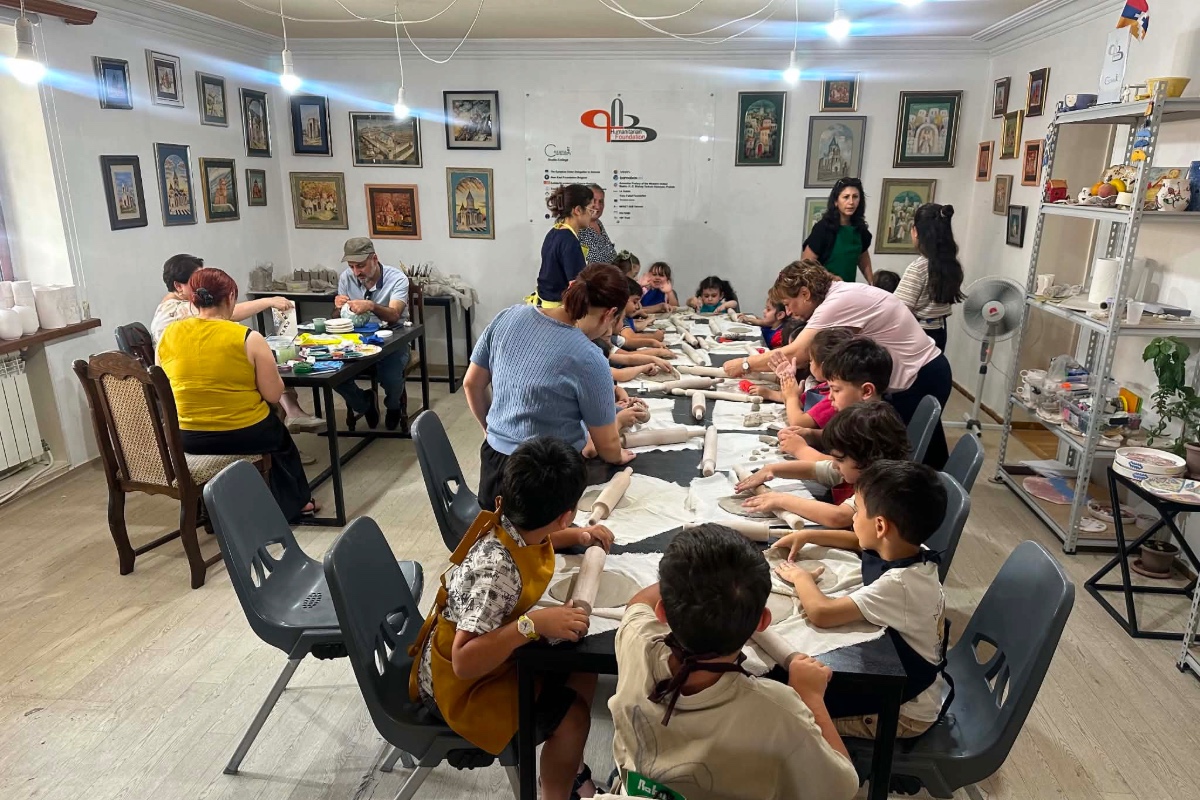
In the wake of the ethnic cleansing of Armenians in Artsakh, the fight to preserve Armenian heritage has extended from the geopolitical stage to the cultural trenches. In a quiet Yerevan workshop, the GOY Humanitarian Foundation and its social enterprise, CeramaZart, have built a vital sanctuary. Here, displaced Artsakh artists paint traditional carpet motifs onto everyday ceramics, while hundreds of children heal from trauma through free clay therapy.
I sat down with Azatoohi Simonian, former advisor to the President of Artsakh on diaspora affairs and the driving force behind GOY, to discuss cultural resistance, community survival and how each hand-painted cup helps sustain a people in exile.
Milena Baghdasaryan: What was the journey that brought you to your work with the Artsakh community?
Azatoohi Simonian: Born in the New Julfa community of Iran, I moved to Armenia in 2003, where I studied political science and international relations and initially worked in the National Assembly of Armenia.
My journey with Artsakh began in 2014 when I accepted an offer from Deputy Prime Minister Artur Aghabekyan to head his office. What started as a professional career quickly became a lifetime purpose. By June 2020, I was appointed advisor to the President of the Republic of Artsakh on Diaspora Affairs. We were planning to establish a dedicated state structure for Diaspora relations, but the outbreak of the war on September 27 completely disrupted our plans and shifted the country’s priorities.

Operating a one-person office in a devastating post-war reality where Artsakh had lost 75% of its territory, the economy was ruined, and nearly half the population was left homeless, I focused on laying foundational partnerships to navigate this entirely new and difficult reality.
Baghdasaryan: The crisis of 2020 clearly shifted your trajectory from state governance to direct humanitarian action. How did the idea for your foundation emerge from that chaos?
Simonian: During the 2020 war, I coordinated logistics, aid and diaspora investments for the 39,500 displaced Artsakh residents who had moved to Armenia. Seeing that many could never return because their homes and villages were permanently lost, the idea was born to establish long-term, sustainable support.
Together with Lilit Melikyan from the Teryan Cultural Center and other like-minded friends, we founded the GOY Humanitarian Foundation. Our largest, most extensive and continuously expanding project to this day is CeramaZart.
Baghdasaryan: Why did you decide to establish a workshop specifically? What was the underlying philosophy behind choosing this model?
Simonian: We established the workshop so displaced Artsakh artists could pursue their professional calling and earn a living with dignity, achieving a true “happiness index.” From the start, our goal was self-sustainability. We wanted to stand on our own feet, move away from continuous charity and manufacture a competitive product to reinvest our revenues into salaries, rent and operations.
Market research led us to handmade ceramics, which perfectly met our two primary objectives: providing employment for Artsakh artists who paint the pieces by hand, and offering free clay art therapy to Artsakh children. These children suffer from severe war-related trauma, which requires play-based psychological intervention rather than a sterile office setting. Today, our trained clay therapist provides free sessions to 20–30 Artsakh children and their parents every month.
Baghdasaryan: Who were the main supporters at the very beginning, and has their number grown over time?
Simonian: When this was just an abstract concept, several key partners pushed me to turn it into reality. Our first partners are the French-Armenian SPFA Foundation led by Janik Manissian and the “Espoir pour l’Arménie” (Hope for Armenia) Foundation led by David Chahinian. It has been almost three years since we started a strategic and long-term partnership with the Vahé Fattal Foundation led by Yervant Nahikian, which has supported us and has helped us spread art, culture and clay therapy among children and young people in need.
Since our founding in 2020, our network has grown significantly. We continuously secure grants from individual donors in Brazil, Argentina and Uruguay, as well as international NGOs, Impact Hub Yerevan, the Barnabas Aid agency and numerous others.
Baghdasaryan: So, you take the first step and approach these benefactors, rather than them finding you?
Simonian: At the very beginning, yes, we reached out. Today, however, our network has grown so much that benefactors frequently visit us to plan new initiatives. While CeramaZart is our stable anchor, the Goy Foundation continuously wins grants to execute other diverse projects for vulnerable Artsakh groups, including women, children, wives of fallen heroes and families affected by the fuel depot explosion.
For instance, we are about to launch a parenting course for the wives of fallen heroes. Last year, in partnership with SPFA and the Fondation de France, we provided advanced accounting, financial literacy and job placement training for 15 displaced women.
Additionally, funded by the Fondation de France, the French Ministry of Foreign Affairs, L’Œuvre d’Orient, Espoir pour l’Arménie, and SPFA, we initiated a family empowerment program in the border community of Zorakan in the Tavush Province. We recently completed the first phase by providing turkeys to both displaced and local vulnerable families to help them establish small agricultural holdings. The next phase will launch a beekeeping project, distributing beehives to families in Zorakan and neighboring border villages to improve their social status and economic self-sufficiency.
Baghdasaryan: The very name, the word “Goy” [meaning “Existence” or “Being” in Armenian], seems highly symbolic, evoking a struggle for survival or existence. Could you elaborate on that?
Simonian: The 2020 war was a massive psychological blow that forced us to realize we were in an existential battle to survive as Armenians and to preserve the Republics of Armenia and Artsakh. The word “Goy” became a fixture of our daily life because it perfectly captured that struggle for our very being and sovereignty.
Recognizing this threat, we worked tirelessly from 2020 until 2023 to manage the resettlement of displaced residents within the remaining areas of Artsakh to stem the tide. Unfortunately, due to overwhelming external factors, we ultimately passed the point where we could preserve Artsakh’s existence as a separate, sovereign state. We unfortunately crossed that line.
Baghdasaryan: Your ceramics prominently feature historical Artsakh carpet motifs and cultural symbols. How are your artists adapting these ancient patterns into daily household art, and how are these techniques being passed down?
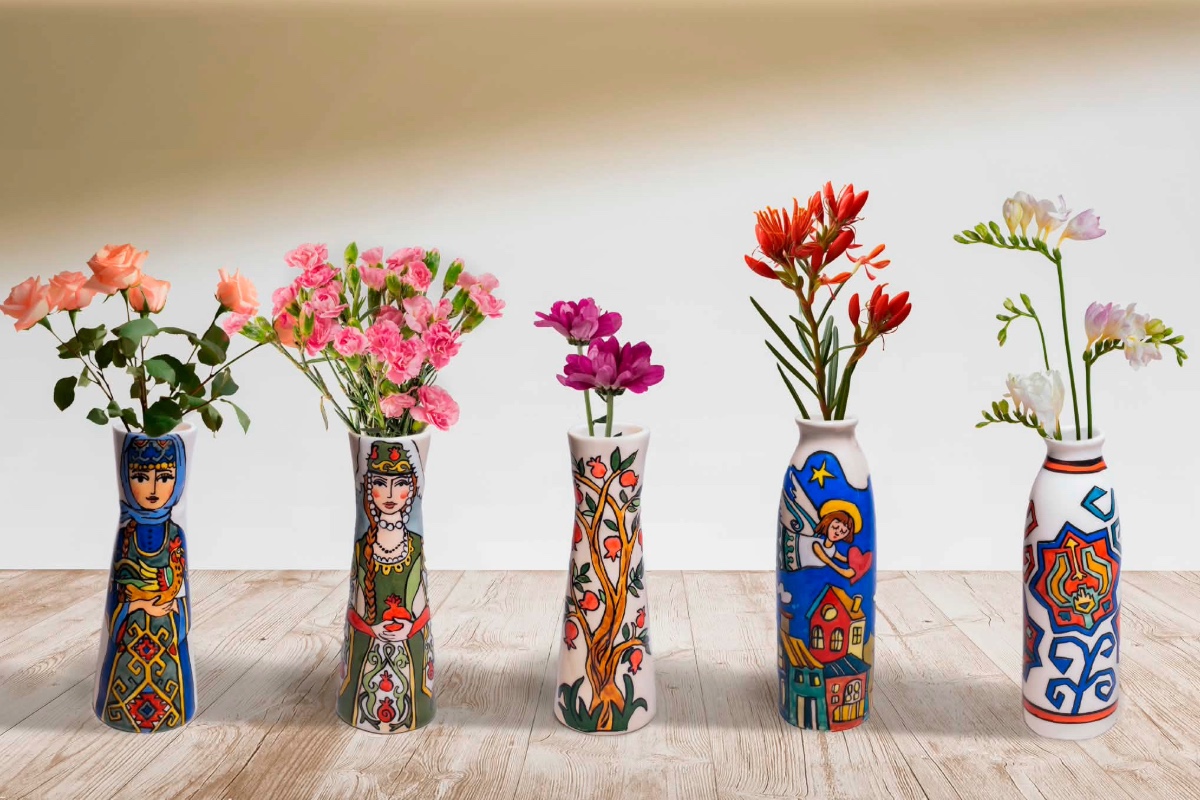
Simonian: A key objective of CeramaZart is the revival of Armenian cultural heritage, our centuries-old carpet-weaving traditions, traditional costumes and ornaments by making them a part of daily life. For example, drinking morning coffee from a cup adorned with the authentic symbolism of an Artsakh “Vishapagorg” [Dragon Carpet] infuses the day with genuine cultural meaning.
Modernizing these authentic models into functional pottery is also a form of cultural resistance. Our heritage, including historic 15th-century “Jraberd” or “Gardman” carpets, is actively being appropriated by our hostile neighbor and presented to the world as their own. By painting these native patterns, our foundation and team of artists are holding a vital line in the trenches of a cultural battlefield. We are on a mission to preserve and modernize everything from carpet art to traditional costume motifs, translating them into beautiful, applied art.
Baghdasaryan: Who are the people working behind these pieces?
Simonian: Our team consists exclusively of displaced Artsakh artists, including Erna Mkrtchyan, Gayane Babayan, Seda Mikayelyan, our sole potter Emin Mikayelyan, and many others. Our primary goal is to provide sustainable employment, allowing these creators to translate their skills, paintings and traditional carpet designs into handmade ceramics.
A central feature of our workshop is a collection painted entirely from memory, capturing the villages, churches and monuments of Artsakh. We paint these landscapes to preserve our culture and show the world a rich heritage that is being systematically erased; tragically, many monuments we depict, like Kanach Zham Church or the Stepanakert Cathedral, have already been destroyed.
To raise global awareness, each framed tile includes a historical biography in three languages. We also feature modern artistic interpretations, such as Samvel Tavadyan’s stylized paintings of Shushi, allowing visitors to bring the resilient spirit and memory of Artsakh into their homes.
Baghdasaryan: And how are sales conducted? Is it online, or do people buy them directly from here?
Simonian: We utilize a multi-channel sales approach. Thanks to the Vahé Fattal Foundation, we launched an official website and online shop, allowing us to ship globally. Interestingly, our primary market is the United States, where 40% of our buyers are non-Armenians who deeply appreciate our cultural handiwork. Locally, we sell directly from our physical workshop, via our social media platforms, and through partnerships with about 25 hotels, restaurants and souvenir shops across Armenia.
“We paint these landscapes to preserve our culture and show the world a rich heritage that is being systematically erased.”
As a social enterprise, our entire monthly revenue is funneled back into the project to cover operational costs, raw materials and artists’ salaries. Crucially, all surplus profit is directly converted into funding free pottery and clay therapy classes for traumatized Artsakh children. The more items we sell, the more children we can enroll.
We also run paid pottery masterclasses for non-Artsakh residents, a service that directly funds our charitable classes. Through this self-sustaining loop, we have provided free art therapy to around 550–600 Artsakh children since 2022, partnering closely with the HAYORDI Charitable Foundation to support children of fallen soldiers and explosion victims.
To further expand this circle of impact, we are transforming our space into a combined souvenir shop and family-style restaurant. We regularly host large tourist groups, such as French travelers brought by our partner, SPFA, to serve authentic Artsakh cuisine like zhingyalov hats, share our artists’ life stories and conduct masterclasses. The proceeds from their visits and souvenir purchases are immediately reinvested into bringing new children into our free therapy programs.
Baghdasaryan: How are the prices of the items determined, and on what basis?
Simonian: Pricing reflects an intensive 20- to 22-day handmade timeline, heavy kiln electricity costs and a standard 10% ceramic defect rate. We add a profit margin to this baseline cost, but as a certified social enterprise, 100% of it is legally reinvested into expanding our team and funding free classes. CeramaZart LLC is owned entirely by the GOY Humanitarian Foundation; there are no private shareholders. Our absolute transparency has been approved through partnerships with Impact Hub Yerevan and its first impact investment fund for social enterprises, VIA Fund, and the Armenian government’s Humanitarian Aid Committee has granted us tax-exempt status as an official charitable program.
Baghdasaryan: What has been the greatest challenge you’ve faced over these years?
Simonian: Our biggest hurdle is sales volume. We produce faster than we sell locally, leaving our workshop overstocked. To break into new markets, we partnered with the Fund for Armenian Relief (FAR), its Ayo! platform, and its SheCan program. Following business training, FAR began buying our ceramics in bulk to export to America, which has deeply stabilized our financial cycle.
Still, global expansion remains a challenge. Another vital partner is France’s volunteer-run foundation, “Espoir pour l’Arménie.” They buy our products and resell them at French expos, covering all travel expenses out of pocket so that 100% of the resale profit can fund independent humanitarian projects in Armenia, like purchasing livestock for vulnerable families.
This creates a compounding network of value, what I call the “CeramaZart effect.” A cup painted here funds a local artist’s salary and a child’s art lesson; when that same cup is resold in France, its profit accumulates to fund an entirely separate charitable initiative. We hope to see this effect multiply worldwide.
Baghdasaryan: Regarding FAR, how did your cooperation begin? Was it after the business courses, through the SheCan program, or how did it unfold?
Simonian: It began directly through the SheCan program organized by FAR’s Gyumri Information Technology Centre (GITC). I applied, participated and physically attended intensive business training courses, which truly opened up the FAR network to us.
During that time, we connected closely with FAR staff Helena Melkonyan and Sarah Stites. They made initial test purchases from several beneficiaries, including CeramaZart, and successfully exported the products to America for a large exhibition and sales event. That initial success has grown into a second, a third and what we hope will be an endless cycle of future orders to showcase and sell our products on their international platforms.
Baghdasaryan: That is a wonderful milestone. Looking closely at these years, what would you say is the absolute greatest achievement for yourself personally or for CeramaZart as an institution?
Simonian: Institutionally, our greatest achievement is building an expanding network rooted in deep trust, transparency and absolute accountability. To us, the frequency or amount of a donation matters far less than the fact that a donor believed in our vision. We view our partners, whether pinned to our wall or not, not as mere financial benefactors, but as like-minded peers who share both our ideology and our responsibility.
On a human level, our ultimate achievement is uniting displaced Artsakh artists under one roof to preserve our vital cultural heritage. By translating traditional costume art, carpet art and historic patterns into daily household items, we actively introduce these indispensable national treasures back into our people’s lives.
Baghdasaryan: What is your ultimate message, your word of advice, or your appeal to the people of Artsakh during these deeply trying times?
Simonian: My message is to never despair. Keep the light, the spirit and the dream of returning to Artsakh alive. Never renounce Artsakh in your minds, and stand proud of your origins regardless of any external propaganda. Remain loyal to Artsakh’s land, villages and mountains; visualize it, pass its memory to the next generation, and preserve its beautiful dialect. In fact, our students automatically and exclusively speak the Artsakh dialect here without any prompting.
Yerevan is vast and congested, making it difficult for displaced families from tightly knit communities to stay connected. CeramaZart has organically solved this by becoming a vital weekly anchor and community center. Once a week, parents gather here to share memories and discuss the future, while children reunite with childhood friends who are now scattered across different schools and neighborhoods. Without any bureaucratic planning, this space naturally transformed into a living sanctuary for the people of Artsakh, and I say that with immense pride.
“My message is to never despair. Keep the light, the spirit and the dream of returning to Artsakh alive.”