


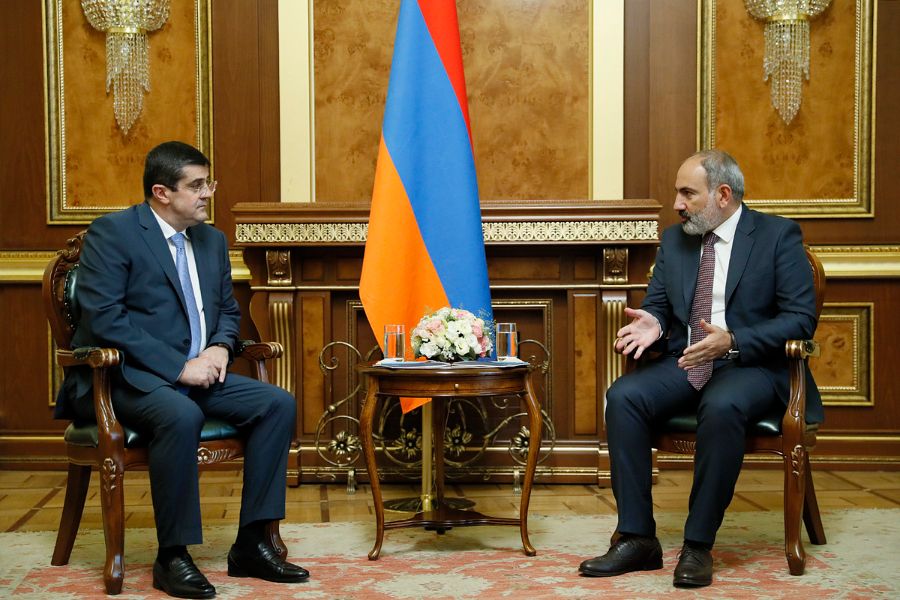
YEREVAN — During a campaign event in Syunik on the eve of the Tri-Festival commemorations marking the liberation of Shushi and the formation of the Artsakh Defense Army, Prime Minister Nikol Pashinyan made a series of remarks that stirred significant public and political reaction.
Speaking to citizens in Syunik, Pashinyan questioned the historical and material foundations of Armenian presence in Artsakh, stating: “In what sense was Karabakh ever ours? Explain.”
He went further, framing the issue in explicitly material terms: “What did we do there? Did we build schools? Preschools? Factories? Did we live there? With what was it ours? It wasn’t ours.” He continued by asserting that the territory had not only been outside Armenia’s effective control, but also had been used, in his words, “to make sure that Armenia will not be ours too.”
Pashinyan argued that the current political trajectory represents a corrective shift, stating that, thanks to his leadership, “Armenia is finally ours.”
The comments made by Armenian Prime Minister Nikol Pashinyan have since drawn criticism from academic, religious and political circles, because his framing challenges established historical narratives and disregards the documented developments in Artsakh over the past decades.
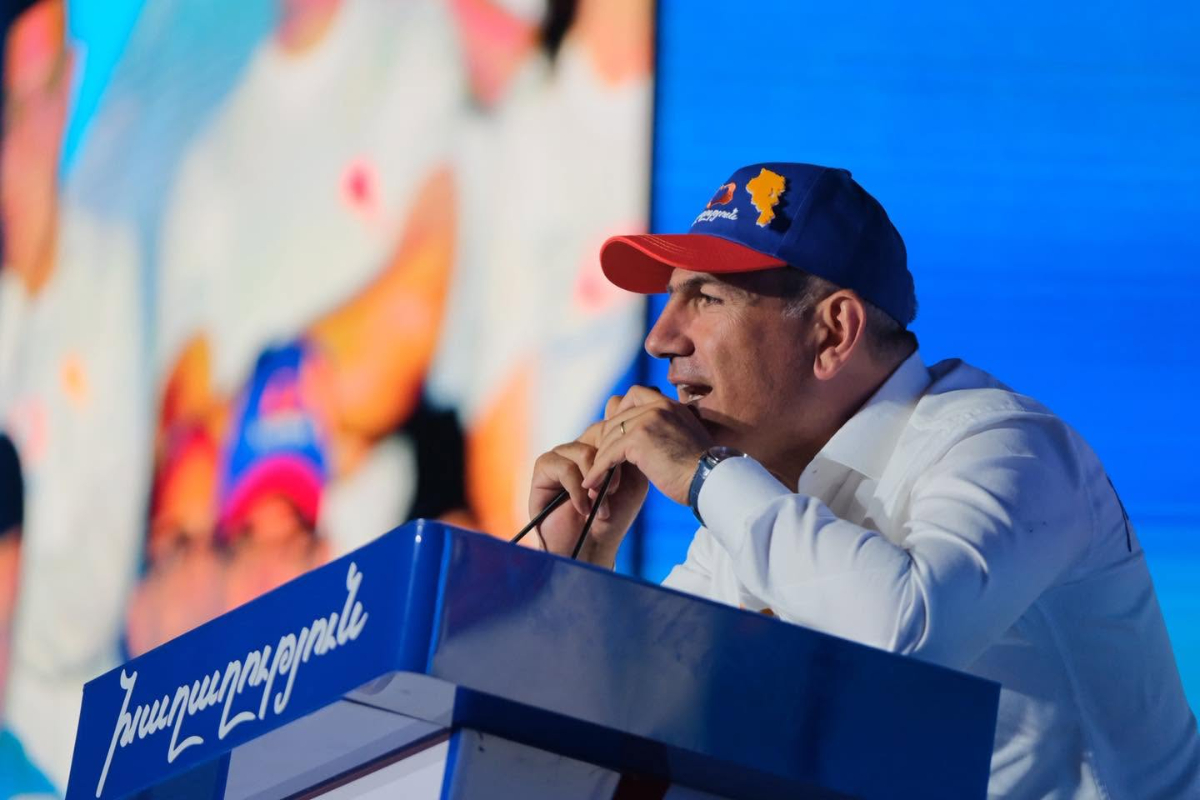
Political scientist and professor Vahe Davtyan described the statements as “far more than political manipulation” and characterized them as “a denial of an entire layer of reality.”
He highlighted the sustained socioeconomic growth and institutional development in the region, arguing that Artsakh had, by multiple indicators, demonstrated some of the highest economic growth rates in the South Caucasus. Referring to external assessments, he noted that as early as 2014, Russian business outlet RBC reportedly described Artsakh as a “South Caucasus tiger,” with periods of growth reaching between 9% and 15.6% annually, particularly after 2010.
Davtyan emphasized large-scale infrastructure expansion, including energy generation, gasification and transport systems. He highlighted the development of hydropower capacity, modernization of electrical transmission networks, the expansion of public utilities, and the construction of Stepanakert Airport.
According to his account, institutional frameworks for energy policy also were established with the aim of strengthening economic and energy independence, with electricity exports to Armenia beginning in 2018. He further referenced what he described as a milestone in institutional finance: the 2009 initial public offering of the Artsakh hydroelectric power plant, which he argued represented the first Armenian IPO of its kind and a level of financial sophistication uncommon even in Armenia at the time.
By 2020, Davtyan noted, the region had implemented an extensive hydropower program, with dozens of small and medium-sized hydroelectric plants constructed. He said electricity production had nearly doubled internal demand, moving the system toward an energy-surplus model. Gasification, he added, had reached 67.1% overall, with urban coverage reportedly as high as 93%.
“Is this what ‘building nothing’ looks like?” he asked. Taken together, he argued, these developments constituted not an absence of state-building, but a sustained process of institutional and economic formation.
Fr. Ararat Poghosyan framed the issue as “documented continuity rendered undeniable by scale.” “The claim that ‘Artsakh has never been ours’ collides with documented reality,” he said. “When a territory has, for centuries, been inhabited by hundreds of thousands of Armenians, with hundreds of churches, schools, teachers, parish communities and cultural institutions, the denial of its Armenian identity becomes a crude dismissal of historical fact.”
Poghosyan argues that the Armenian presence in Artsakh was not episodic or symbolic, but structured, measurable and deeply institutionalized across generations.
Nineteenth-century records, he said, already describe a densely Armenian-populated region: tens of thousands in the mid-1800s, rising to well over 100,000 by the late Russian imperial period. Even after waves of violence, displacement and political upheaval, Armenian communities persisted into the Soviet and post-Soviet eras, maintaining a visible demographic presence.
Shushi, in particular, is presented not as a peripheral detail but as a focal point of historical contradiction. “If Armenians did not live there,” he argued, how does one explain a city where Armenian life once constituted a dominant urban reality, only to later shrink dramatically under the weight of conflict and demographic change?
In Poghosyan’s account, the late 19th and early 20th centuries reveal an already functioning Armenian educational network: dozens of schools, hundreds of teachers and thousands of students engaged in structured learning. This, he argues, was not incidental habitation but organized civic life. Hundreds of active churches and monasteries, alongside a stable clergy presence, are evidence of an enduring ecclesiastical infrastructure.
The argument extends into the modern period, where the continued presence of Armenian religious sites suggests that despite political ruptures, the cultural and spiritual footprint of Armenian life in Artsakh never disappeared.
Armenian Revolutionary Federation Bureau member and lawmaker from the Armenia Alliance Lilit Galstyan accused Pashinyan of “systematically falsifying reality” regarding the scope and scale of development in Artsakh.
“Pashinyan is once again lying,” Galstyan wrote. “He continues to set new records for distortion, surpassing even himself. His claim that ‘whatever was built in Karabakh counts as nothing built’ is absolute and unequivocal falsehood, stated in broad daylight.”
Challenging the premise that Artsakh lacked meaningful construction or investment, Galstyan pointed to what she described as decades of coordinated development financed through the Hayastan All-Armenian Fund and related initiatives. According to her account, between 1995 and the 2020 war, approximately $200 million was directed toward infrastructure and reconstruction projects in Artsakh.
She argued that major interstate highways such as the Goris–Stepanakert road, internal North–South routes within Artsakh and the Vardenis–Martakert highway corridor were not symbolic but foundational, reshaping connectivity and regional integration.
Galstyan further referenced a substantial expansion of social infrastructure: more than 100 schools, a near-complete school construction program, hundreds of kilometers of irrigation and water systems, 15 hospitals, dozens of community centers, more than 50 kindergartens, as well as cultural and residential projects, including the Shushi cultural center and hundreds of private homes.
“This is not a complete list,” she noted, emphasizing that multiple funds, donors and private initiatives contributed to what she called the “revival of Artsakh” over the years.
She also underscored the lack of institutional awareness at the highest level of government, pointing out that the prime minister himself served on the board of the Hayastan All-Armenian Fund. “He should have been informed,” she said.
Galstyan further referred to postwar reconstruction planning following the 2020 conflict, citing a joint Armenian government-Artsakh government program worth 110 billion drams (about $298 million), designed for housing construction and infrastructure development in coordination with the same fund. She recalled that at a joint government session, Pashinyan himself had described the initiative as a “110 billion-dram capital program for housing and infrastructure development.”
Against this backdrop, she posed a pointed question: “If Artsakh was not Armenian — or if it was going to be handed over — why were millions of dollars being invested there?”
Galstyan framed the issue as one of national denial: “This is what denial looks like. If one can deny an entire homeland — Artsakh — then what is a few buildings compared to that?”

Archtraitor Pashinyan’s pathetic and futile attempt to deny the existence of Artsakh (as well as Western Armenia and Nakhichevan) as an Armenian homeland for three millennia, is a direct product of artificial Azerbaijan’s falsification of history and creation of pseudohistory; all done to please that fake Turkic “nation-state” and its big brother Turkey, and to fulfill their revisionist narratives amidst their endless humiliating demands. This loser is also toying with the idea of using Mount Aragats, instead of Mount Ararat, as a new “national symbol” and focal point for Armenians; furthermore, he could completely remove Mount Ararat from the Armenian coat of arms, constitution, currency and official documents, in order to please Turkey, which demands this. As if that weren’t enough, this coward even downplays and questions the Armenian Genocide, whose international recognition as one of the main pillars of Armenian foreign policy, was also dropped by him, just as the Turks demanded. As long as this traitor-in-chief remains in power, further humiliations for Armenia lie ahead, and the abovementioned ghastly examples could become a reality.
+💯
Just when you think you hate Pashinyan enough, he gives you reasons to hate him even more.
This carpet seller is going to sell Armenia to the Turks.
NOT IN PARTISAN CONTEXT. In my younger years in Lebanon, among others, i also read Raffi’s novel “David Bek Դավիթ Բեկ”. I spent a good part of our summer vacation reading Sero Khanzadyan’s massive, over 750 pages long novel “Mkhitar Sparapet (Մխիթար Սպարապետ)” I know a thing or two about Karabakh, its meliks, and on their sway on national imagination.
I also know that the backlash Hoory Manoyan reportrd, is a partisan undertaking alleging that the Nikol Pashinyan Armenian government is attempting to “falsify Artsakh history”.
Since the Artsakh issue is not being debated in a history class or in an academic conference, I join Nikol Pashinyan in Armenia, and ask, ““In what sense was Karabakh ever ours? Explain.”
After being stateless for 543 years (1375-1918), we attained statehood on May 28, 1918, and since no Armenian state official claimed Artsakh is part of Armenia. The first PM Hovhannes Katchaznouni did not. The signatory of the Treaty of Sevres, Avedis Aharonian did not. Nor did Aram Manougian/Manukian, the founder of the Republic of Armenia claimed that Artsakh is part of Armenia, although he was born and raised there. After the First Republic, the Soviet Socialist Republic of Armenia commissars did not claim that Artsakh is part of Armenia. After September 21, 1991, Presidents Levon Ter-Petrosaya, and especially presidents Robert Kocharyan and Serzh Sargsyan, who were born and raised in Artsakh and came to power in Armenia driven by the patriotic euphoria of the day, did other things, but did not claim that Artsakh was or is part of Armenia. The PM elect Serzh Sargsyan of the Parliamentary Republic of Armenia, did not claim that Artsakh as part of Armenia. PM Nikol Pashinyan is not claiming Artsakh was part of Armenia.
Oh, yes, I forget to note that the segment of Diaspora, that included I, who upheld Wilsonian Armenia, failed to educate the Diaspora community that we left Artsakh out. Artsakh is in Eastern Armenia and was and is not part of Wilsonian Armenia pertaining to Western Armenian lands, we uphold. I pose the same question, and ask Diaspora leaders, ““In what sense was Karabakh ever ours? Explain.”
The status of Artsakh is a profoundly sad and immensely tragic historical event that will forever haunt us. Unfortunately, it is politicized in Armenia, especially in the context of the upcoming election. It behooves the Diaspora journalism and press, not engage the Diaspora readership in that context.
“Oh, yes, I forget to note that the segment of Diaspora, that included I,…” So you equate yourself with everyone that you mentioned? Reminds me of the “You’re no Jack Kennedy” comment. Thanks for the history lesson, pumpkin.
Your segment of the diaspora had over three decades to recognise Artsakh, and to pressure Armenia to recognise it or annex it – yet in its entire history only one territory recognised it – Abkhazia. You also had over three decades to find allies and make common causes with other territories and groups similarly seeking self-determination – but you cowardly refused to make any such alliances for fear of offending the powerful and their idea of world order. Worst of all, you expected things in Artsakh to just continue on uninterrupted, year after year, regardless of the fact that for every one of those years it was still at war with Azerbaijan, a wealthy, militaristic, totalitarian country with genocidal ideologies whose many-times stated goal was Artsakh’s complete elimination. Here is a history lesson for you, pumpkin: nothing ever stands still.
What difference does it make to our Turkish and pseudo-Turkish Azerbaijani racial enemies what we claim as Armenian if their ultimate goal is the destruction of the Armenian statehood? According to our genocidal Turkish enemies, originally from Central Asia, we wanted to establish an Armenian state on “Turkish lands” where native Armenians had lived and existed for thousands of years with their ancient civilization, kings and kingdoms. The very lands they stole from us early on under the banner of Islam and Turkish fascism and later denied to us by way of mass deportation, mass extermination and genocide. And according to our former homeless Caucasian Muslim Tatars, today’s criminal Azerbaijanis, we are all immigrants into our own homeland and been here for less than two hundred years when they desecrated and destroyed in 2005 a 1,300 years old Armenian cemetery in Julfa and built a military training camp to train more terrorists to kill Armenians. If you listen to what their fake historians say about us you will have to conclude that we Armenians must have landed here from planet Mars! How much weight do our claims carry, in terms of what is ours, when these two terrorist states themselves were created by way of invasion and occupation of our native lands? Absolutely none!
I can rephrase your argument and say that all these leaders you mentioned, who according to your argument, have never said or claimed Artsakh was Armenian, they have never said or claimed Artsakh was not Armenian either. Even traitor Pashinyan said Artsakh was Armenian first after his election and then said it was not only after his disastrous defeats and capitulation. But facts remain facts. No matter how you phrase it, the Turks are not native to this region. They are outsiders who invaded and occupied our homeland for as many centuries as you claimed we did not have a state. If today we don’t live on our stolen and ethnically cleansed lands that does not mean they don’t belong to us because they do!
+💯
The biggest threat to Armenia is Nikol Pashinyan.
The next biggest threat is anyone deflecting, or not holding Nikol’s accountability.
Armenians must either choose Armenia, or Nikol and the dustbin of history.
Nicole is just another manufactured savior. Armenians should stop falling for this traitor.
This unpatriotic scoundrel masquerading as “prime minister” is truly sick. He will say anything to absolve himself of all the sins he has committed. I watched the video of his self-incriminating rant and I found it infuriating and irresponsibly traitorous. Self-incriminating because when you listen to all his loud fiery speeches during his so-called “velvet revolution” early on you realize they were the exact opposite of what he says and claims today. Irresponsibly traitorous because by denying the Armenian origin of Artsakh he is not only justifying the ethnic cleansing of Artsakh but that he is also encouraging further enemy aggression and demands. This is a pathetic man that at best can be described as a self-loathing con man. He claimed in his rants that we have done absolutely nothing to make Artsakh ours completely ignoring hundreds of millions of dollars pouring into Artsakh for over a quarter century after its liberation in 1994, including Diasporan Armenia-Fund contributions, to construct schools, institutions of higher education, hospitals, construction of roads and highways connecting remote towns and villages to increase commerce as well as for strategic and military purposes and much more to list here. If that piece of land with 95% Armenian population was not Armenian then to whom did it belong? To today’s artificially-invented Azerbaijani terrorist cesspool, a mere petrol station disguised as a country, that itself never existed in the entire history of the region and showed up on the map only 108 years ago? How can a non-existent state, throughout the history of Artsakh, have any relevance in the history of Artsakh?
Furthermore, if Artsakh was not Armenian, according to this con man in office, what then was his own son doing serving there? Let’s not forget that the Azerbaijani chicken-hawk mafia boss Aliyev has many times labeled as “separatist terrorists” those Armenians who fought for Artsakh in defense of their families as a result of a war imposed by the enemy on Artsakh Armenians for legally and democratically, based on Soviet Premier Gorbachev’s own Glasnost and Perestroika (Openness and Restructuring), demanding the reunification of Artsakh with Armenia in the dwindling years of the Soviet Empire. What if tomorrow this Azerbaijani filthy dictator, hiding in Islamo-fascist genocide denier Er-dog-an’s rear end, demanded the handover of high-ranking military officials and others including his own son who served and fought in Artsakh? Would he turn his own son over to the enemy? Of course he would not. That alone makes him a liar and a double-talking hypocrite. Let’s also not forget that both Artsakh and Nakhichevan, belonging to Armenia, stood outside the boundaries of newly-invented Azerbaijani terrorist state in 1918 and they were illegally seized and placed under AzSSR jurisdiction under USSR only which itself disintegrated and came to an end and has ceased to exist since 1991. Bottom line, Azerbaijani terrorist cesspool would never have allowed a piece of its territory be populated, almost exclusively (95%), by enemy Armenian population if it indeed belonged to it. Not now and not ever! Artsakh was just about exclusively Armenian populated only because it was and it has always been Armenian.
He made similar statements about Shushi the cultural capital of Artsakh by questioning its Armenian origin implying that if in 1992 the population of Shushi was 93% Azerbaijani how could it possibly be Armenian while totally ignoring the 1920 joint Turkish and Azerbaijani, among them Kurdish gangs, destruction of the town’s Armenian quarters burning them down to the ground and murdering 20,000 native Armenians in the process and keeping it occupied for over seven decades, as long as the Soviet Union lasted, until its liberation on Mat 9th 1992 by brave Armenian patriots. Pashinyan is the embarrassment of our nation and a traitor. There is no other way to describe this con man!
Lest we forget “Artsakh is Armenia, period!” Will this finally wake up the comatose Armenian voters? Will the Yerevantsis finally realize that the Turkish and Azeri forces are already at their doorsteps and they will be next if they keep burying their heads in the sand?
Pashinyan is Ergogan and Aliyev’s $itch. How else can you explain his statements? How could any self respecting Armenian vote for this guy?!
This article highlights how deeply emotional and politically sensitive the issue of Artsakh remains for many Armenians. The reactions to Prime Minister Nikol Pashinyan show that debates around history, identity, development, and national memory are still very intense in Armenia.
What stood out most was how critics responded with references to infrastructure projects, schools, churches, roads, energy systems, and demographic history to argue that Artsakh had long-standing Armenian cultural and institutional ties. The article clearly shows that this discussion is about much more than politics alone — it also involves identity, history, and collective memory.
I was recently reading some public policy and national development discussions on https://8171-web-portals.pk/ about how historical narratives, infrastructure investment, and government decisions can strongly shape public trust and national sentiment, and the same broader dynamic is visible here as well.
Overall, this reflects how historical interpretation and political leadership can become deeply connected during periods of national crisis and geopolitical change.
Ararat, you have chosen a decent screen name, unlike H who called me a pumpkin. H invoked LLyon Bentsen, because Bensen was dump enough not to know that he is debating Dan Quyale, and not a Kennedy, as H is dump enough not to know the difference between a commentator and a pumpkin. The editorial board should have a modicum of standards for commentators to respond to the comment and not to the commentator.
Ararat, your comment entails the crux of the matter. I know Armenia as the Republic of Armenia we founded on May 28, 1918, which became Soviet Socialist Republic of Armenia as of 1920. Anything beyond the Republic of Armenia, I know as Armenian historical lands.
You may be young and have not heard sung during festivities that popular song, whose lyrics said “Mush and Van, Armennian Land-մուշ ու վանը, հայկական հողը»
Are you that young that you may have remained unaware that the Karabagh Movement’s battle cry in 1988 was “Մեր Հողերը, Մեր Հողերը-Mehr Hoghereh, Mer Hoghereh – Our lands, Our lands.”?
Consequently, I have no response to you because we have way different perspectives.
But I feel compelled to note here that the leaders who ousted Levon Ter-Petrosyan and did not heed to his warning, bear historic responsibility for the loss of Artsakh. LTP had warned: ““It is not about giving or not giving Karabakh. It is about keeping Karabakh Armenian. It was inhabited by Armenians for 3000 years and it should be inhabited by Armenians for another 3000 years.” (Nov. 1, 1997, “Time to Get Serious” position paper). Alas, Artsakh is no longer inhabited by its native Armenians.
You initially commented, “[since 1918] no Armenian state official claimed Artsakh is part of Armenia.” During the 1919 Paris peace conference, the Armenian delegation that included Avedis Aharonian claimed Eastern Armenia *including Artsakh*, the six Western Armenian vilayets plus Trebizond and Cilicia, as part of Armenia. The US Wilsonian Armenia boundaries for Western Armenia did not include all the vilayets, and excluded Cilicia with the understanding that it would be autonomous with French protection. That worked out well with the US and France betraying and abandoning Armenians altogether after making deals with the Kemalists. Today they are here to save Armenia, because what would the EU ever do without it? 🫶🏻
With the exception of Pashinyan and Civil Contract dimwit types, no person denies Armenian lands as part of historic Armenia, both east and west. Artsakh was transferred to Azerbaijan by Stalin and the people eventually decided to be independent, who had the right to self-determination as oppressed people similar to Kosovo, but Armenia’s genius leaders including your beloved LTP failed to recognize it awaiting another country to volunteer first. In the end, Pashinyan went to Artsakh in 2019 and chanted ‘miatsum’ like a clown during a speech to annex it. Did you forget? I would think that triggered the Azeris to prepare for the big war to resolve it. Today he’s questioning if Artsakh existed like a mental patient.
Levon
Your comment reminded me of an article my uncle Dr. Antranig Chalabian, had written years ago about the proceeding of the Armenian National Delegation to the Paris Peace Conference. The unsurpassed Armenian orator Avedis Aharonian representing the Eastern Armenians, met Boghos Nubar Pasha, who was barely conversant in Armenian, but headed the Western Armenian delegation. They had with them an Armenian cartographer, who at the request of the delegation, with a few strokes of his pen came out with a vast Armenia, that extended to far reaches of the Western Armenia and the far reaches of Eastern Armenia. Yes, you are right that included Artsakh. The Paris Peace Conference that came with Wilsonian Armenia, Avedis Ahanorian signed, did not include Artsakh. The rest is history.
I stand by my statement that no Armenian state officials has claimed, Artsakh, or Western Armenian lands, or Cilician Armenian lands, was part Armenia. The same have also not raised the issue of Genocide. I do not say this with criticism but with commendation. Yesterday’s revolutionaries, social activists acted statesmen like to safeguard Armenia attained by much blood. That policy will not. Change whatever is the outcome of June 2026 general election.
I consider your singling of Pashinyan as Diaspora partisan statement, which I cannot justify. Sine May 28, 1918 the policy of the Republic of Armenia and its officials have not changed. Armenia, observes April 24 as non-working holiday, which by law the state officials observe, and the state – I should say the Armenian taxpayers – subsidize the maintenance and the upkeep of memorial monuments and tne Armenian Genocide Museum-Institute.
The fact that only South Ossetia, Abkasia and transdinistra recognised Arktash and they aren’t UN members shows what a farce it all was, the fact that Armenia never even recognised it as an independent entity again doesn’t suit the narrative. As long as a collective delusion prevails sorrow will follow. At least from this debacle Russia who for so long was generally admired and respected has lost credibility and the deference attached and a more honest appraisal of reality will help to manage affairs better. Of course it was perverse of the Soviet Union in their boundaries but their bias is now at last being acknowledged too long the anger towards Azerbaijan and Turkey blinded many Armenians as to what Moscow was really upto!
@ Charles: in my opinion had Armenia recognized Kosovo after they declared indepedence in 2009, Kosovo would have recognized Artsakh in return, and likely Albania would have done so too. Instead, everyone was extra careful not to offend Serbia, Russia’s ally.