



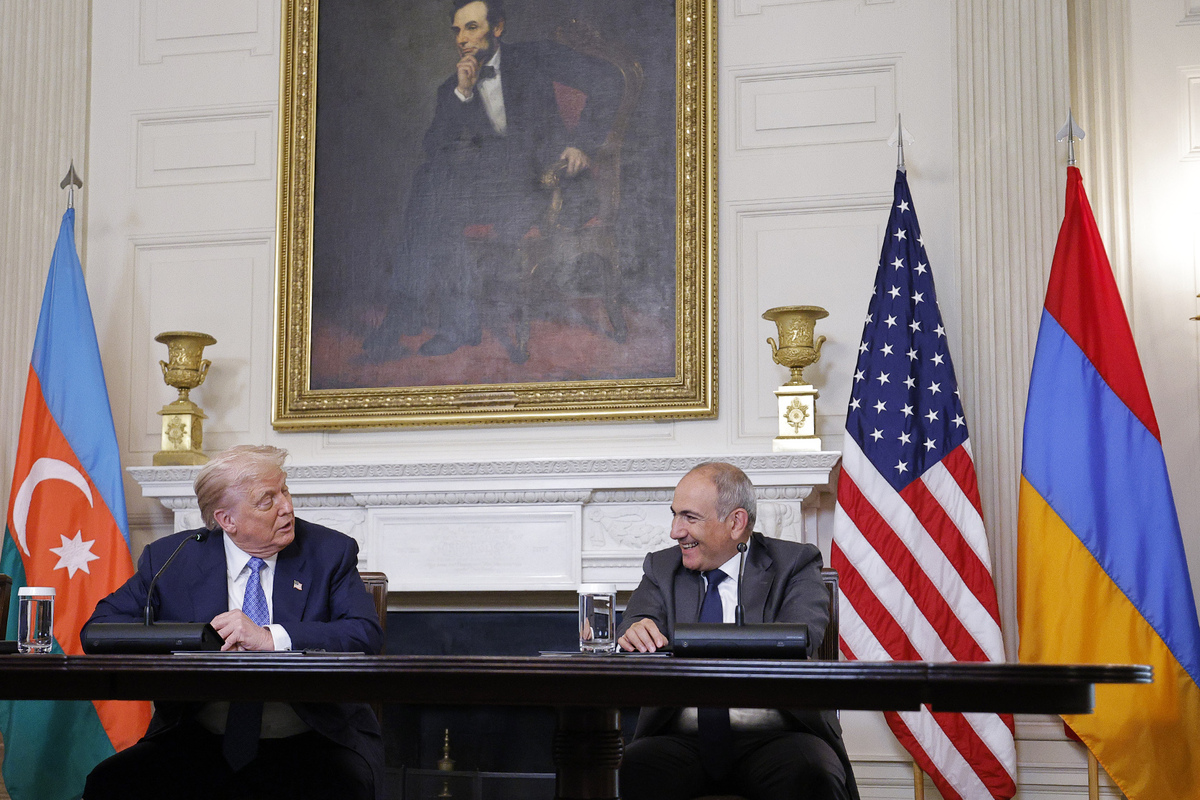
No foreign country should meddle in the internal affairs of Armenia — a sovereign and independent country. Its people are the only ones entitled to choose their government leaders and determine their policies.
Ironically, those Armenians who have been screaming day and night about Russian intervention remain completely silent when Western countries — the European Union and the United States — blatantly intervene in Armenia’s domestic affairs. Those who think that Western interference,



Pillar to post, indeed the basis of much of the infatuation with Russia came from the Turkish genocide and periodical favours from Moscow which during the USSR didn’t want to encourage pan Turanian notions. This led to a simplistic Turks bad, Russians because they aren’t Turks good rather than a critical appraisal on their own actual merits. Subsequent disillusionment with Russia and an end of unquestioning belief in Kremlin lies and Soviet ignorance within Armenia itself due to its dalliances with Azerbaijan especially and to lesser extent Turkey , the defeat of 2020 and the USA and France reaching out more to Armenia than previously has perhaps led to unrealistic expectations of them obviously their geographic position relative to Armenia and their own abilities and priorities, means they are limited in what they can do. The subsequent falling out between Russia and Azerbaijan who like it’s kin Turkey a century before has pulled a fast one on Russia, shouldn’t mean that Armenia should automatically reach out to Russia, it chose in mendacious conciet in it’s arrogant era prior to it’s Ukraine debacle to be in cahoots with Azerbaijan at Armenias expense in the vain belief that it would secure Azeri friendship and Armenia would still be taken for granted as an ally due its isolation and animosity with Azerbaijan and Turkey. So developing of relationships with USA France India Greece in ways that weren’t possible due to the tie in with Russia is welcome especially given the long history of Armenian diaspora and links to many countries but yes don’t get carried away!
Dear Mr. Sassounian, another brilliant column. Thank you. It’s hard to disagree with you about anything, from the Pashinyan regime to the complexities of the proper relationship between Armenia and Diaspora. I am an Armenian-American originally from Fresno, since 2018 settled in San Diego, whose parents, Morris and Doris (nee Parigian) Manoogian, and I, were Courier readers from the beginning (1958?). In any case, you have become the leading commentator on Armenian matters, at least in the English-speaking world, since the independence year 1991, and I would be honored to meet you, either here in San Diego or in L.A. Specifically, in this time of such sorrow for Armenia, I have an idea, a discovery, actually, that might now make both Armenia and you smile with skepticism as it once did me (but no longer): Is “America” somehow named for “Armenia?” I’ve been researching the “somehow” for years. Specifically, “America” was named in a famous 1507 book and map, both in Latin, the map now owned by the Library of Congress, for which I was a Docent for many years, for the Florentine “Amerigo” Vespucci (1454-1512). But after whom, or what, was “Amerigo,” by his parents, named? Specifically, for over half a millennium, it has remained true that in the two first languages of the New World’s discovery, Latin and Italian, and of course, in American English, “Armenia” and “America” are almost the same word, almost the same. “Armenia” lacks only America’s “c” and America lacks only “Armenia”‘s “n.” European spelling was very approximate in those days (“Shak-spere,” “Shake-speare,” Columbus, Colombo, Colon, etc.). Also, to the extent the mysterious but powerful namers of America wanted the earth’s continents to be maximally named with names beginning and ending in “a,” (“AfricA” and “AsiA” before 1507, “AustraliA” and “AntarcticA” after 1507) the word “Armenia” meets that requirement, whereas the words “Colombia”, “Vespuccia,” “Fernandina” or “IsabellA” clearly do not. The issues are complex but I’ve figured them out! Incredibly yet truly, America was named, indirectly, for Armenia! The rival theories are a joke. Could I introduce myself to you and ask you a couple of questions?
Mr. Sassounian, I am Bill Manoogian, born in Fresno to Morris and Doris Parigian Manoogian, I declined a full tuition scholarship to the Harvard class of 1968 to accept a full tuition athletic scholarship (swimming) to Stanford, graduating with honors in History in 1968, Dean’s List in 1966-7). In 1969-70 I was a student of political science and European languages at the Sorbonne in Paris to tour Europe a bit (the Sorbonne having just been ravaged by the shutdowns of May, 1968), improve my knowledge of French (which I had studied since the age of 13), Italian and German, but also to reunite, visit, in Bollene, Vaucluse, France, with the only member of my family to have been in the death march of 1915 (remembering nothing except having cried, “Where’s Mayrig?”), my grandmother’s much younger sister Siranoush Perzigian Zadikian, her one French son Marcel and daughter-in-law Louise and five young grandchildren. In October, 1968, on my way to Europe on the Italian ship, Leonardo da Vinci, stopping at Genoa, I got a letter from my beloved father insisting that I meet with “Bill” Saroyan, with whom Dad had Caesar Chavez issues, but who would contact me the following summer after I had an established Paris address and phone number. Saroyan was something of bother to Dad in Fresno, where, with his big hat, he would show up at my Dad’s packing house, the Morris Fruit Company looking, he said, for grapes, but actually for material, for conversation. I met with Saroyan on two consecutive days that month. We visited his law firm on the Rue Galilee, where he took care of some legal business, and was even taken, briefly, to his apartment on the Rue Taitbout. But I’m rambling on. Could we meet sometime soon so I could sell or give you a piece on how half the world, the American half, was indirectly but knowingly named not for Columbus, but for Armenia, or even for a particular individual, Leonardo da Vinci, whose (never married) mother was Armenian?
In Bristol there’s the tradition of captain Americk who sailed from there in 1497 to Newfoundland, another theory of the origin America and his coat of arms was stars and stripes!
Dear Armenians,
Integration with the West is conditional on imposing demographically, culturally and spiritually destructive policies.
That danger is existential, and it outweighs any imagined benefits.
The diaspora should be hammering this point home by now.
♥️🇦🇲