


An Artsakh teacher’s journey to Harvard
“I want to become a spy. That is the only way I can see my village once again.”
This is what one of Ashot Gabrielyan’s students told him after being displaced from Artsakh.
The boy’s teacher is himself a young Armenian from Artsakh, now on his way to Harvard University.
“Harvard is my next step in the work that I’ve been doing,” Gabrielyan told the Weekly. “I’m a forcibly displaced person who works with Artsakh youth in emergency settings. I decided that this was what needed to happen for me to continue to help my people.”
Gabrielyan was born in Askeran, a town near Stepanakert, and grew up as one of three brothers. He later moved to Yerevan to study and became involved in youth and educational initiatives. His academic journey also took him to Europe, where he studied international relations and explored pathways toward peace for Artsakh.
He returned home just days before the outbreak of the 2020 Artsakh War. In November 2020, he applied to Teach For Armenia while working at the alumni desk of Birthright Armenia. He noticed a steady stream of diasporan Armenians arriving to volunteer in the homeland—an experience that stayed with him.
“That was a pivotal moment for me,” he recalled. “I realized that I needed to go back to Artsakh.”
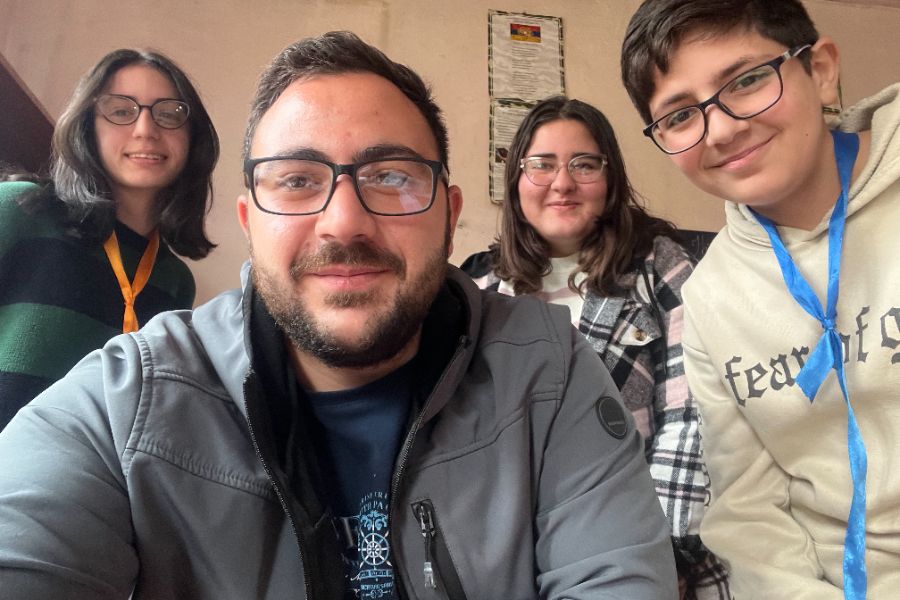
Gabrielyan returned and began teaching in Kolkhozashen, a village in the Martuni region. Together with his students, he set out to bring visibility and opportunity to their community. They founded a youth center called “Janeh”—a term of endearment derived from “jan”—which quickly became a gathering place for young people.
What began with 35 students soon grew into a lively hub serving more than 200 youth from surrounding villages. The center hosted activities ranging from scavenger hunts to community events that attracted visitors from outside the region. Through Gabrielyan’s teaching, students developed skills in English and social studies, opening doors to higher education and new possibilities for their futures.
Gabrielyan can trace his lineage to the 1600s in Artsakh, reflecting generations of connection to the land his family has called home. For him, this connection informs a strong sense of responsibility and purpose.
“Growing up, I didn’t fully understand what displacement and loss meant on a deeper level,” he explained. “It became real for me in 2023, when we were forced to leave Artsakh.”
“When the blockade happened in December 2022, I was abroad and couldn’t return. My family, my village, my students—everything was there. I stayed in Armenia and tried to stay engaged, organizing protests and supporting students who had already left,” he continued.
At some point, Gabrielyan heard there was a way back through a dangerous road, and decided to go.
“The trip that should have taken 30 minutes took six hours,” he stated. “I stayed with my family briefly, then went back to my students. Over time, things became harder—no food, no electricity, constant uncertainty. The students kept asking what would happen to them, and I didn’t have answers.”
By August 2023, evacuation plans were being discussed, but Gabrielyan chose to stay. Days later, the war began.
“I was trying to show what life looked like in Artsakh during the blockade,” he said. “I used my platforms to communicate what was happening. Artsakh is home. It holds my best memories. It’s the place I would always return to. Now, it’s some place I can’t go back to,” he reflected.
“I went to Kornidzor and saw the lights across the border. I think that was the first time I fully understood that I might not return. I started wondering how the next generation will come to know this place.”
Gabrielyan explained that the road leading to Harvard began in 2023, while he was working with students dealing with displacement, fear and uncertainty. That was when one of his students told him that he wanted to become a spy so that he could return to Artsakh.
At that moment, Gabrielyan realized that many programs are designed for displaced communities, but not with them. “That’s when I saw the urgency of creating solutions together with the community.”
After displacement, he re-established “Janeh” as an NGO and continues to work with partners to support displaced children and communities. “I want to use my education to better support my community,” he explained.
This experience has shaped the path he continues to build—through education, community work and a focus on long-term impact.
At Harvard, Gabrielyan will pursue a master’s degree in educational leadership, organizations and entrepreneurship. He hopes to strengthen his ability to design and scale education initiatives that respond to the realities he has experienced firsthand.
You can support Ashot Gabrielyan’s journey by contributing to his Harvard campaign.
All photos are courtesy of Ashot Gabrielyan unless otherwise noted.