


The Art of Inheritance and Armenian Genocide Remembrance
April mourning,
damp winds unfurling
winter’s parting grip—
snow drifts grasping for the past
while emerging wide-eyed—
red mountain-poppies tousle in spring breezes,
rousing cold springs,
cross roads of seasons—
like the West Asian Highlands
host to the wild ancestors,
of the Armenians,
and the first wheat.
Morning light seeps,
across the rising room
while tending my teapot on the fire.
Slumbering leaves roll awake,
a morning ritual hits my tongue,
steeping down my throat before words come,
awakening the senses before digesting—
the beckoning day unfolds,
like lavash1 bread.
Permission to pause
with a steamy mug of tea,
perched between cupped palms,
my eyes rest on a photograph—
portal to the past,
of an Armenian village
with women baking lavash,
like my great-grandmother, Hegenagh.
Sticky flour sheets stretched-wide,
dancing on forearms
slung deep beneath the ground,
inside the glowing womb
of the clay tonir oven,
hearth of the home.
A regional ritual
belonging to peoples
across the Asian continents.
Blooming lavash clings to the cavity,
spitting dung-smoldering flames
ablaze with volcanic ash,
holding ancient genes
of the Armenian Anatolian Highlands—
foothills of Mesopotamia
meaning, ‘between two rivers,’
the Tigris and Euphrates —
the mighty arteries
that carry lifeblood
to the low lands,
valleys, gorges and plains,
a vast ecosystem with one heartbeat
that knows no borders
or death campaigns.
Where currency is generations of communal hands
unfurling in formation
kneading flour trails,
whispering prayers.
Heart-songs rise from old-world throats
beneath veils,
weeping maqam scales
like the voice of fluted apricot wood.

Who is to say new generations should not desire more
then sustain what was ruptured for us—
while in diaspora we safeguard fragments almost lost.
The Ottoman Empire seized our ancestors, assets and homes
claiming our culture and eastern Anatolia for their own.
While the Soviet Empire extracted resources, faith and individuality
of lands locked between borders of the Caspian and Black Sea.
Our living stories are found
in unbroken chains of line-dances
passed-down—
to stopping dhol and whining zurna sounds,
and tied into handwoven knots,
garnet wool carpets hung from looms,
my grandmother said each bride made for her groom,
tufted ornate dragons, seeds and stars—
encrypted borders of my childhood room,
wrapped around souls at birth and death,
adorning my father gone too soon.
‘Give us this day, our daily bread’
Grandmother’s faith endures
across her faded pot-holder at 5 Appleton St.,
a fixture by the toaster-oven reminiscent of the old-country tonir,
and the Genocide memorial’s steady flame.
Ancestors carry centuries
of sustenance in their palms,
and their pain—
through hundreds of barefoot miles on death marches
to Syria and Iraq,
the burnt sienna mountains
and church domes
bared to watch
the outpouring of souls hollowed by hunger,
who sprang from land of first crops,
swallowed by the hot sands
in land called the fertile crescent.
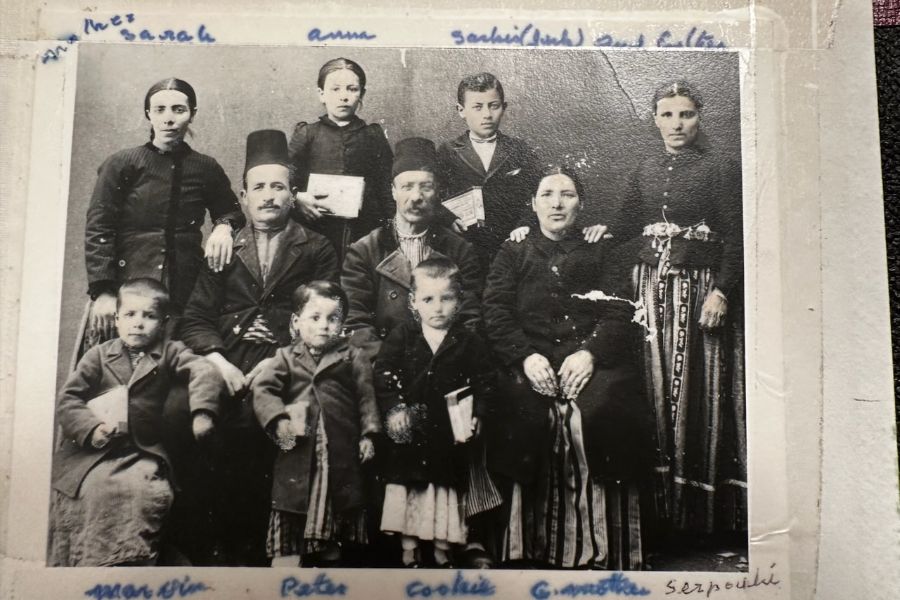
Where my great-great grandmother, Serpouhi, was last seen —
passing on her three gold sultani coins
as she passed to sand-dust,
bones surface and remember
stories passed down to us—
from her granddaughter, Vicky
still yearning for their Turkish
bath picnics she never forgot.
Great grandmothers
dressed in Taraz—
Ottoman joppas and saltahs,
embroidered golden wheat stalks
stitched across borders,
of my great-grandmother Sara’s silk mulberry wedding gown—
worn on her fleeing body,
as her parents, Nigohos and Serpouhi, bid farewell,
disappearing in the bend of the road, forevermore—
as their caravan departed Hussenig
for the belly of the ship,
from Smyrna to Marseille—
she kept night-watch over her daughters,
Anna’s long braids—
tied with gold dangles,
to show she was promised for marriage,
while the crewmen gazed,
attempting to bribe for bread.
Lavash holds seeds born of the region,
blessings draped over a bride and groom—
for fertility and abundant harvest season,
carried in the ash from her family’s tonir to her groom’s,
an ancient wedding heirloom.
Lavash protects all that’s inside,
like great-grandmother Hegenagh’s palms,
kneading dough to support her sons—
Arisdakis and Haroutoun left Arabkir at 11,
to paint gold cherubs and saints on cathedral ceilings,
traversing Beirut—Aleppo, Alexandria to Boston—
Aris, Alfred and Sons painting migrated and blossomed,
cemented into vast landscapes never to be forgotten.
Gold keepsakes of inheritance:
like the color of persimmon fruit trees,
painted angels and crispy lavash sleeves,
pilaf’s golden vermicelli,
and shiny trout from Arabkir’s tributaries—
feeding into the Tigris and Euphrates,
gold borders around my grandparent’s china
for their golden anniversary,
and coin-headdresses worn for pre-1915 dowry,
golden fields of flourishing wheat
stitched across Sara’s mulberry gown,
like gold dangles impressing Anna’s braids,
and Grandmother Serpouhi’s three valueless coins.
Gold, still dug from ancestral ground—
of the vanished Armenians,
once called Arevortik, ‘children of the sun.’
Lavash stretched-wide
envelops the past,
cracked bulgur wheat
and sharp scallions rolled tight
to swallow the pain,
great-grandmother Hegenagh’s name—
means “bright,”
like pomegranate seeds
and tarragon leaves,
in the biting Lake Van air at dawn,
beyond borders of Genocide.
As migrating winds blow at my window pane,
the teapot exhales
over the April 24 remembrance stain—
the Yerevan monument’s enduring flame disarms,
while the Turkish Government still denies
our ancestors’ legacy—
and unspeakable harm.
We pause in their honor,
for their sacrifice that lives on,
from the orphans, ashes and embers,
the Armenian diaspora was born.
April morning,
a new season unfurling
winter’s parting grip—
rousing winds grasp for the past,
while clearing the path,
emerging wide-eyed—
spring blooms tousle
with gold inheritance and pride
for all who came before.
***
Thank you for reading this narrative poem, dedicated to Nigohos and Serpouhi (who had been an orphan) — who stayed behind to care for orphans of the Hamidian massacres and were later killed in the 1915 genocide. It is also for all our ancestors who perished, and all who survived, so we might live. It is my hope that, in reading it, you will recognize and share your own inheritance stories, too.
1. lavash: In 2014, lavash’s significance was recognized on a global stage when UNESCO inscribed “Preparation, meaning and appearance of lavash as a traditional bread” on its Representative List of the Intangible Cultural Heritage of Humanity. Some historians believe lavash, or a primitive version of it, was baked as early as the dawn of agriculture, when ancient civilizations first began cultivating wheat. ↩︎