


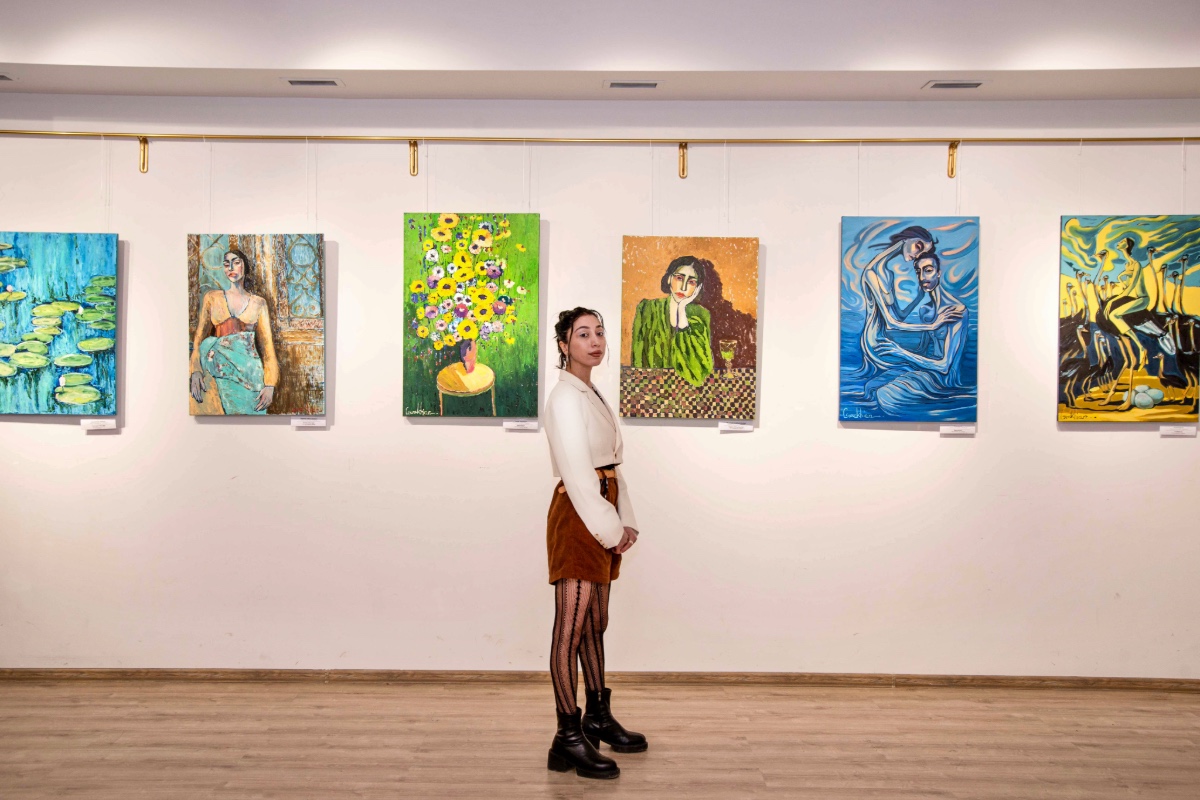
The rugged silhouettes of the Garni mountains, the stony silence of the ancient temple and the pristine breath of nature have, for years, served as the nourishing environment that shaped this unique young woman. Born in Yerevan but connected by essence and roots to Garni, Lilit Gurekhyan is opening new surrealist layers within contemporary Armenian painting.

From roots to visual thinking
From an early age, while attending the Garni School of Art, Lilit began to perceive the world not through words, but through colors and figures. The artist says that visual language is far more precise for her than speech.
“Over time, I realized that visual language is much more accurate for me than words, especially for expressing states that are difficult to verbalize. Painting became a natural extension of my thinking,” she told the Weekly.
Her professional journey began in the class of Ruben Babayan and continued at the Panos Terlemezyan State College of Fine Arts in the ceramics department, in the studio of Susanna Parsamyan. Although working with clay gave her a sense of form and volume, the domain of color ultimately prevailed, leading Lilit back to painting.
Exhibition at Pyunik: The first encounter with the audience
A significant milestone in the artist’s life was her solo exhibition held March 12-20 at the Pyunik Development Center. Organized with the support of the center’s founder, Sofya Mkrtchyan, the event presented 25 canvases to the public, summarizing the artist’s explorations in recent years.
Lilit speaks with gratitude about the environment that allowed her voice to be heard.

Surrealism as a reflection of the soul
Lilit Gurekhyan’s signature style can be characterized as surrealist figurative painting. In her canvases, figures often undergo deformation, not as an aesthetic game, but as a way to find an internal truth. She is interested in the point where the body ceases to be a purely physical presence and transforms into emotion.
“I am interested in the moment when a character begins to deconstruct and rebuild itself as a feeling rather than a body. For me, oil paint is not just a material, but a way of working with time. Layers accumulate, are erased and reappear — just like memories,” Gurekhyan said.
Today, the artist continues to create in her private studio in Garni. Silence and isolation are her primary tools. There, secluded with her thoughts, she allows intuitive impulses to transform into compositional structures.

“Music”: When silence finds a voice
One of the pivotal works in the exhibition is the canvas “Music,” which best defines Lilit’s philosophy. It speaks of human alienation and, at the same time, a profound connection.
“This painting is an attempt to capture a state where people are together externally, but in reality, they live in their separate inner worlds. Everyone lives within their own ‘music.’ The central figure does not seem to be playing, but rather flowing through that music. To me, that movement is closer to a prayer than a performance,” she told the Weekly.
In the canvas, blue symbolizes silence, yellow represents the creative spark and the birds signify the free movement of the soul. It is a work about the idea that true seeing occurs not with the eyes, but with an internal sensation.
Faith and vision for the future
A spiritual layer is also palpable in Lilit’s art. Having grown up in an Armenian Apostolic family, she perceives faith as a personal, non-dogmatic pillar. It is a trust in the creative process when the result is still unknown, but the inner voice suggests the path.
Speaking about the future, the artist says the concept for a new series has already matured. It will be deeper and connected to collective memory and identity.
“As an Armenian, for me, this is also an attempt to delve deeper not only into personal feelings but also into the field of collective emotions and memory,” she concludes.
Lilit Gurekhyan’s art is an invitation to stop, be silent and look into one’s own inner world. Where words end, the mysterious music of her colors begins.
Follow Lilit’s work on Instagram.