



The origins of Armenian American public life: Christopher Oscanyan’s 1835 lectures
Editor’s note: This article appeared in the Armenian Weekly’s March 2026 special magazine issue, “America at 250: An Armenian American Retrospective,” guest edited by former Weekly editor Dr. Khatchig Mouradian and dedicated to the 250th anniversary of Declaration of Independence and the history of Armenian American life.
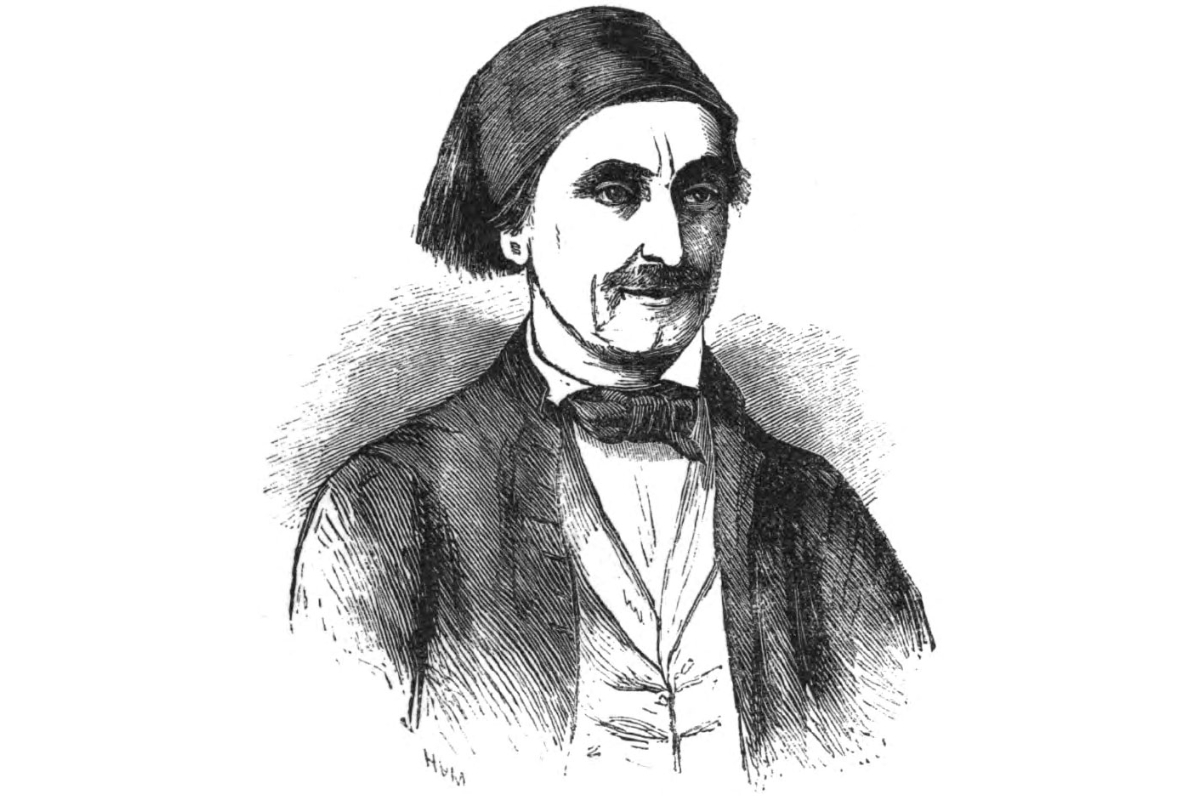
In the fall of 1834, a young Armenian Ottoman named Khachadour “Christopher” Oscanyan arrived in New York City to attend the new University of the City of New York, now New York University. He was a precocious teenager who had caught the attention of the American Protestant missionaries in Constantinople, his home city. Through some combination of tenacity and good fortune, Oscanyan was able to make the voyage to the “New World” and commence a career that would one day land him in conversation with the likes of Ralph Waldo Emerson, P.T. Barnum and Abraham Lincoln. But those are stories for another day. Here, we transmit an origin story: the origin not just of Christopher Oscanyan’s American career, but of Armenian American public life itself.
When the young Oscanyan had been in New York for just one year, a relatively new organization invited the 17-year-old to give a public lecture in New York on the topic of “Education Among the Armenians.”1On the establishment of the institution, see American Lyceum, with the proceedings of the conference held in N.Y., May 4, 1831, to organize the National Department of the Institution (Boston: Hiram Tupper, Printer, 1831). The organization was called the “American Lyceum,” and it was designed to foster “mutual education” societies across the country meant to promote “useful knowledge” and advance popular education. The early American lyceum system emphasized local, member-driven self-improvement and civic participation, especially through discussion and debate.
Oscanyan delivered his lecture on “Education Among the Armenians” to the American Lyceum in the fall of 1835 and was billed as “Christopher Oscanean, a native Armenian.”2“Education Among the Armenians,” Americans Annals of Education and Instruction, Vol. V, No. X, October 1835, 445-450. This essay is included in the October section of the Annals. Quite understandably, the address was written in language that Oscanyan called his “medley sort of half Armenian and half English expressions”3Ibid., 445 — and he confided that it took him “great pains to construe such a labyrinthian synthesis.”4Ibid., 450 Half educational essay, half philanthropic appeal, the lecture showed how Oscanyan’s first public presentations of the Armenians embraced an American missionary view of the world. The bulk of the lecture, for example, aimed to encourage an American public to fund new schools for Armenians in the Ottoman Empire — an enterprise of the American missionaries themselves. To bolster his appeal, Oscanyan conveyed descriptions of the Armenian schools and academies in Constantinople, Venice, Moscow, Tiflis, now Tbilisi, and Calcutta. This was meant to demonstrate the will of Armenian youth to learn, but the lack of proper schools through which they could do so beyond ages 14 to 16 in Constantinople itself. Oscanyan, likewise, lamented that such Armenians who sought higher education had needed to “set out from home” and have since “lost the recollection of their native country … becoming members of different literary departments in Europe.”5Ibid., 447 What’s more, he explained, for an “Armenian youth to start on a journey from Constantinople to Hindoostan [India], or to the new world [for higher education], is equal to an attempt to travel towards the moon.”6Ibid., 449
After demonstrating the Armenians’ merits in this way, Oscanyan explicitly advertised his relationship with his missionary “friends at Constantinople, the Rev. Messrs. Goodell and Dwight, two of your American Philanthropists, who are deeply engaged for the enlightening of my nation,”7Ibid., 449 before closing his lecture with a direct solicitation as a “delegate from the Armenian youth.” He asked: “Trusting to your philanthropy, I have been impelled to lay this petition before you, and solicit your aid and interest in the cause of their [the Armenian youth’s] advancement in knowledge, that by your means, they might again be an enlightened nation, of which they show great marks.”8Ibid., 450

In short, in his first presentation in front of an American audience, Oscanyan argued that the Armenians were a good American investment. Echoing American missionary arguments regarding the relationship between civilization, enlightenment and conversion, he sought to persuade Americans that the Christian Armenians were a people capable of (renewed!) enlightenment and thus worthy of the expense of the educational resources needed to get there. This was a model of Christian diplomacy that was not dissimilar to the model used by American fundraisers during the Greek War of Independence (1821-1832). Many Americans who backed the Greek Revolution saw it as a moral struggle of divine virtue: a chance to aid Christian Greeks in toppling Muslim Ottoman rule and restoring a lost independence — one they imagined had not existed since the era before Alexander the Great.”9Santelli, The Greek Fire, 8. Oscanyan would indeed reference American charity toward the Greeks in his next lecture, noting that he had “tread [sic] the Grecian shores, and witnessed [sic] the stamp of American charity upon the condition of the inhabitants.”
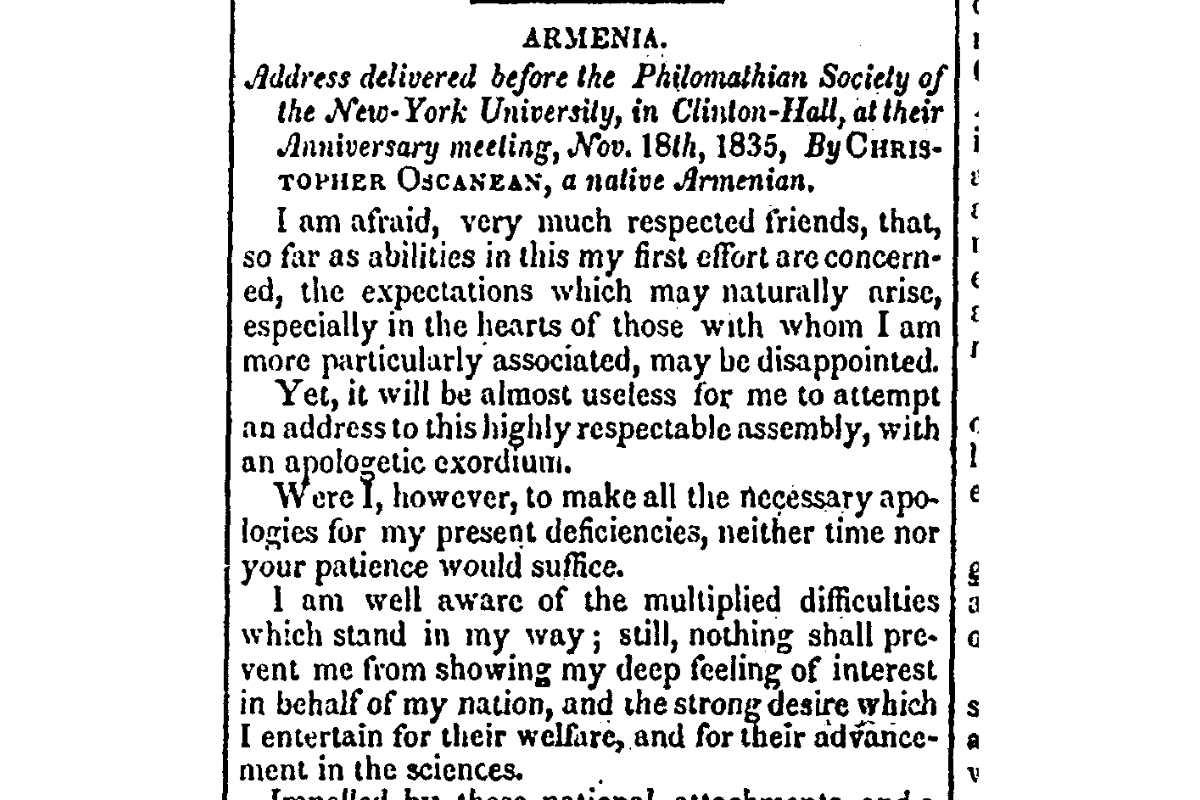
On Nov. 18, 1835, Oscanyan delivered what was likely his second-ever lecture on the topic of “Armenia” before the Philomathean Society of New York University, an extracurricular literary club. While this lecture, too, had a philanthropic angle, he did not this time talk at length about Armenian educational institutions. He did, however, express his deep commitment to what he described as his “nation” and his “country,” and finished with a direct appeal to American charity for the “introduction of schools and colleges among the Armenians … that the lights of science may be rekindled in the East.” He concluded: “I will comfort myself with the reflection that the gradual march of education, aided by patriotism and Christianity, may yet revive the ancient glory of Armenia.”10“Armenia,” New-York American for the Country [New York], November 24, 1835
To teach his audience about the people on whose behalf he was petitioning, he appealed, however sincerely, to their prior knowledge: “You will, doubtless, recollect the geographical situation of that beautiful portion of the world, viz. Armenia, which is bounded on the east by Media and Albania, on the North by Iberia and Colchis, on the West by Assyria, and on the South by Mesopotamia.”11 Ibid. These boundaries did not correspond to any map from the 1830s, but rather evoked an ancient Caucasia (95-55 B.C.). He then proceeded to describe this ancient Armenia as “the birthplace of man” and the “harbor to Noah’s Ark.” The Armenians, he explained, are the descendants of Noah and his three sons.
But his introduction to his people soon turned somber: “I cannot … for a moment reflect upon the ancient state of that country, without yielding myself to painful emotions, in comparing it with its present condition,” he declared. “Armenia, like many other countries, became subject to those neighboring monarchs, who took possession of her territory by the unresisted force of an illegal usurpation. And these freeborn children have since courted the heavy yokes of their most despotic tyrants.” Notably, he continued his lecture with an unattributed passage from an 1824 speech by Daniel Webster, the famed Massachusetts congressman, in support of the “Revolution in Greece.” In his rendition of the passage, Oscanyan replaced Webster’s “Greece” with “Armenia.” He began: “What I have, therefore, to say of Armenia concerns the modern, not the ancient — the living, and not the dead. It regards her not as she exists in history, triumphant over time, and tyranny, and ignorance, but as she is now, contending for the common privilege of human nature.” He then shifted from Webster to Shakespeare. He used “Shakespeare’s vocabulary” to define the “common privilege of human nature.”12Daniel Webster, The Writings and Speeches of Daniel Webster, National Edition, Volume 5 (Boston: Little, Brown, 1903), pp. 60-93, at 62. See also Edward Mead Earle, “Early American Policy Concerning Ottoman Minorities,” Political Science Quarterly 42-3 (September 1927), pp. 337-367. According to Earle, “Webster’s speech was translated into Greek, printed in pamphlet form, and shipped to Greece in large numbers for distribution there,” at 355. Namely: “To be, or not to be; since to be, is to know — for through knowledge comes civilization; through civilization, morality; through morality, Christianity; and through Christianity, eternal life. For this, and this alone, they [the Armenians] solicit compassion from their friends and “cousins” in every part of the world.13“Armenia,” November 24, 1835.
Oscanyan then built on his argument from the first lecture, noting that helping the Armenians would not just help them, but ultimately the whole “East.” The Armenians, he argued, exactly like his missionary associates before him, were the key to converting the entirety of the region to Christianity. “A country with such promising prospects and interesting anticipations as Armenia,” he elaborated, “must naturally produce something of warmth and enthusiasm in the heart of every Christian.”14Ibid.
Oscanyan’s Armenian self-presentation was, in this second lecture, quite clear: He spoke directly of Armenia as his “nation” and his “country.” He affiliated with Armenia in this way in order to represent the Armenians’ cause to an American audience. He solicited an American audience in order to bring “schools and colleges” to his people: as he said, in terms that directly mirrored the missionaries: “through knowledge comes civilization; through civilization, morality; through morality, Christianity; and through Christianity, eternal life.” And he prefaced this declaration by quoting both Webster and Shakespeare, which not only demonstrated his own civilized nature (and thus his worthiness) but, by extension — through affiliation — the worthiness of all Armenians to receive the generosity of Americans.
In this way, Oscanyan set up a theme that he would return to in various guises throughout the rest of his career: The United States, specifically, could help the Armenian people. In closing, he exalted: “Though deprived of our political eminence, tho’ subjected to the slavish yoke of vile Barbarians, although for centuries, sojourners and helpless wanderers over the face of the globe, yet we cannot but cheer our hearts with the rays of comfort, brightly beaming from these most philanthropic and Christian friends of this Western Hemisphere. How wonderful, how interesting, that the youngest nation of the earth should become the instructor of the oldest!”15Ibid.
While Oscanyan would later complicate (and sometimes even disavow) this early missionary-informed posture as he experimented with other identifications, these 1835 performances already show the basic architecture of Armenian American public life taking shape: an Armenian giving his nation a voice through American civic forums, bolstered by the borrowed authority of American politicians and Shakespeare, and filtered through missionary and philhellenic modes of thinking that made the Armenians both legible — and fundable — in the United States.



Hello Nora I would like to read the rest of the manuscripts. My father was William H. Oscanyan III. I’ve been researching his family to get a better understanding of his Dynamics. I registered but it’s not allowing me to read further. My email is Angelaowheeler@yahoo.com