


Young Indian architect documents Armenia and beyond through photography
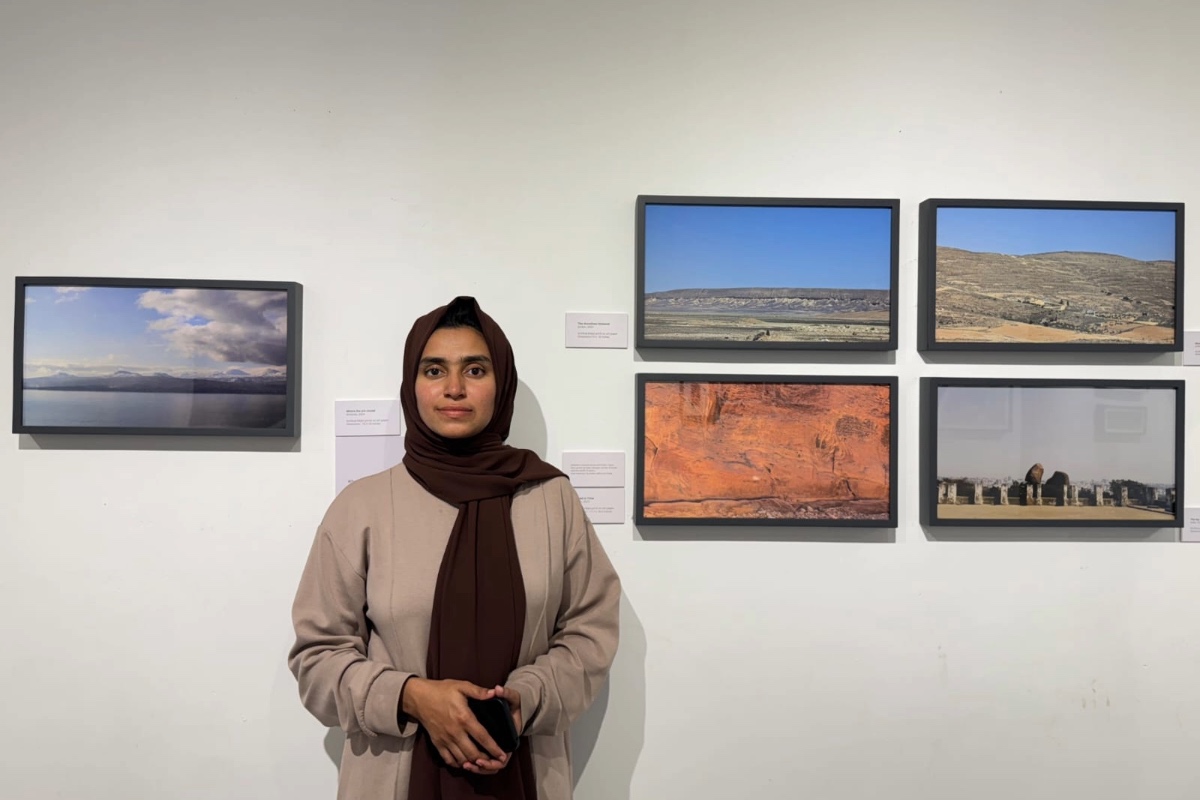
When Khadeeja Zayan photographed Mount Ararat while passing along Armenia’s border, she knew that it was a sacred symbol of the country, traditionally associated with the resting place of Noah’s Ark. She paused, feeling a growing sense of connection. She then traveled across Armenia, taking pictures of centuries-old candlelit spaces, the “Symphony of Stones” in Garni Gorge and the country’s landscape and daily life. Her journey continued through carved stones of Petra, Jordan, as well as the United Arab Emirates and Saudi Arabia, before moving to renowned architect Geoffrey Bawa’s estate, Lunuganga Garden, in Sri Lanka. A couple of weeks ago, her exhibition “Trace Me Where the Horizon Passes Through,” organized by the Kerala Lalithakala Akademi, drew a strong response.

The photographs and poems presented in the exhibition emerged from quiet moments of observation and reflection during her travels. “What initially drew me to Armenia was not only its ancient landscapes, but the way land, belief and daily life seem deeply intertwined. I was interested in understanding Armenia beyond its monuments, through its people, practices and lived rhythms,” said Khadeeja Zayan, an architect and lens-based artist based in the UAE who grew up in a traditional Muslim family in Kozhikode, a coastal town in the South Indian state of Kerala.
Zayan spent much of her time traveling through Armenia’s rural and peripheral regions rather than urban centers. Places such as Armavir, Oshakan and the surrounding areas of Tsaghkadzor, Garni, Lusarat and Lake Sevan became central to her experience. “These expansive, weathered and contemplative landscapes strongly influenced the visual language of my work. The terrain, the light and the stillness offered a space to slow down and observe,” she added.
Working across photography and new media, her practice engages with place, memory and community-based research. Traveling largely through local routes and outskirts allowed her to encounter Armenia on an intimate scale. “Although I was unfamiliar with the language and often unable to communicate verbally, it was the care, warmth and small gestures of the people that shaped the journey most profoundly. These moments of human connection — shared food, silent exchanges and simple acts of kindness — became deeply personal and reflective experiences,” said Zayan.
Zayan’s photographs capture fragments of this journey: moments of quiet understanding between land and people, tradition and everyday life. “Despite cultural and linguistic differences, the experience reaffirmed a simple truth: we are all connected through shared humanity. The exhibition was an attempt to hold space for that realization through images and words shaped by travel, listening and presence,” she said.
From Lake Sevan, Mount Ararat remains visible but distant. The horizon here, according to Zayan, carries the weight of memory — of crossing, of survival and what was once preserved against overwhelming loss. In this landscape, she said, the idea of an ark becomes less a story and more a measure of the present.
Waiting for the ark today is not about rescue. It is about recognizing the conditions we inhabit. Violence, exhaustion, and erasure accumulate slowly, causing lives, labor and care to sink out of sight. What disappears first is often what was held most gently.
“The ark imagined here is not an escape from the world, but a return to responsibility. If an ark is to exist in the present, it cannot be built alone. It must be built together. You tell me, can we build it together?” she asked.

Zayan’s practice unfolds as an ongoing dialogue and visual inquiry shaped by the lands she has moved through, by shifting ecologies, layered historicity, time and evolving ways of engaging with the world around and within us. “My visit to Armenia was my first solo international trip. Factors that attracted me included the ease of travel from the UAE, the change in landscape and the autumn, which I had not experienced before. What I hold close to heart is the respect people showed me and my belief system, as well as their hospitality along the way,” Zayan said.
Raised in a traditional Muslim family in Kozhikode, India, Zayan said her travels across Armenia helped her reconsider faith and the concept of oneness. “It was my first visit to a Christian country, the first nation to adopt Christianity as a state religion. The people I met there welcomed me as one of their own, even taking me to family churches for Friday gatherings. It was a great experience,” she said. Zayan traveled across the country using various modes of transportation, including trains, taxis and buses.
Zayan found Armenia’s landscape weathered and quiet. “These landscapes reflect how many understand cycles of change, aging and evolution — not as a single moment of transformation, but as a gradual accommodation to time. What recedes makes room for what remains. The body, like the land, carries its history quietly through adaptation rather than renewal,” she said.
When Khadeeja Zayan visited Jordan in 2024, she saw missiles crossing the horizon as the country found itself caught in the confrontation between Iran and Israel. She photographed their movement, revealing the horizon as a political construct — one that gestures toward freedom while persistently deferring it.
Saudi Arabia, UAE, Jordan, Kazakhstan and Sri Lanka are among the countries that she has traveled to over the past three years. The works, exhibited in “Trace Me Where the Horizon Passes Through,” explore how neo-colonial structures shape movement, identity and claims to rights across contested geographies. Zayan is planning to exhibit her work in other cities in India in the coming months.