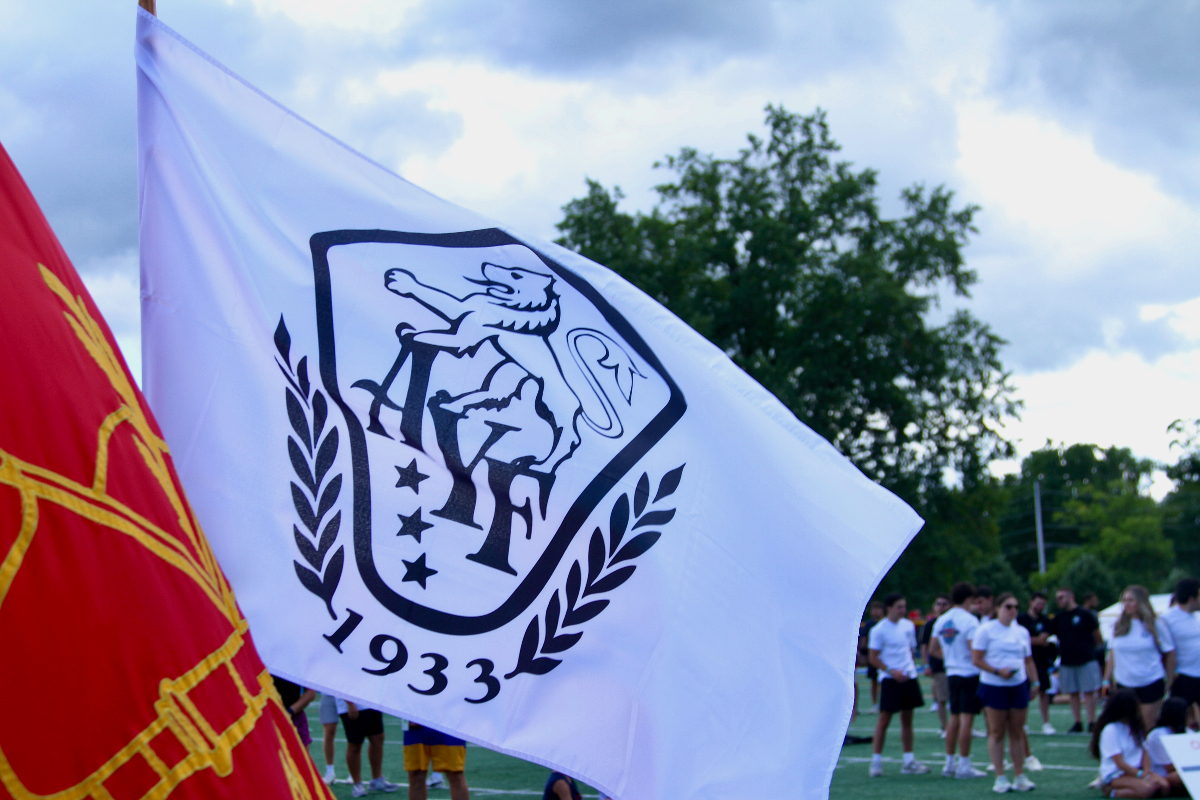



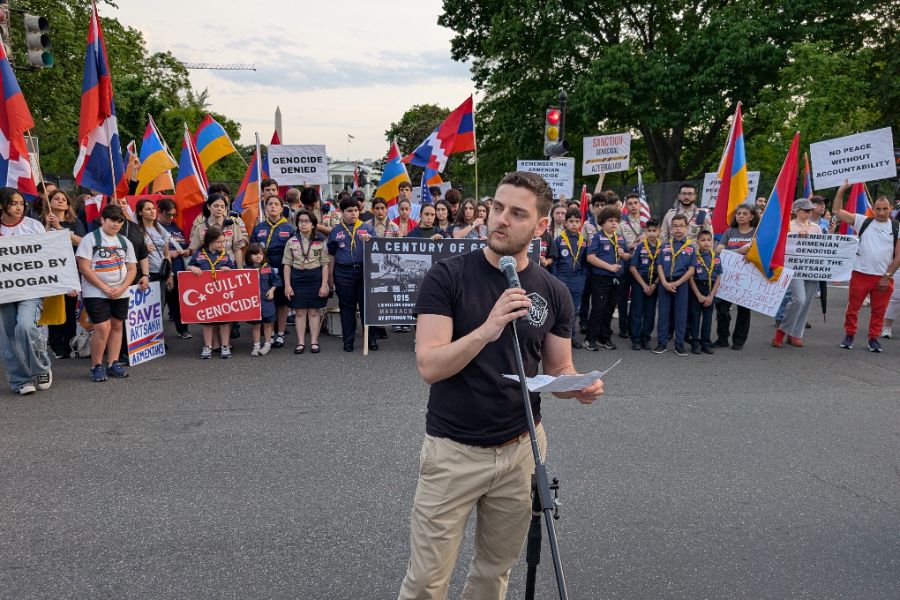
The following remarks were delivered at the AYF D.C. “Ani” Chapter’s annual April 24th demonstration, gathering the Greater Washington, D.C. community in a powerful “March for Justice,” marking the 111th anniversary of the Armenian Genocide of 1915-1923 and demanding accountability for Azerbaijan’s 2023 genocidal ethnic cleansing of Artsakh.
You know, I often wonder what life would be like if I weren’t born Armenian. Being an Armenian in the 21st century has meant growing up with a sense of profound responsibility. A responsibility to preserve what it means to be Armenian. A responsibility to learn, to advocate, to teach, to represent, to excel and, most importantly, to carry on living proudly and boldly as an Armenian. And so sometimes, I think, Wow wouldn’t life have been so much easier without this weight on my shoulders?
This weight of carrying the history and culture of a people who have, against all odds, survived 3,000 years of human warfare in their homeland and beyond. A nation that has escaped extermination by the barest of margins, fighting for freedom and safety against one of the largest empires of the time. A people who now constitute roughly 0.133% of the world’s population.
But if I weren’t Armenian, I would not be the person I am today. My sense of morals, my values, my understanding of the world and the injustices perpetrated within it, are all shaped by my default participation in the Armenian struggle. A struggle that, for the last 111 years, has been defined by genocide, occupation, denialism, refugee crises and forced assimilation.
But within this struggle, we have had victories too. Survival against all odds, gifted to us by our ancestors; an independent state that so many other nations and people groups have failed to obtain; an Artsakh that stood as a testament to the Armenian spirit for over 30 years; and a highly educated and motivated diaspora, filled with young and energetic people who ready and eager to share in the burden of the struggle.

And yet, my friends, the situation looks increasingly dire. Artsakh has been ethnically cleansed, parts of Armenia have been militarily occupied for three years, cultural and historical heritage around the region being willfully neglected and destroyed, ancient thriving communities in Syria, Lebanon, Iran, Iraq, Jerusalem and many other places continuously shrinking, and all the while in Armenia itself, at best, there is a marginalization of these issues and, at worst, the placation of the very actors who carry out these crimes against us.
And so in many ways, these issues fall back on us. The everyday people of the diaspora. The resilience, the ingenuity, the bravery and the sense of duty that have been passed down to each and every one of us who is a descendant of a survivor of one of the largest crimes of the 20th century. It is our time and energy that we so willingly give to the struggle that has kept our ancient community alive, spread out over a hundred modern nation-states, and this has been a success!
So if there is one thing I want to leave with you today, it is this: our struggle is not futile. It is our collective effort that has always carried us forward. Even when the odds feel overwhelming, as they may today, we cannot afford to give up.
To understand this, we need only look to our history. In 1080, the Armenian Kingdom of Cilicia was established after Armenians were driven from their ancestral homeland. That kingdom endured for three hundred years before falling in 1375 to the Egyptian Mamluks. What followed was not years, but more than five centuries—543 years—without an independent Armenian state. Generations lived and died under foreign rule. And yet, they did not stop being Armenian and they did not stop believing in the possibility of self-determination.
Imagine that moment when Cilicia fell: the fires, the displacement, the collapse of a society built over centuries. It must have felt like the end of everything. And yet, here we stand today, nearly 700 years later, with a state of our own, a military of our own, a homeland of our own.
What felt like an ending to our ancestors was, in truth, a beginning. Like a seed buried in ash, what seemed like destruction became the very ground from which renewal could grow.
Even now, when it feels like our progress has been cut short, we must remember: growth does not end here. It continues through us. Just as our ancestors endured unimaginable hardship and still prevailed, so too can we. The story of Armenia is not only one of survival, but of renewal, and we are its authors now.
One day, generations from now will look back on this moment and tell the story of what we chose to do. So, do not surrender to despair. Hold fast to hope, because the future is not something we wait for. It is something we build.