




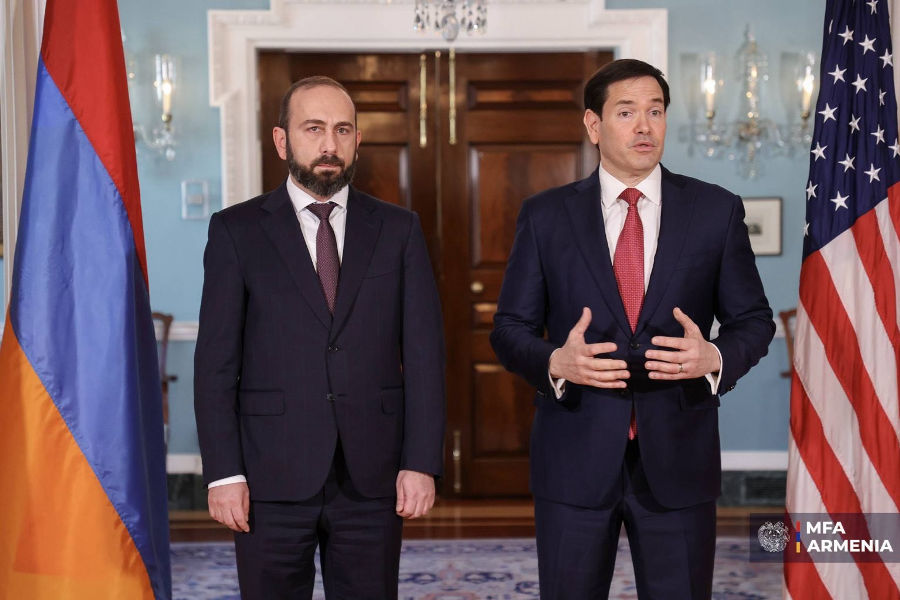
YEREVAN — Armenia and the United States have signed a framework agreement establishing the “Trump Route for International Peace and Prosperity” (TRIPP) project, officials announced following meetings in Washington on Jan. 13–14.
The agreement establishes the TRIPP Development Company, which will manage transit infrastructure through Armenian territory, connecting Azerbaijan with Nakhichevan and linking to the Trans-Caspian Trade Route.
Under the terms of the agreement, the United States will hold a 74% stake in the company in exchange for financial investments, while Armenia will retain a 26% share, contributing development rights and access to infrastructure. After an initial 49-year period, Armenia’s share is expected to increase to 49%.
The project is set to include railway and road networks, energy pipelines and digital systems such as fiber-optic infrastructure. It introduces a “front office-back office” operational model, under which U.S. operators will handle document collection and initial service functions, while Armenian authorities will retain responsibility for customs clearance, security checks, migration control and law enforcement. All taxes and fees generated through TRIPP operations will be paid to the Armenian state budget.
Armenian Foreign Minister Ararat Mirzoyan said the ownership structure reflects the respective contributions of both parties, with the United States providing financial investment and Armenia contributing development rights. He emphasized that Armenia’s sovereignty and jurisdiction over border and customs operations will remain absolute and that security of the route will be fully controlled by Armenian authorities.

Mirzoyan also noted that the participation of Turkey and Russia was not discussed within the framework of TRIPP, though he suggested that broader regional coordination may be required to ensure logistical connectivity, including the Gyumri-Kars road linking goods to European markets.
Prime Minister Nikol Pashinyan described the agreement as a framework defining the operational structure of TRIPP. He noted that bilateral trade between Armenia and Azerbaijan has begun earlier than anticipated and characterized the project as a step toward regional connectivity. Pashinyan also highlighted the role of U.S. President Donald Trump in promoting the initiative.
Ayhan Hajizadeh, spokesperson for the Azerbaijani Foreign Ministry, stated that the framework agreement reflects the United States’ commitment to the Washington summit agreements of Aug. 8. He said ensuring unimpeded communication between Azerbaijan and Nakhichevan remains a priority for Baku and described TRIPP as contributing to the diversification of trade and transport in the wider region while fulfilling obligations previously undertaken by Armenia.
According to the joint statement, the TRIPP Development Company will have an initial 49-year exclusive right to develop the transit corridor, overseeing transport, logistics, energy and digital infrastructure. Private operators from the United States will manage technical services, document collection and payment processing, while Armenian authorities will retain physical presence and oversight over all sovereign functions.
Pilot projects are planned to digitize customs procedures and implement a “single checkpoint” system. Armenian authorities will retain control over all border, customs and security functions, including migration and law enforcement operations.
Despite being framed as a project to enhance regional connectivity, the scale of foreign investment and operational control raises questions about the long-term implications for Armenian sovereignty over transit infrastructure.
The TRIPP agreement has already affected Armenia’s relations with regional neighbors and drawn scrutiny from multiple states. On Jan. 14, Iran’s ambassador to Armenia, Khalil Shirgholami, expressed concern that Armenia is becoming a hub for activities hostile to Tehran.
Speaking at a press conference in Yerevan, Shirgholami said that groups had been allowed to stage protests near the Iranian Embassy for six consecutive evenings, during which “disrespectful and offensive statements” were made. He emphasized that Iran has repeatedly lodged formal complaints with Armenian authorities, but the demonstrations have continued.
Shirgholami warned that some actors are seeking to exploit instability in Iran to encourage separatist movements and fragment the country. He claimed that such efforts were initially planned by external actors, naming Israel, and cautioned that if these attempts succeeded, Armenia “would find itself among the losers.” He added that Iran has historically supported Armenia during difficult periods and said the ongoing protests have left a mark on the historical memory of the Iranian people.
According to Shirgholami, Tehran is concerned that the TRIPP project could be leveraged by the United States within the framework of its security policy. “We have conveyed these concerns to our Armenian counterparts,” the ambassador said. “They have assured us that Armenia will never become a source of threat to Iran. It was agreed that discussions will continue on a regular basis to assess the full scope of this project.”
The comments come amid widespread unrest in Iran, where preliminary reports indicate that more than 2,000 people, including security personnel, have been killed during protests. Iranian Foreign Minister Abbas Araghchi told Al Jazeera that terrorist groups were responsible for both civilian and security force casualties, and Tehran has threatened death penalties for those damaging state property or confronting law enforcement.
Meanwhile, Russia has also voiced concerns. Russian media host Vladimir Solovyov suggested publicly that Armenia’s role in TRIPP could conflict with Russian interests, implying that military measures might be justified in areas within Russia’s perceived sphere of influence. His remarks were widely criticized by Armenian officials as interference in Armenia’s sovereignty.
Turkey has likewise signaled its strategic interest in the project, framing the Kars–Iğdır–Aralık–Dilucu railway as critical for the so-called “Zangezur Corridor.” Turkish Minister of Transport and Infrastructure Abdulkadir Uraloğlu emphasized the corridor’s importance and noted that Azerbaijan continues work on the route, including unfinished sections in Nakhichevan expected to begin this year. He also highlighted U.S. involvement in the corridor’s construction and projected that it could become operational by 2030.
Republican Party Vice President Armen Ashotyan sharply criticized the recent TRIPP-related statements by the government, in which Pashinyan reportedly framed the initiative as a diplomatic success, calling the agreement “unprecedented” in its implications.
Ashotyan argued that the document, while legally non-binding, carries long-term consequences for Armenia’s geopolitical position and represents what he described as a “geopolitical gamble.”
He further stated that the TRIPP framework risks turning Armenia’s logistical potential into a tool serving Turkish and Azerbaijani strategic interests, rather than national priorities. According to Ashotyan, the agreement effectively ensures unhindered connectivity between Azerbaijan’s main territory and Nakhichevan, while Armenia receives only conditional, long-term promises of “mutual benefit.” This, he said, allows Azerbaijan to achieve immediate strategic gains, leaving Armenia dependent on future reforms and bilateral relations.
Ashotyan also criticized the operational model outlined in the TRIPP statement, saying it would leave customs and security decisions formally under Armenian authority while placing operational flows, data collection and logistics under the control of foreign capital through private operators. He argued that this separation between formal sovereignty and practical authority threatens the state’s ability to function independently within its territory.
He concluded that references to “full sovereignty” in the framework are inconsistent with its operational design, and warned that the government’s policies continue to impose growing risks on Armenia’s future.

Making any agreement that greatly benefits Azerbaijan prior to the total release of the Armenian hostages held by the Azeris is plainly irresponsible. The establishment of this corridor between Azerbaijan and their enclave in Nakhichevan is likely the most significant asset that Armenia holds in dealing with their neighbor. I have to wonder why the current Armenian administration is foregoing the release of the hostages…
to me it looks like more of an Armenina American deal since Azerbaijan is not a part in this agrement. The mention of the Gumri-Kars crossing point by Mirzoyan indicates that this is not going to be a single line of transit in the south but will cross all over Armania from fiber optic to pipelines. It gives the US an upperhand on this “canal” to controll all that passes over the territory of Armania in exchange of security. Even if there are no guarantees from the US, anyone be it Azerbaijan or Turkey will think twice before crossing the line since it will pit them in direct conflict with the US.
What the Armenian government has done is send a clear message to Moscow, if you are not able to guarantee security for Armenia then The US will se\tep in the region.
Iran’s and Russsian concern is not just border security. With this step a new route is established, from Asia to Europe avoiding Iran and Russia.
Now it’s the US role to put pressure in releasing the Armenian hostages from Azebaijan.
Sovereignty Through Strategy: Why the TRIPP Framework Strengthens Armenia, Not Weakens It
The reaction to the Trump Route for International Peace and Prosperity (TRIPP) framework has revealed a familiar pattern in Armenian political discourse: any major infrastructure initiative involving external powers is reflexively framed as a threat to sovereignty. The recent article questioning whether TRIPP represents “sovereignty or strategy” follows this well-worn path, invoking historical analogies, regional anxieties, and speculative risks while overlooking the legal, operational, and strategic realities of the agreement itself.
A sober examination of TRIPP shows that far from undermining Armenian sovereignty, the framework consolidates it—legally, economically, and geopolitically.
Sovereignty Is Jurisdiction, Not Ownership Percentages
At the heart of the criticism lies a fundamental misunderstanding of sovereignty. Sovereignty is not measured by corporate shareholding structures or investment ratios. It is defined by jurisdiction: control over territory, borders, customs, security, and the application of domestic law.
Under the TRIPP framework, Armenia retains absolute authority over all sovereign functions. Border control, customs clearance, migration management, law enforcement, and security operations remain exclusively in Armenian hands. The TRIPP Development Company does not exercise police powers, does not control border crossings, and does not operate outside Armenian law. All taxes and fees generated by the corridor are paid directly into Armenia’s state budget.
The United States’ majority stake in a development company does not equate to territorial control, extraterritorial rights, or political authority. Equating the two is legally incorrect and strategically misleading.
False Historical Analogies Cloud the Debate
Critics, most notably Republican Party Vice President Armen Ashotyan, compare TRIPP to the Panama Canal, the Suez Canal, and the Black Sea straits. These comparisons collapse under even minimal scrutiny.
Those projects emerged from colonial-era concessions involving foreign military presence, internationalized waterways, or long-term territorial control. TRIPP does none of these. It does not internationalize Armenian land, does not grant foreign security rights, and does not remove Armenian legal supremacy.
A more accurate comparison would be modern European transit corridors, port concessions, or cross-border energy infrastructure—all of which operate under full national sovereignty while relying on foreign investment and expertise. Armenia is not entering a historical anomaly; it is adopting contemporary state practice.
Modern Governance Requires Operational Delegation
Much criticism has focused on TRIPP’s “front office–back office” model, which assigns document collection, logistics, and payment processing to private operators while reserving sovereign decisions for Armenian authorities. Opponents frame this as a dangerous separation between “formal” and “real” power.
In reality, this model reflects how modern states function. Airports, ports, customs systems, telecommunications networks, and even tax collection platforms around the world rely on private operators under state regulation. Outsourcing operational tasks does not diminish sovereignty; it enhances state capacity by improving efficiency, transparency, and enforcement.
Armenian authorities retain the power to approve, deny, inspect, detain, and enforce. Private operators execute processes under Armenian law. This is not erosion of authority—it is administrative modernization.
Strategic Balance, Not Strategic Capitulation
The claim that TRIPP delivers immediate benefits to Azerbaijan while offering Armenia only vague future promises misrepresents the strategic balance of the agreement.
Azerbaijan gains transit access only through Armenian-controlled territory, under Armenian law, without extraterritorial privileges or security control. Armenia, meanwhile, secures long-term infrastructure investment it cannot finance alone and embeds U.S. strategic interests directly into the stability of Armenian territory.
This creates a critical shift in leverage. Any disruption to Armenia’s sovereignty or territorial integrity would now directly affect American commercial and strategic interests. For a country historically exposed to unilateral pressure, this is not a liability—it is a shield.
Regional Objections Reflect Discomfort, Not Legal Defects
Iran’s concerns regarding TRIPP are geopolitical, not legal. Tehran has not alleged any treaty violation, loss of Armenian jurisdiction, or security breach. Its discomfort stems from the reduction of its monopoly over regional transit routes and the expansion of U.S. economic presence.
Armenia has provided assurances, retained full control, and committed to dialogue. What Armenia is not obligated to do is forgo economic development to preserve another state’s strategic comfort.
Russia’s reaction further underscores TRIPP’s strategic value. For decades, Armenia’s vulnerability has been amplified by overdependence on a single security and economic axis. TRIPP introduces diversification—economic, strategic, and diplomatic. Resistance from entrenched power centers is not evidence of national harm; it is evidence of changed dynamics.
Long-Term Frameworks Are Standard, Not Surrenders
Criticism of the 49-year term and initial equity structure ignores global infrastructure norms. Long-term concessions are standard for large-scale transport, energy, and logistics projects. Armenia contributes development rights rather than capital, limiting financial exposure, while its equity stake increases over time.
The infrastructure remains on Armenian soil, governed by Armenian law, subject to Armenian courts and future legislation. There is no dispossession—only structured risk-sharing.
The Real Dispute Is About Armenia’s Strategic Autonomy
Ultimately, the backlash against TRIPP is less about sovereignty and more about mindset. The agreement challenges a model of permanent isolation framed as security and rejects the notion that Armenia must exist solely as a buffer between competing powers.
TRIPP positions Armenia as a governing state rather than a passive corridor—a regulator of transit rather than a hostage to geography.
Conclusion: Sovereignty Strengthened, Not Surrendered
The TRIPP framework preserves Armenia’s jurisdiction, enhances its economic resilience, and embeds powerful incentives for regional stability. It modernizes state capacity, diversifies strategic partnerships, and reduces exposure to coercive pressure from any single actor.
Claims that TRIPP undermines sovereignty rely on outdated analogies, selective readings, and fear of strategic independence. In reality, Armenia does not lose sovereignty by governing transit—it exercises it.
In a region where isolation has long been Armenia’s greatest vulnerability, TRIPP represents not surrender, but strategic maturity.
@Hagop
Do you know where Armenia actually is?
All you pro-Westerners always sufcer from tbe same delusions.
1) Armenia is in the heart of Europe, right next to Austria – No, it is not.
2) Armenia matters to the West – No, it does not.
The West will sell out Armenia to the Turks in a heartbeat if it can get what it wants – a direct connection to Kazakhstan..
All what you are saying ir right but show me where does it say that Armenia can decide who participates in these projects since it own a minority share. Consider this scenario. Turkish and Azebaijani companies sign agreements with Tripp to build infrastrucure in Armenia, then insist of having boots on the ground to protect their investments from iran or Russia, let’s say.
How on earth is this a “win” for Armenia? On paper, the corridor is de jure Armenian territory and under Armenian jurisdiction, but de facto it will be controlled and run by the United States to the benefit of itself, Azerbaijan and Turkey. The only loser in all of this is Armenia. From a position of weakness, cowardice and stupidity, Pashinyan has squandered the only major trump card held by Armenia by conceding control of this corridor. That the lease is for 99 years, with Armenia holding 26% of the shares and the United States holding 74% of the shares, is fraught with dangers for Armenia. Who can guarantee that this 99 year lease might not become a fait accompli and entail the permanent loss of this corridor and territory for Armenia? No one. In fact, even this rotten agreement could be violated by the three beneficiaries, despite this agreement being so advantageous for them – especially by Azerbaijan, which certainly awaits its opportunity to annex this Armenian territory with no repercussions, either by seizing it or by illegally being awarded by the majority shareholder. There are many historical examples of countries losing their territories this way. Armenia is the victim of old fashioned imperialism, which never went away, along with insatiable Azerbaijani irredentism.
Total agreement with Steve M…it’s rotten.
What’s more: https://mirrorspectator.com/tag/green-card-lottery/
.
Total agreement with Steve M…it’s rotten and imperialistic.
https://mirrorspectator.com/tag/green-card-lottery/
Great way to treat friends or business partners?
.
Althoug your concerns are valid, I do not see the names Azerbaijan or Turkey in this agreement. They will benefit from this but they have no say in any agreement. The key remains in the hands of Armenin government and we need to make sure that there are no traitors there to sell our vito right to Turks and Azeries. besides, what were the other options given to Armania that it has refused ?
The other option was Russia as per the 2020 ceasefire but since they failed to safeguard the Armenians in Azerbaijan as they had sought in what seemed at the time a masterstroke on Russia part having sought the situation of 2020 so as to better control a weakened Armenia and also keep the conflict festering they are discredited as a result of their shortcomings and also ironically Azerbaijan is also distancing from Russia whose attempts to woo it closer have failed after Azerbaijan initially played along so as to get what they wanted. It should be worth noting that Azerbaijan has changed it’s military structure to NATO format thus meaning it’s most unlikely to join the CTSO.
Anything that improves the position of the Turks is a danger for Armenia.
Armenia could have got a lot more for this transit route.
Turks cannot be trusted. Any agreement with them must be accompanied by cast iron guarantees.
The Turkish ambition to create the Vilayet of Ermenistan can never be ignored or forgotten.
@Robert Whig
100%. Every agreement between Armenia (Pashinyan, who thinks he is Armenia and omnipotent) and Turkey/Azerbaijan have been made from a position of weakness and indeed with no firm or any security guarantees, and each of them is very disadvantageous and a potential Pandora’s Box for Armenia, no matter how much rose-tinted spin Pashinyan and his supporters like Hagop try to put. And it is a near certainty that the very greedy Turkish/Azerbaijani gang will break these agreements despite being so advantageous for them and without any repercussions, precisely because they already violated the ceasefire agreements of Artsakh signed by Pashinyan with no repercussions whatsoever. An internal enemy like Pashinyan, is worse than an external enemy like Azerbaijan and Turkey, and as long as he stays in power, the disastrous trajectory for Armenia will continue.
I don’t believe this will be in any way advantageous to Armenia. I’m not trying to troll, but they basically bought the snake oil as a remedy for some international facade of trade. A Trojan Horse, and for 99 years! In reality how many of the coming 99 years will “Armenian law” be in place?
Armenia better build strong alliances and build up advanced technical military strength. It’s not like the U.S. is cold with Turkey or Azerbaijan. This is regrettable.
100% – especially your third to last sentence.
Garo, any relation to Guregh Kalfayan?
I wish I could share Hagop’s enthusiasm. I sense nothing but grief in the outcome of this.
Armenia is being used as a pawn to achieve ill geopolitical aims, the cancer is within is insidious.
Armenia’s strength has to come from within to resist the evil having taken over.
The pivot towards the West is fine. But what is the West? The Diaspora is Armenia’s West always has been.
I see a slowly unfolding tragedy to end all tragedies.
The moment the ICA END, GON “West” or whomever, goes after the AAP, it should be a resounding response of “FUCK NO.”
Artsakh has been given up as a gift. The AAP is next. And thereafter??? Do you think the US will aid Armenia?
If they won’t/don’t/can’t stop Gaza, do you think they will stop Armenia’s annihilation?? It is part and process of their sick and evil plan for End of Times. The US powers that be are itching for Armageddon and Armenia is part of that process.
I hope that Hayastanzis awaken with a resounding NO, June 2026.
Watch: Praying for Armageddon, ‘Til Kingdom Come to understand the illness of the US government that is in power today.
See Mahapat on substack, who seems to get it…. understands how besieged Armenia is.
@Marta Vartuhi
I 100% agree with your assessments.